TRANSMISSION // 2611.27631v1
Giving AI agents safety rules they cannot learn around
Source published
Epistemic typestates restrict what each learning agent may do based on what it can observe and what teammates promise. In nine simulated benchmarks, typed learners recorded no agent-caused safety violations—but the guarantees depend on accurate models and have important limits.
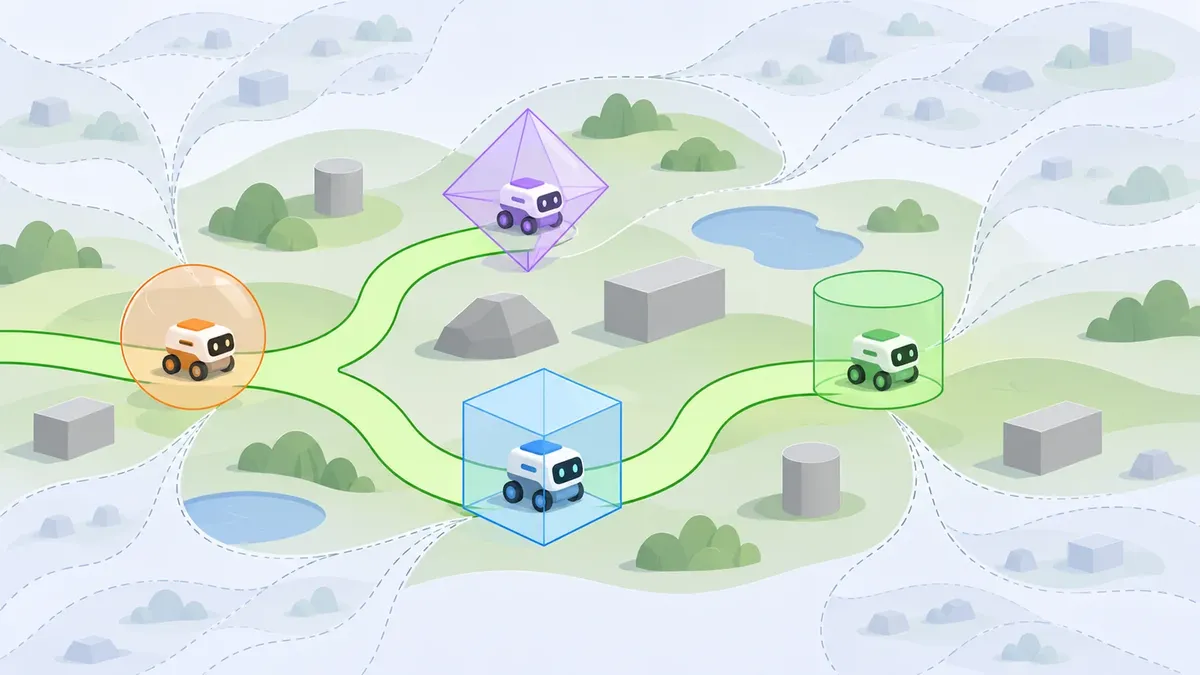
How can a team of learning agents stay safe when each sees only part of the world? A preprint proposes giving each agent a checked protocol that masks unsafe choices, so learning can continue without runtime communication.
Reinforcement-learning agents improve through trial and error. In a team, that creates a safety challenge: an action that looks harmless to one agent may become dangerous because of something another agent does—possibly outside the first agent’s view. A new preprint by Lorenzo Bacchiani and colleagues asks whether formal rules can prevent unsafe choices throughout learning, without requiring agents to communicate while they act.
The paper’s answer is a framework called epistemic typestates. The name combines two ideas from computer science. A “typestate” is a protocol that says which actions are allowed in each state; “epistemic” refers to what an agent knows. Here, a protocol tracks the set of situations an agent cannot rule out given its observations and past actions. It permits an action only if that action remains safe in every possible situation in that set.
Consider a car following another car in a line. The follower may see the car ahead but not the traffic farther up the line. Its safe response depends partly on what the unseen cars might do—and on what the visible car is permitted to do. The proposed protocol accounts for those uncertainties and the other agents’ public safety rules. It then gives the learner an action mask: a list of choices it may make. The learning algorithm can choose among permitted options, though a triggered obligation in the protocol can require a particular action.
Each agent’s protocol is built and checked separately against its own model and the other agents’ public types. Once running, agents update their protocols from their own observations; the approach does not require communication between them. The authors prove that a well-formed type preserves its agent’s safety, and give conditions under which those local guarantees combine into team safety. One condition is that dependencies on other agents’ safety after a step do not form a cycle. The formal proofs, including the soundness of an independent checker, are mechanised in Rocq, a proof assistant.
The team tested the idea on nine benchmarks, including simulated traffic, warehouse tasks and multi-robot navigation. The experiments used standard reinforcement-learning methods, including IPPO and independent Q-learning, with five training seeds for those learners and evaluation over 1,000 episodes per trained policy. In the tested runs, no learner operating inside a type caused a safety violation during training or evaluation. The authors also compared task performance with two recent multi-agent shielding methods. Across the reported comparisons, performance generally did not differ significantly; one comparison involving a shield that used information unavailable to the agent was an exception.
Construction results suggest a potential scaling advantage in particular tests. For the Car Platoon and LBF benchmarks, the same agent roles could be reused as teams grew to ten agents, and types for ten agents were built in under a second. A contract-based method did not find a certifiable profile for five- or ten-agent Car Platoon teams in the reported attempts, and its LBF construction did not finish within the stated memory budget. These are results for the tested setups, not a general guarantee that typestates will always be faster or scale better.
The continuous-world tests are especially relevant to the method’s limits. The authors built types from designer-supplied guards rather than synthesising them by enumerating possible beliefs. They report no agent-caused collisions for typed learners in those tests, while the compared Lagrangian learners—methods that penalise safety costs during learning—recorded many collision events in training. But the continuous types were supported by written and numerical checks, not the same kind of fully verified certification used for finite types. The paper also reports differences in task outcomes between methods, so safety results should not be read as evidence that one approach wins on every objective.
The guarantees are conditional, not a promise of safety in any real deployment. They depend on the environment behaving as the model specifies, and on each agent’s model covering what its teammates may do under their public types. Designers must supply those models. For infinite world spaces, guards need to be provided and justified; they do not automatically have the synthesis method’s maximal-permissiveness guarantee. The current framework also assumes a finite set of actions, leaving continuously valued actions outside its scope. Even in finite cases, synthesising types can become costly as the number of possible beliefs grows.
The work is available as an arXiv preprint, not evidence of peer-reviewed acceptance. Its experiments are benchmark simulations, and the authors note that testing a model against a simulator cannot prove the model correct. The results show how formal restrictions can let learning proceed within specified safety boundaries—not that those boundaries, or the models behind them, will capture every hazard outside the tested settings.
- safe reinforcement learning
- multi-agent systems
- epistemic typestates
- AI safety
- formal verification
- action masking
Reviewed cross-references
These connections were reviewed by a model, not independently fact-checked by a human. Similarity does not imply agreement; consult the original papers and the evidence below.
Teaching AI to judge the safety of a whole maneuver
Shared method: Both papers use shielding to constrain reinforcement-learning decisions. Epistemic typestates mask actions unsafe across the acting agent’s belief, while POS learns an option-safety critic and uses its estimates to reweight the option policy. The mechanisms differ, and POS is evaluated on LogiCity tasks rather than the multi-agent benchmarks used for typestates.
Model review: · openai-codex/gpt-6-luna
Evidence and provenance
Selected excerpts, not complete papers. PDF extraction can omit figures or damage equations, tables and reading order; sources may be preprints.
2611.27631v1 — Original paper
Excerpt reference:
static/papers/2611.27631v1.md:269-319
Basis: Paper text
Source SHA-256:d3ad71cbb04260da2de574bf6f0b8f2bbf3e19b7980999bc35ca5b93dd2d42f12611.09197v1 — Original paper
Excerpt reference:
static/papers/2611.09197v1.md:100-183
Basis: Paper text
Source SHA-256:f0ef1fc74ef05b26ac42eb42434496664b7aedf56f2669094735c3f40335d68a
When Observations Limit an AI Safety Guarantee
Supporting evidence: The papers offer compatible, bounded results about safety under limited information: typestates permit actions safe across worlds consistent with an agent’s observations, while Zeitler et al. prove that no latency-bounded controller can guarantee safety when indistinguishable states have disjoint safe actions. The typestate guarantees depend on accurate dynamics and models covering peers’ permitted behavior; the impossibility result concerns specified observational conditions, not the same experiments.
Model review: · openai-codex/gpt-6-luna
Evidence and provenance
Selected excerpts, not complete papers. PDF extraction can omit figures or damage equations, tables and reading order; sources may be preprints.
2611.27631v1 — Original paper
Excerpt reference:
static/papers/2611.27631v1.md:75-133
Basis: Paper text
Source SHA-256:d3ad71cbb04260da2de574bf6f0b8f2bbf3e19b7980999bc35ca5b93dd2d42f12611.27631v1 — Original paper
Excerpt reference:
static/papers/2611.27631v1.md:2177-2234
Basis: Paper text
Source SHA-256:d3ad71cbb04260da2de574bf6f0b8f2bbf3e19b7980999bc35ca5b93dd2d42f12610.10285v2 — Original paper
Excerpt reference:
static/papers/2610.10285v2.md:82-142
Basis: Paper text
Source SHA-256:cb04b2f1f6e0ce92850310516c8ad8da85e60f45275e78923da3111d30d0d6ee2610.10285v2 — Original paper
Excerpt reference:
static/papers/2610.10285v2.md:933-986
Basis: Paper text
Source SHA-256:cb04b2f1f6e0ce92850310516c8ad8da85e60f45275e78923da3111d30d0d6ee
Related reading
Automatically matched by shared topic keywords. These links do not imply that the sources agree or establish a consensus.
Teaching AI to judge the safety of a whole maneuver
Source published
Shared keywords: ai safety
Language models write small neural policies—and model checking tests their promises
Source published
Shared keywords: ai safety, formal verification
Deception-Prompted AI Agents Had the Largest Effects in New Influence Tests
Source published
Shared keywords: ai safety, multi agent systems
Why aligned AI may still produce an unsafe society
Source published
Shared keywords: ai safety, multi agent systems
When an AI’s World Model Runs, Does It Describe the Right World?
Source published
Shared keywords: ai safety, multi agent systems