TRANSMISSION // 2611.27626v1
How Impurity Arises in Quantum Code Constructions
Source published
A mathematical study gives necessary conditions for impurity in quantum locally recoverable codes and constructs unbounded families in a key distance case.
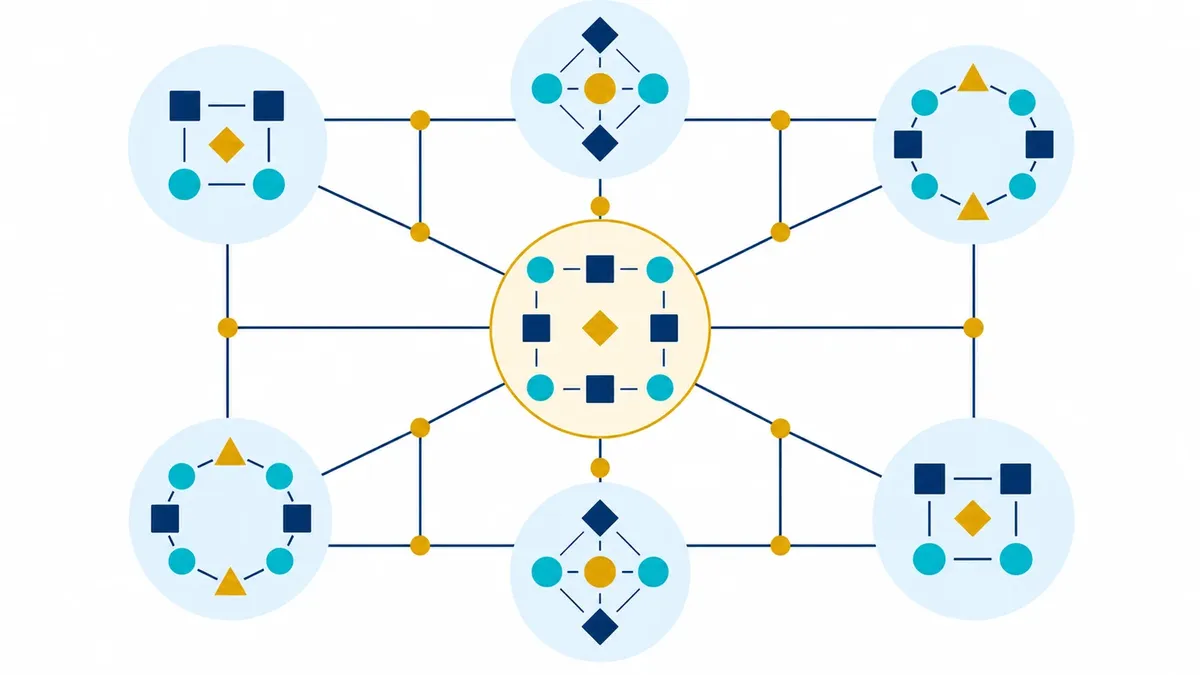
Kun Zhou and Meng Cao study when optimal classical locally recoverable codes can induce impure quantum codes. Their results identify the case where the classical distance equals the locality parameter plus one as important for constructing families of unbounded length—but the criterion also depends on other code parameters and does not decide impurity for every code.
Quantum error-correcting codes protect encoded information against errors. Locally recoverable codes are designed with local groups of symbols that have their own error-protection properties. The paper by Kun Zhou and Meng Cao investigates how optimal classical locally recoverable codes can be used to construct quantum codes, and when the resulting quantum codes are impure. This is a mathematical study, not a demonstration of a quantum-storage device or a practical recovery procedure.
For the classical codes considered here, locality is specified by parameters ((r,\delta)): each symbol belongs to a local code of length at most (r+\delta-1) and minimum distance at least (\delta). “Optimal” means the code meets a Singleton-like bound. To induce quantum codes through the CSS or Hermitian construction, the classical codes must also satisfy the corresponding Euclidean or Hermitian dual-containment condition.
Purity has a precise technical meaning in this setting. It compares the classical code’s minimum distance with the minimum weight of a codeword outside its Euclidean or Hermitian dual. For an impure induced quantum code, the quantum distance can be greater than the classical code’s minimum distance. The authors’ constructions give examples where this gap is strict; impurity is not a claim that a code is defective.
A necessary-condition criterion
The authors derive a criterion, expressed in terms of code parameters including (r), (\delta), dimension (k), and classical minimum distance (d). It gives necessary conditions for an optimal, dual-containing classical ((r,\delta))-LRC to induce an impure quantum code. One important condition is whether (d=r+1). This is a key factor in the paper’s results, not a stand-alone rule that determines the impurity of every code.
Under the paper’s optimality and dual-containment assumptions, if (d\ne r+1), the criterion implies that impure codes can occur only at bounded lengths when the relevant parameters—including (r), (\delta), (k), and (d)—are fixed. Thus there cannot be an unbounded-length family of such impure codes with those parameters fixed. This does not say that impure examples are impossible at every length when (d\ne r+1), nor does it apply without the stated hypotheses.
The criterion is based on the structure of optimal locally recoverable codes. The paper uses a decomposition result for these codes and develops conditions for recognizing impurity in codes that satisfy the required dual-containment property. Because the criterion gives necessary conditions, it narrows where impurity is possible; it is not a complete decision rule for every candidate code.
Constructions with unbounded length
The authors also give a construction framework based on parity-check matrices, which encode the linear constraints defining a code. Applying it, they construct two infinite families of impure quantum locally recoverable codes: one using the CSS construction and one using the Hermitian construction. In both families the classical distance satisfies (d=r+1), and the lengths can grow without bound. Under additional conditions, the paper establishes specific quantum-distance values for members of these families.
These are existence results proved through algebraic constructions. They do not report tests on quantum hardware, measured recovery performance, or practical advantages over other codes. The constructions require stated conditions on the field and code parameters, so they do not show that every code with (d=r+1) is impure.
The paper’s open question concerns extending the construction approach to optimal dual-containing codes whose local protection-code pieces intersect. Its framework for the results discussed here uses non-intersecting pieces; the authors ask how intersecting pieces might be used to obtain impure quantum locally recoverable codes.
This article is based on the supplied arXiv v1 manuscript. The source does not establish peer-review status or scientific consensus. Its extracted text has damaged equations and apparent transcription inconsistencies, so detailed parameter formulas are not reproduced here. The qualitative claims above follow the manuscript’s abstract, main results, and conclusion; consult the original for exact hypotheses.
- quantum error correction
- locally recoverable codes
- coding theory
- impure quantum codes
- CSS construction
Related reading
Automatically matched by shared topic keywords. These links do not imply that the sources agree or establish a consensus.
A New Stress Test for QUBO Solvers Comes from Coding Theory
Source published
Shared keywords: coding theory
Could the brain’s error control resemble quantum error correction?
Source published
Shared keywords: quantum error correction
A compact proof for quantum error correction across code sizes
Source published
Shared keywords: quantum error correction
GARI++ splits quantum error correction into a fast first pass and a smaller cleanup
Source published
Shared keywords: quantum error correction
A quantum decoder that learns to adapt to changing noise
Source published
Shared keywords: quantum error correction