TRANSMISSION // 2611.27609v1
When does quantum-informed graph learning help?
Source published
A proposed quantum-informed method adds node-wise regularization to graph-based label propagation, but its benefits vary by dataset—and the experiments do not show a quantum speedup.
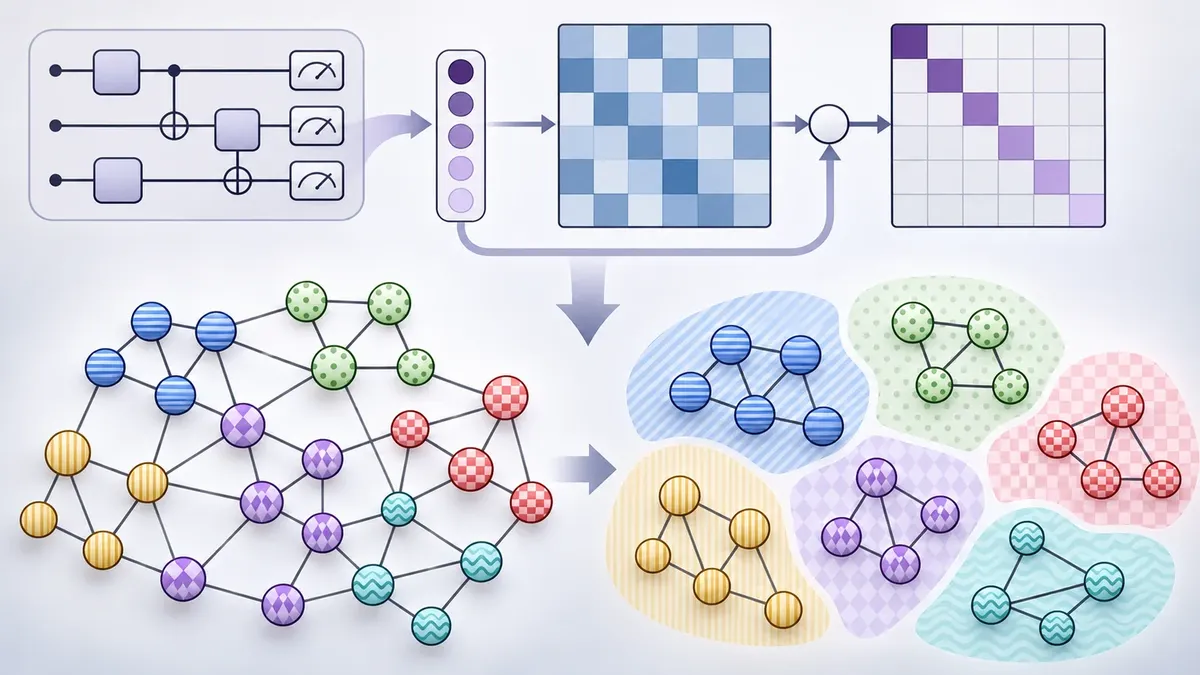
With only a few labeled examples, graph-based learning uses similarities among data points to extend known labels. This study tests whether node-specific regularization can improve Poisson label propagation, and whether a quantum-circuit-based method for choosing those weights adds value.
The question: can regularization steady label propagation?
Many datasets contain plenty of examples but few labels. Graph-based semi-supervised learning represents examples as nodes and similarities as links, then uses the graph to extend information from labeled to unlabeled nodes. The method depends on whether the graph reflects useful relationships. When labels are scarce, propagation can also be sensitive to how its equations are set up.
The authors propose IPQSSL, a “quantum-informed” version of Poisson graph learning. They ask whether node-specific diagonal regularization improves classification under limited supervision—and whether the proposed circuit-based approach contributes more than simpler ways of choosing regularization weights.
How the method works
For each node, the researchers combine its features with those of nearby nodes in a local context. They apply QR factorization, a matrix operation that extracts orthogonal directions, and use the resulting representation to form an input for a small quantum circuit. The same parameterized circuit processes each node and produces a bounded score. These scores become diagonal weights in a regularized Poisson system, which calculates class scores for the nodes.
The tested pipeline is hybrid and mostly classical: graph construction, QR preprocessing, and the linear-system solution run on classical computers. The circuit supplies the diagonal weights, and the experiments evaluate its outputs through exact statevector simulation rather than on quantum hardware. The paper also derives a Hermitian, block-encoding-compatible form of the operator. This describes a possible route to future quantum linear-algebra methods under stated assumptions; it is not a demonstration of an end-to-end quantum algorithm or speedup.
The evaluation uses seven benchmarks: six tabular datasets, including Iris, Wine, and German Credit, and the Cora citation network. The authors compare IPQSSL with Poisson-based alternatives using shared graphs and matched data splits. They test budgets of one, two, five, or ten labeled examples per class, repeat the splits over 20 seeds, and report accuracy on unlabeled examples. A separate ablation compares trained and untrained circuit-derived weights with random weights, degree-based weights, and no diagonal regularization.
Results vary across datasets
IPQSSL did not perform best across the board. It had the highest mean accuracy among the compared methods on Iris and Wine once there were at least two labels per class; on Iris, it reached 0.946 accuracy with ten labels per class. It also led the comparison at every tested budget on German Credit. But all methods scored below the majority-class rate on that dataset, so none beat the baseline of always predicting its most common class.
On Breast Cancer, Heart Disease, Optdigits, and Cora, other Poisson-based methods generally performed better. For Optdigits and Cora, IPQSSL’s gap relative to Original Poisson narrowed as the label budget increased. The authors report these comparisons descriptively and do not conduct formal hypothesis tests; the results therefore do not establish that differences are statistically significant.
The ablation helps separate the effect of adding a diagonal term from the effect of training the circuit. At a separate setting with 30% of the data labeled, at least one nonzero diagonal construction improved mean accuracy over the unregularized setup on six of seven datasets. German Credit was the exception, where the unregularized arm performed best. No single nonzero diagonal construction led across all datasets.
For the circuit comparison, trained and untrained circuit-derived weights had identical mean accuracies at the displayed precision on five datasets. Training lowered the mean on Iris and Cora. The authors therefore report no measurable contribution from SPSA training under this protocol, based on the reported means and precision. The findings point to diagonal stabilization as the main source of the observed gains, rather than variational training, though they do not fully establish why regularization helps.
What remains uncertain
One important qualification concerns the unregularized system itself. At the default settings, a parameter can make its operator indefinite. The diagonal term may therefore be repairing this mathematical issue, including one introduced by the chosen setting. The authors identify a control with that parameter set to zero and no regularization as needed to distinguish spectral repair from conditioning improvement.
Other limitations include the absence of a matched-capacity classical model to test whether the circuit’s constrained representation adds value, high split-to-split variability on Optdigits, and reliance on accuracy alone, which can obscure performance on imbalanced data. Circuit-noise diagnostics use simulation and a simplified noise model, not hardware measurements.
The supplied source identifies this as an arXiv version 1 preprint; its review status is not independently established by the evidence provided here. The results should be read as preliminary and limited to the reported datasets and protocols. The main conclusion is conditional: diagonal regularization can help Poisson graph learning in some tested settings, but the study does not establish a universal improvement or quantum computational advantage.
- semi-supervised learning
- graph learning
- Poisson learning
- quantum-informed machine learning
- regularization
- preprint
Related reading
Automatically matched by shared topic keywords. These links do not imply that the sources agree or establish a consensus.
HypSEE Uses Hypergraphs to Capture Graph Hierarchies
Source published
Shared keywords: semi supervised learning
LandslideFM pairs landslide mapping with image-based descriptions
Source published
Shared keywords: semi supervised learning
Two AI Teachers Take on the Problem of Learning from Mistakes
Source published
Shared keywords: semi supervised learning