TRANSMISSION // 2611.27600v1
When Gain and Loss Don’t Break T Symmetry
Source published
A theoretical study finds that real quasi-energies persist in certain finite, time-dependent T-symmetric lattice models as gain and loss increase. The result depends on the model’s structure.
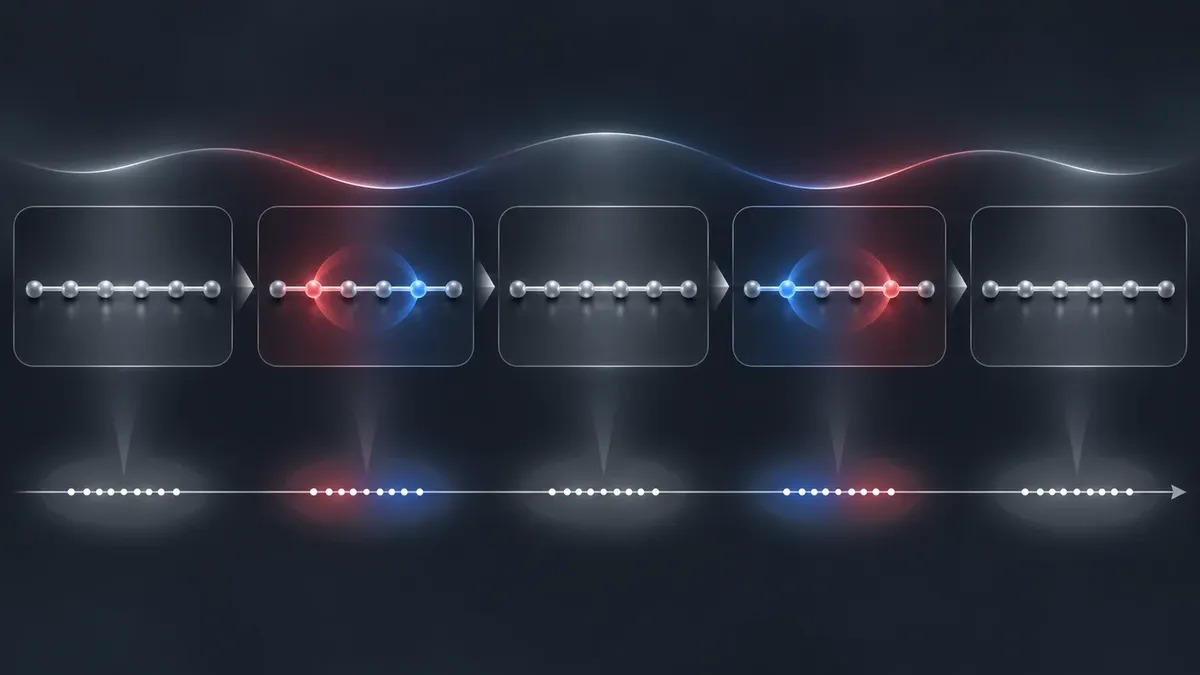
In many non-Hermitian systems, increasing gain and loss can turn real energy levels complex, marking symmetry breaking. Li Ge’s preprint asks whether this familiar pattern must also occur in systems that change over time. For particular finite lattice models with T symmetry, it reports that it need not—but the result depends on how the model is constructed and is not a general rule for driven systems.
In many non-Hermitian systems, gain and loss can push a system past a threshold: real energy levels become complex, signaling symmetry breaking. Li Ge’s preprint investigates whether that pattern also holds when a system changes over time. It reports cases where it does not, within a specific class of finite lattice models with gain and loss and T symmetry.
Here, T symmetry is a mathematical condition relating the system at one time to its counterpart at the reversed time, with complex conjugation. In the classical and integer-spin systems considered, this is not a claim about every aspect of ordinary physical time reversal.
Because gain and loss can make amplitudes grow or shrink, the evolution is non-unitary. The paper examines the evolution operator over a chosen duration and its associated quasi-energies. In the T-symmetric phase, these quasi-energies are real. In the T-broken phase, some have nonzero imaginary parts, corresponding to amplification or attenuation. The question is whether increasing gain and loss necessarily produces that change.
The role of the sequence
The paper studies one-dimensional lattices evolved through five steps, ordered −2, −1, 0, 1, 2. Steps −1 and 1 are non-Hermitian and related by T symmetry; steps −2, 0, and 2 are Hermitian. The author analyzes the evolution operator and its spectrum, using symmetry arguments to identify when the quasi-energies remain real.
The two main scenarios are derived with no couplings in the non-Hermitian steps. In the first, gain and loss have a specific pairwise relationship across sites; the couplings in the central Hermitian step need not be staggered. In the second, gain and loss can be uncorrelated from site to site, but the couplings in the Hermitian steps must be staggered. These are distinct sets of conditions, not ingredients that can be freely mixed.
For these scenarios, the paper derives a non-unitary similarity transformation connecting the full evolution to a Hermitian evolution. Under the stated conditions, this accounts for real quasi-energies as gain and loss increase. The author reports that this behavior persists across modulation durations and the allowed spatial patterns of gain and loss in these cases. The paper also describes generalizations that alter couplings in the unitary steps, including complex and random couplings, and split central steps. Thus, uncoupled non-Hermitian steps describe the main derivation’s scenarios, not every reported generalization.
The paper also presents cases where T-symmetry breaking does occur, including when required coupling patterns are absent. The persistence of real quasi-energies is not simply a consequence of the non-Hermitian skin effect—where modes accumulate toward an edge—because the paper reports cases without that effect too.
What the PT-symmetric comparison shows
The author compares these constructions with systems having parity-time (PT) symmetry, combining complex conjugation with spatial reflection. In the main PT-symmetric systems examined, increasing gain and loss does not show the same persistence of real quasi-energies. This is a comparison between particular constructions, not a general rule that T symmetry and PT symmetry must behave differently.
An appendix gives an important qualification: it constructs a PT-symmetric example with real quasi-energies at a particular modulation duration. That setup requires additional couplings and detunings, and the effect is lost when the duration changes. It therefore differs from the duration-independent T-symmetric scenarios.
What remains uncertain
The work offers a mathematical account of how timing and lattice structure can alter the usual threshold picture. Its conclusions apply to specified finite models and conditions; they do not establish that symmetry breaking is impossible in driven systems generally. The paper is theoretical and reports no experimental demonstration. It also leaves open whether similar behavior could occur in scattering systems.
This account is based on the arXiv preprint Forbidden T-symmetry breaking in time-dependent non-Hermitian systems with gain and loss. Preprints are research manuscripts shared publicly and may not have completed peer review. The results should be read as a model-specific theoretical finding, not as a settled rule or evidence of scientific consensus.
- non-Hermitian physics
- T symmetry
- gain and loss
- time-dependent systems
- quasi-energies
Related reading
Automatically matched by shared topic keywords. These links do not imply that the sources agree or establish a consensus.
When boundaries amplify non-Hermitian waves
Source published
Shared keywords: non hermitian physics
How patterned quantum lattices could sharpen sensing
Source published
Shared keywords: non hermitian physics
When a wave gets trapped, but not in the usual way
Source published
Shared keywords: non hermitian physics
How one quantum boundary can create nonunitary critical behavior
Source published
Shared keywords: non hermitian physics
A frequency-comb sensor separates a weak signal from measured noise
Source published
Shared keywords: non hermitian physics