TRANSMISSION // 2611.27556v1
How AI could help engineers investigate reactor-monitoring anomalies
Source published
A pilot at Switzerland’s Beznau plant uses coordinated language-model agents to gather and analyse records for engineers. Its examples illustrate a workflow, not proof of improved accuracy or safety.
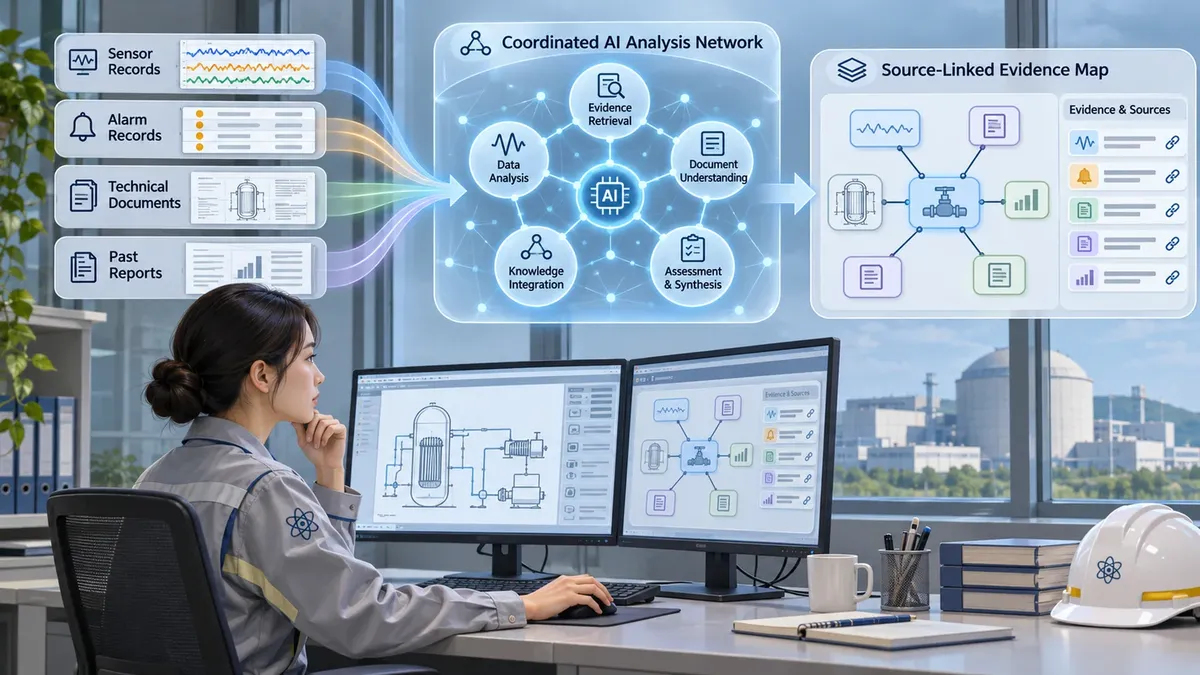
At an ageing nuclear plant, answering a question about an unusual signal can mean searching several databases and documents. A Beznau pilot brings those sources into one advisory assistant—but its authors say broader testing is still needed.
The challenge: evidence scattered across systems
When a reactor-monitoring signal behaves unexpectedly, engineers need more than the number on a screen. They may need to identify what the signal measures, check nearby alarms, examine historical readings, consult technical specifications and compare the event with earlier investigations. At Switzerland’s Beznau Nuclear Power Plant, these records sit in different information systems, shaped by decades of upgrades.
A paper by Wenqi Zhou and colleagues describes a pilot assistant designed to help engineers gather that evidence. The system is intended to support investigations, not make operational decisions. Beznau’s Unit 1 has operated since 1969, making it a long-running setting in which to explore how digital assistance might work alongside accumulated plant knowledge.
How the assistant works
The system uses large language models (LLMs)—software that can interpret and generate text—and organises work through an orchestrator and specialist agents. An engineer asks a question in a conversational interface. The orchestrator breaks it into tasks and assigns relevant work to agents that consult particular sources or analyse monitoring data. It then assembles their contributions into a response with references to supporting evidence.
The sources described include operational data from the ANIS plant information system and GARDEL reactor-core monitoring system, alarm logs, variable definitions, technical specifications, previous investigation reports and organisational records. Agents have read-only access to their sources. The paper says the language-model service is hosted through Azure in Switzerland, while the application and its data stores are in a local deployment environment.
Plant engineers can inspect and revise the natural-language procedures that guide the agents. This is meant to make the system’s working instructions visible to domain experts, rather than burying them in code. The assistant can also show plots and source references so engineers can examine the underlying records rather than relying only on a written summary.
What the examples show—and do not show
The paper presents three illustrative exchanges: an introduction to the assistant, a query about anomaly detection in GARDEL data, and an investigation of fluctuations in ANIS data. In the GARDEL example, the system retrieves and analyses records, reports detected anomalies and displays a plot alongside available ground-truth labels. The paper says the demonstration uses injected synthetic faults; it does not establish how well the system would detect real faults across routine plant operations.
The ANIS example starts with a deliberately vague question about a fluctuation on a particular date. Agents examine the data and earlier reports, then present the observed pattern in the context of a previously documented phenomenon. The authors stress that resemblance to an earlier case is not, by itself, proof of a cause. The fluctuation used in this example was described as a known, manufacturer-recognised phenomenon that posed no operational risk.
Together, these cases demonstrate how the assistant can coordinate retrieval, data analysis, visualisation and synthesis for engineering review. They are qualitative demonstrations, not a systematic performance test. The authors say that evaluating retrieval accuracy, analytical correctness and usefulness to plant engineers requires a broader set of investigations. The paper therefore does not establish how reliably the assistant would perform across varied monitoring cases.
A cautious role for AI
That distinction matters in nuclear engineering. A response can be well referenced and still require careful scrutiny: sources may be incomplete, an analysis may be mistaken, or a plausible interpretation may go beyond what the evidence supports. In the system described, plant personnel retain responsibility for judging the evidence and deciding what action, if any, to take. The assistant is advisory, and its access to plant information is read-only.
The paper’s contribution is a piloted workflow, plus lessons about introducing agentic AI into a setting that prioritises traceability and conservative change—not evidence that AI has made the plant safer or that engineers can rely on it without review. The next research steps identified by the authors include testing more monitoring scenarios, examining agent coordination and the reliability of generated interpretations, and assessing the effort needed to maintain procedures as plant systems change.
The manuscript is available as an arXiv preprint. Its demonstrations help explain the system’s design, but the limited evaluation means its performance and practical value remain open questions.
- nuclear power
- large language models
- AI agents
- reactor monitoring
- engineering decision support
- Beznau
Reviewed cross-references
These connections were reviewed by a model, not independently fact-checked by a human. Similarity does not imply agreement; consult the original papers and the evidence below.
Giving AI agents a workflow map instead of the whole steering wheel
Shared method: Both papers describe orchestrating LLM-based agents within a broader workflow: the Beznau system delegates investigation tasks to specialist agents, while the BPMN approach places agent reasoning in selected activities within an explicitly modeled process. This is an architectural connection, not evidence that the systems share an implementation or have comparable performance; the BPMN paper notes that larger-scale evaluation remains future work.
Model review: · openai-codex/gpt-6-luna
Evidence and provenance
Selected excerpts, not complete papers. PDF extraction can omit figures or damage equations, tables and reading order; sources may be preprints.
2611.27556v1 — Original paper
Excerpt reference:
static/papers/2611.27556v1.md:195-279
Basis: Paper text
Source SHA-256:f3b545ccb6a64006d66572c3777c829515da0988c769ad725260e65ce70449ad2611.13196v1 — Original paper
Excerpt reference:
static/papers/2611.13196v1.md:13-82
Basis: Paper text
Source SHA-256:f811eaff062c56b94782241045364aeb7b5db554970533dfca74b37a158c32ed2611.13196v1 — Original paper
Excerpt reference:
static/papers/2611.13196v1.md:697-731
Basis: Paper text
Source SHA-256:f811eaff062c56b94782241045364aeb7b5db554970533dfca74b37a158c32ed
Related reading
Automatically matched by shared topic keywords. These links do not imply that the sources agree or establish a consensus.
Reddit debates reveal what lies behind data center opposition
Source published
Shared keywords: large language models
When LLMs Choose Their Own Bets, Risky Patterns Grow
Source published
Shared keywords: ai agents, large language models
AI models know time’s rules but struggle to predict their own runtimes
Source published
Shared keywords: ai agents, large language models
When AI Agents Agree, Their Majority Can Still Be Wrong
Source published
Shared keywords: ai agents, large language models
Teaching AI agents to patch their skills with code
Source published
Shared keywords: ai agents, large language models