TRANSMISSION // 2611.27543v1
Why AI forgetting can be hard to verify
Source published
A study argues that evaluations of machine unlearning can miss successful deletions—and overlook requests a method cannot reliably fulfill.
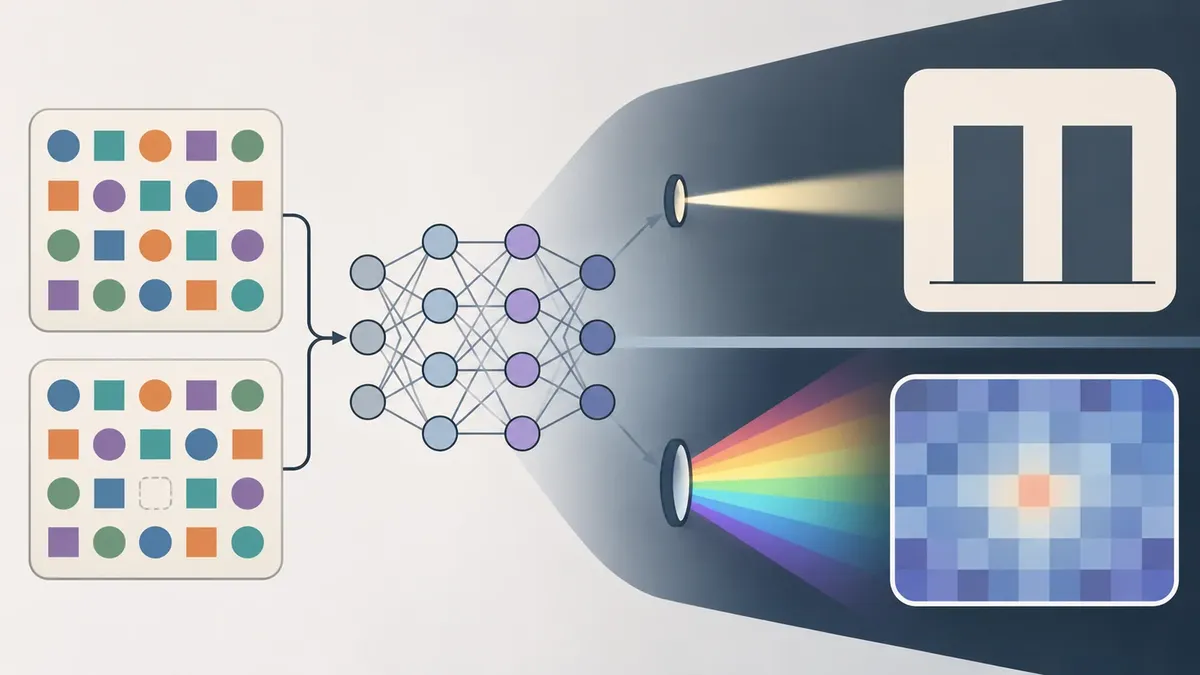
When an AI model is asked to forget training data, a good score on a few examples does not show that it can handle every deletion request. This preprint examines that gap, called coverage, and asks how much an evaluator can actually observe.
Machine unlearning is meant to remove the influence of specified training data while keeping a model useful on what remains. But how can anyone tell whether a method works for a wide range of deletion requests, rather than just the examples chosen for a test? A new preprint by Ziluowen Luo and colleagues calls this broader question coverage: the range of requests a method can fulfill while preserving retained information.
The authors argue that coverage is hard to assess because evaluations rely on limited observations, such as model predictions or selected internal activations. If these signals do not change noticeably after a deletion, an evaluator may conclude that nothing happened—even when the data was removed. Conversely, detecting a change for one target does not establish that the method can handle other targets or larger deletion requests.
Testing what evaluators can see
The researchers first tested this problem using retraining as an oracle. For each target, they trained a model again without that target, providing a reference in which its exclusion was known. They examined 502 retrained models across two datasets and compared ways of detecting the deletion from model outputs or internal representations.
Some deletions were missed when evaluators used the model’s original prediction-head features. In certain cases, examining a broader embedding revealed a signal that the narrower view missed. The paper also describes targets that remained undetected across the tested representation widths. This matters because a missed signal is not, by itself, evidence that the deletion failed: the oracle had excluded those targets by construction. It is evidence that the chosen observation method could not reliably reveal the deletion.
The authors then derive mathematical limits for evaluators that use linear scores over a shared representation. Under the paper’s selectivity conditions, distinguishing every one of n single-example deletions can require representation rank that grows at least on the order of log n. The analysis also considers deletion requests involving multiple examples. It shows why comparisons that omit overlapping or partial deletions can make a request look completely handled when the evidence does not rule out partial removal.
A benchmark for request coverage
To measure coverage directly, the authors introduce CEO, a framework tested on a compositional benchmark pairing colors with shapes. Its controlled construction lets the researchers assess a model’s full output distribution and compare edited models with leave-one-out retraining references. CEO counts a target as covered only when the evaluator reliably flags its deletion while rarely flagging it under other deletion requests. The paper’s main criterion requires at least 90% detection and no more than 5% false positives for each other request.
The authors compare 20 unlearning configurations on this synthetic task. Results depend on the number of targets, the editing setup, and the evaluator: performance on a few deletion requests did not guarantee broad coverage. In the reported fixed-evaluator comparison, retraining covered every target at task sizes of 16, 64, and 256 pairs, while approximate methods often covered only a subset. Elsewhere, a separate training-budget sweep reports that some configurations covered all 256 targets after 800 updates. These are results under particular experimental settings, not a general verdict on all unlearning methods.
The benchmark also shows that the evaluator itself matters. Counting colors and shapes separately loses information about which color–shape pairs occurred together; counting the pairs preserves that structure and, in the oracle comparison, detected all targets under the stated empirical criteria. Expanding observations with a sparse autoencoder—a model that represents inputs using a larger set of learned features—also helped reveal some missed deletions in the tested settings. More features, however, do not automatically guarantee reliable evidence: thresholds, false alarms, sample budgets, and the chosen coverage criterion all affect the result.
What the results do—and do not—establish
The work’s central contribution is an evaluation framework and a warning: low coverage can reflect either a method’s inability to fulfill requests or an evaluator’s inability to observe what happened. Distinguishing those explanations requires known deletion outcomes, suitable controls, and measurements of retained utility alongside forgetting. A high detection rate alone is not enough; false positives or damage to retained behavior can undermine the interpretation.
The evidence has important limits. The cleanest coverage experiments use a synthetic color–shape task, and even the broader vision and language experiments do not establish performance across all real-world data, models, or deletion requests. Retraining provides a useful reference in these experiments, but running it for every request is costly. Empirical coverage also depends on finite samples: the paper distinguishes point-estimate coverage from stricter confidence-supported evidence, and reports that the latter can require more validation data.
This is a preprint, so its findings should be treated as research claims that may change with peer review or further testing. The results do not prove that approximate unlearning generally fails, nor that internal representations reveal deletion reliably in every system. They suggest a more precise question for future evaluations: not only whether a method appears to forget selected data, but which requests it can handle—and whether the available evidence is strong enough to tell.
- machine unlearning
- AI evaluation
- data deletion
- observability
- coverage
- sparse autoencoders
Reviewed cross-references
These connections were reviewed by a model, not independently fact-checked by a human. Similarity does not imply agreement; consult the original papers and the evidence below.
Can an AI Model Forget—or Just Stop Answering?
Supporting evidence: Both papers report that output-level behavior can miss information relevant to evaluating forgetting: Luo et al. found hidden embeddings could reveal oracle-known deletions missed in predictions, while Peleg et al. report that suppressed knowledge may remain detectable in activation geometry and relate to adversarial recovery. These are complementary results, not a shared method or a direct replication; they use different tasks, observables, and definitions of success.
Model review: · openai-codex/gpt-6-luna
Evidence and provenance
Selected excerpts, not complete papers. PDF extraction can omit figures or damage equations, tables and reading order; sources may be preprints.
2611.27543v1 — Original paper
Excerpt reference:
static/papers/2611.27543v1.md:81-140
Basis: Paper text
Source SHA-256:0eec1947c13b93fc160cf78a35e2575445f88d5650ad02ed3027b19be7f352882611.05272v1 — Original paper
Excerpt reference:
static/papers/2611.05272v1.md:13-84
Basis: Paper text
Source SHA-256:215a962e9f57056a3d1c6e122fae49e3b960638f437edecabce1d2d30217d70a
Related reading
Automatically matched by shared topic keywords. These links do not imply that the sources agree or establish a consensus.
IDSISA proposes a more selective approach to AI forgetting
Source published
Shared keywords: data deletion, machine unlearning
A proposal to audit what language models unlearn
Source published
Shared keywords: data deletion, machine unlearning
TopicScope tracks an AI response’s subject as it is generated
Source published
Shared keywords: sparse autoencoders
A clearer view inside protein AI—but steering useful proteins remains harder
Source published
Shared keywords: sparse autoencoders
Glyph turns hidden medical AI features into testable disease-risk clues
Source published
Shared keywords: sparse autoencoders