TRANSMISSION // 2611.27535v1
A geometric route to quantum state transfer
Source published
The geodesiq Python package implements a framework that combines adiabatic and diabatic control to shape pulses for state transfer in multilevel quantum systems.
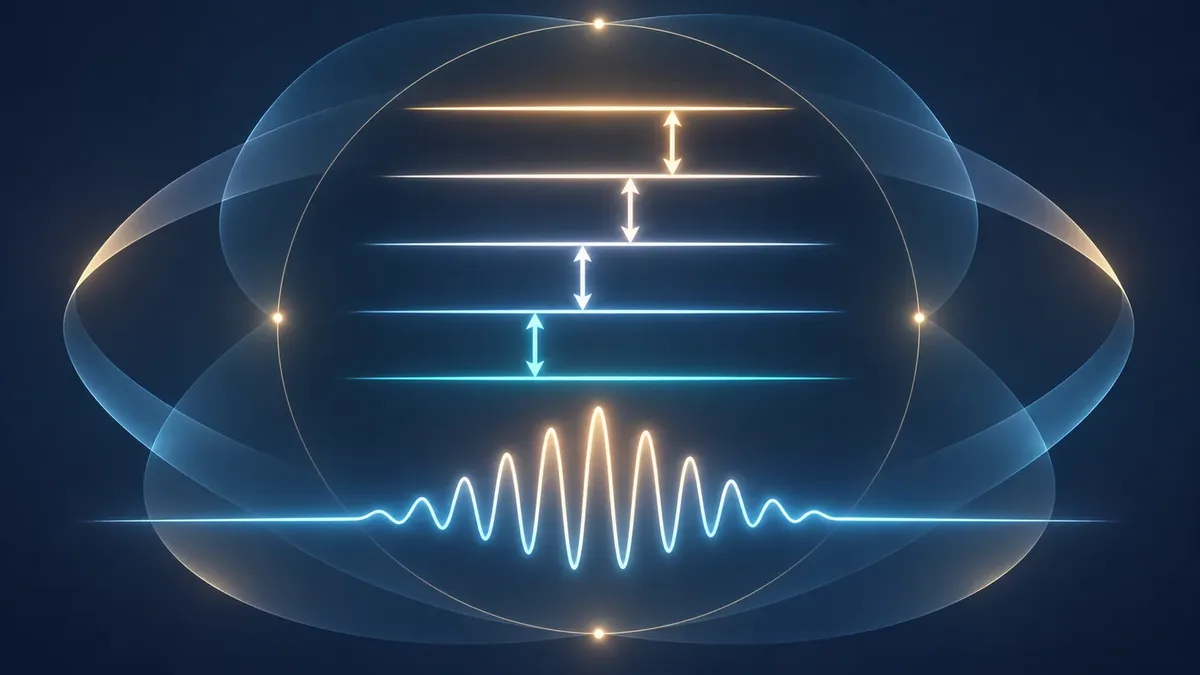
Quantum systems can be steered between states with carefully designed control pulses, but unwanted transitions can interfere with the transfer. A new Python package, geodesiq, implements a geometric method that combines adiabatic control—which can suppress unwanted excitations—with selected diabatic passages, where the system does not follow the adiabatic route.
Combining two approaches to control
Quantum control means steering a system from an initial state to a desired final one. In a multilevel system, a pulse may also excite states that are not part of the intended transfer. One approach is adiabatic control: changing the system slowly enough for it to follow its evolving state. Another is diabatic control, which allows selected passages that do not follow that adiabatic evolution.
The paper introduces geodesiq, a Python package for designing control pulses within a geometric framework that combines these approaches. The authors describe its metric as a way to suppress unwanted excitations while allowing selected diabatic passages. In other words, the framework is intended to treat adiabatic and diabatic behavior together rather than as separate design choices.
Turning the framework into a pulse
According to the abstract, finding a pulse with this method reduces to solving a single first-order ordinary differential equation (ODE). An ODE describes how a quantity changes in response to another variable; here, solving one is the stated computational route for obtaining the pulse. The abstract does not provide the equation, its assumptions, or enough detail to explain the derivation, so those aspects cannot be evaluated from the available evidence.
The authors illustrate the package in four settings: Landau–Zener transitions, spin-qubit initialization, preparation of an adiabatic many-body ground state, and a diabatic–adiabatic transfer in a four-level system. These examples show the kinds of problems for which the package is presented. The abstract does not specify whether each example is simulated or experimental, and it gives no numerical fidelity results or comparisons with other methods.
What remains uncertain
The contribution described in the abstract is a software package implementing a unified geometric method, accompanied by demonstrations of its use. The ODE-based pulse-finding procedure is a central feature, but the abstract alone does not establish whether the method is more accurate, faster, or more robust than alternative approaches. It also does not state how performance depends on noise, imperfect models, or practical hardware constraints.
Those questions matter because a pulse designed using a model may not work equally well in a real device. Assessing the package’s practical value would require the full paper’s equations, implementation details, results for the examples, and discussion of assumptions and limitations. The abstract’s list of applications is not enough to determine their performance or experimental status.
The source is an arXiv preprint, and the evidence available for this account is its abstract rather than the full paper. A preprint is a public research report that may not have undergone peer review. This article therefore summarizes what the authors say the package does; it is not an independent validation of the software or evidence that the method improves state transfer.
For curious readers, geodesiq’s central idea is to bring adiabatic protection and selected diabatic passages into one pulse-design framework. Whether that approach is useful for a particular system depends on technical details and evidence beyond the abstract.
- quantum control
- quantum state transfer
- geodesiq
- adiabatic control
- diabatic transitions
- Python package
Related reading
Automatically matched by shared topic keywords. These links do not imply that the sources agree or establish a consensus.
Slow drives could connect distant superconducting qubits through a shared cavity
Source published
Shared keywords: adiabatic control
A vibrating mirror could shuttle complex quantum light
Source published
Shared keywords: quantum state transfer
Weaker end connections could improve quantum energy transfer
Source published
Shared keywords: quantum state transfer
A Trapped Ion Could Help Cool and Control a Levitated Nanoparticle
Source published
Shared keywords: quantum control
A 10-kilometre optical link delivers control to superconducting qubits
Source published
Shared keywords: quantum control