TRANSMISSION // 2611.27529v1
AI agents look for the weak links in scene-graph models
Source published
RoHa-SGG diagnoses where frozen image-understanding models lose relationships, then searches for changes to their inference code. Tests on two datasets show improved scores, with important limits on what the results establish.
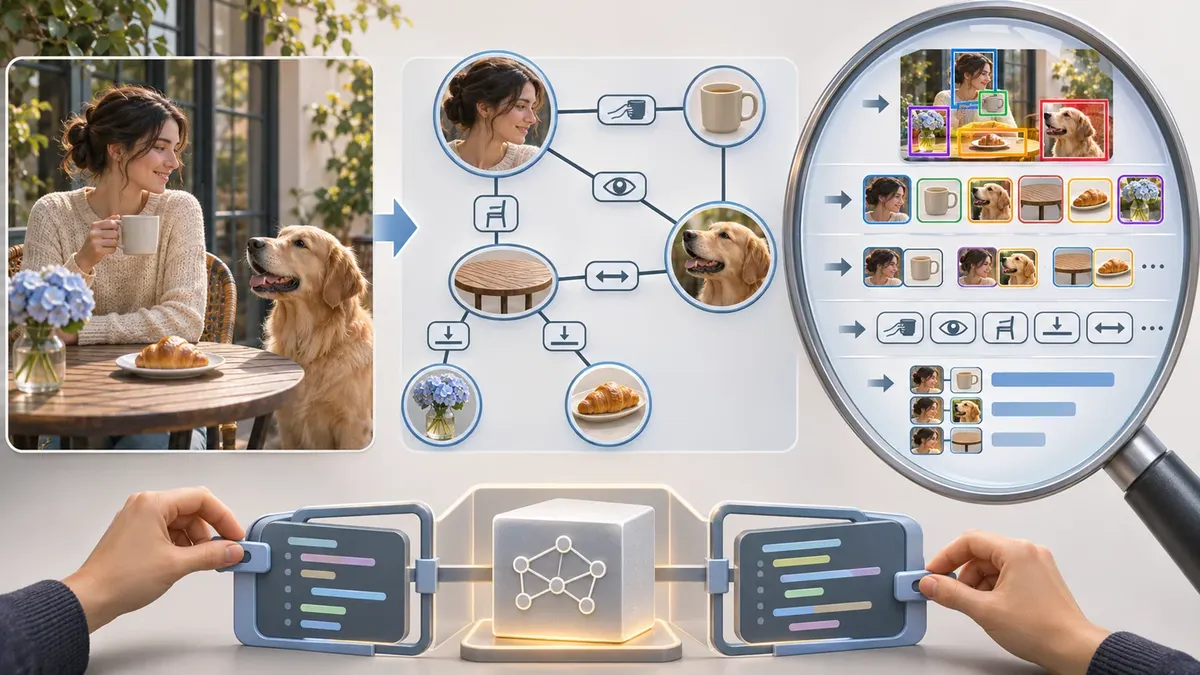
A scene graph turns an image into objects and relationships, such as “person riding horse.” A new system asks not just whether a model missed a relationship, but where in its processing it went wrong—and whether adjusting the surrounding code can help.
A scene-graph model has to get several things right to describe a relationship in an image: locate both objects, identify them, consider them as a pair, predict their relationship and rank that relationship highly enough to be returned. A miss in any of these steps can leave a true relationship out of the final graph.
The usual evaluation settings show how scores change when models are given some correct object boxes or labels. But they do not necessarily reveal which step caused a particular relationship to be missed. That matters if the goal is to improve a model without retraining it.
Jee Eun Kim and colleagues propose RoHa-SGG, a system that diagnoses these weak points and searches for changes to a model’s “harness”: the inference code that prepares inputs, calls the model and processes its output. The underlying scene-graph model stays frozen. The paper, a preprint on arXiv, tests the approach on Visual Genome and PSG using two-stage and one-stage models, as well as a multimodal large language model.
Finding the point of failure
The researchers break a successful prediction into five components: object boxes, object names, object pairs, relationship labels (called predicates), and ranking. To estimate how much each component contributes to missed relationships, they use a method called Shapley values. In plain terms, it shares credit for a recovered relationship across the components that needed correction, rather than assigning all the credit to whichever step happens to be fixed last.
An analysis agent then proposes possible explanations for the errors and tests them with interventions. For example, it might add boxes from an external detector. A separate proposer agent uses the diagnoses to suggest changes to the inference code. Those changes can draw on external tools, adjust how predictions are scored, or alter other parts of the pipeline. The system checks candidates on designated search data, selects among them using separate data, and reports results on test sets.
The diagnoses were not the same for every model and dataset. Across the five available model–dataset combinations, object-pair errors were the largest source of missed relationships in the paper’s initial analysis at one reported cutoff. Other weaknesses varied. For instance, the multimodal model often left objects without boxes, while the traditional models also lost relationships through ranking. This is why the authors argue that a single, generic fix may not address every model’s problems.
Better scores, with trade-offs
The authors report that the selected harnesses improved every reported metric in all five combinations. On the paper’s graph-constrained test metrics, the largest reported gains were 15.8 points in R@100 and 26.4 points in mR@100 for the multimodal model. R@100 measures how many annotated relationships appear among the top 100 predictions; mR@100 gives more equal weight to relationship categories, including less common ones. For the two-stage and one-stage models, the maximum reported gains were 3.6 and 10.1 points on those respective measures.
The changes did not come without costs. Some harnesses call the model more than once or use external tools, which can increase inference time. In the reported tests, multi-pass harnesses could take substantially longer per image than the baseline. The authors also report API costs for the optimization searches themselves; these are separate from the eventual harness’s inference-time costs.
To test whether diagnosis made the search more efficient, the team compared root-cause-guided searches with unguided searches and searches given a general, human-written guide. In the Visual Genome searches for two conventional models, the guided search reached the final score of the other approaches after four or five of 12 iterations. The benefit was smaller for the multimodal model, whose missing boxes were already apparent in its output. That result suggests diagnosis may be most useful when errors are not obvious from the overall score or predictions alone—not that it speeds up every search equally.
What the evidence does—and does not—show
These are results from a specific experimental setup, not proof that the method will improve scene-graph systems in general. The study uses three released models, two datasets and a particular set of allowed tools and harness changes. The authors note that each search was run once, so their confidence intervals capture variation across images, not variation between independent runs. They also identify other LLM agents and additional evaluation settings as future work.
The paper describes a method that can fit small add-on modules using training images, even though the main SGG model is not retrained. So “without retraining” refers to keeping that model frozen, not to forbidding all training within the surrounding pipeline. And while the reported test-set improvements are encouraging, they do not establish that the changes transfer to new datasets or deployment conditions.
RoHa-SGG’s central idea is practical: before trying to improve a system, measure where it loses the information it needs. Whether that diagnosis-and-search approach proves useful beyond these experiments will require further evaluation. This article is based on the authors’ arXiv preprint; preprints may not have undergone peer review, and reported results should be interpreted accordingly.
- scene graph generation
- computer vision
- AI agents
- root-cause analysis
- model evaluation
- inference harness
Reviewed cross-references
These connections were reviewed by a model, not independently fact-checked by a human. Similarity does not imply agreement; consult the original papers and the evidence below.
HarnessFlow searches for better AI-agent software without changing the model
Shared method: Both studies search over inference-harness changes around a fixed model and evaluate candidate implementations to improve task performance. RoHa-SGG uses root-cause diagnoses to guide proposals for scene-graph models; HarnessFlow uses an MCTS refinement tree for coding and other agent tasks. This is a shared iterative harness-optimization approach, not evidence that either method works in the other’s setting.
Model review: · openai-codex/gpt-6-luna
Evidence and provenance
Selected excerpts, not complete papers. PDF extraction can omit figures or damage equations, tables and reading order; sources may be preprints.
2611.27529v1 — Original paper
Excerpt reference:
static/papers/2611.27529v1.md:188-252
Basis: Paper text
Source SHA-256:76c28fa1e677a8a892bf40241c329dec652616b6608f9c2147e05dbc4ce8fc122611.27529v1 — Original paper
Excerpt reference:
static/papers/2611.27529v1.md:253-318
Basis: Paper text
Source SHA-256:76c28fa1e677a8a892bf40241c329dec652616b6608f9c2147e05dbc4ce8fc122611.06254v1 — Original paper
Excerpt reference:
static/papers/2611.06254v1.md:124-171
Basis: Paper text
Source SHA-256:d331ea0b1d5f81332f73bc5d5f348e0e5ca518888d22b1c0a36cf1a623b5e0ab2611.06254v1 — Original paper
Excerpt reference:
static/papers/2611.06254v1.md:355-404
Basis: Paper text
Source SHA-256:d331ea0b1d5f81332f73bc5d5f348e0e5ca518888d22b1c0a36cf1a623b5e0ab
Related reading
Automatically matched by shared topic keywords. These links do not imply that the sources agree or establish a consensus.
Keeping AI workflow instructions separate from implementation know-how
Source published
Shared keywords: ai agents
Virtual Sensors Seek the Source of Industrial Faults
Source published
Shared keywords: root cause analysis
Can AI help improve a training run too expensive to repeat?
Source published
Shared keywords: ai agents, model evaluation
Banking AI compliance depends on the agent harness, not just the model
Source published
Shared keywords: ai agents, model evaluation
GTAGym turns GTA V missions into measurable tests for AI agents
Source published
Shared keywords: ai agents, computer vision