TRANSMISSION // 2611.27527v1
Why sparse scintillation makes fast radio bursts harder to measure
Source published
Simulations and Effelsberg observations show how a limited number of spectral scintles can distort measurements of fast radio bursts—and how averaging can help.
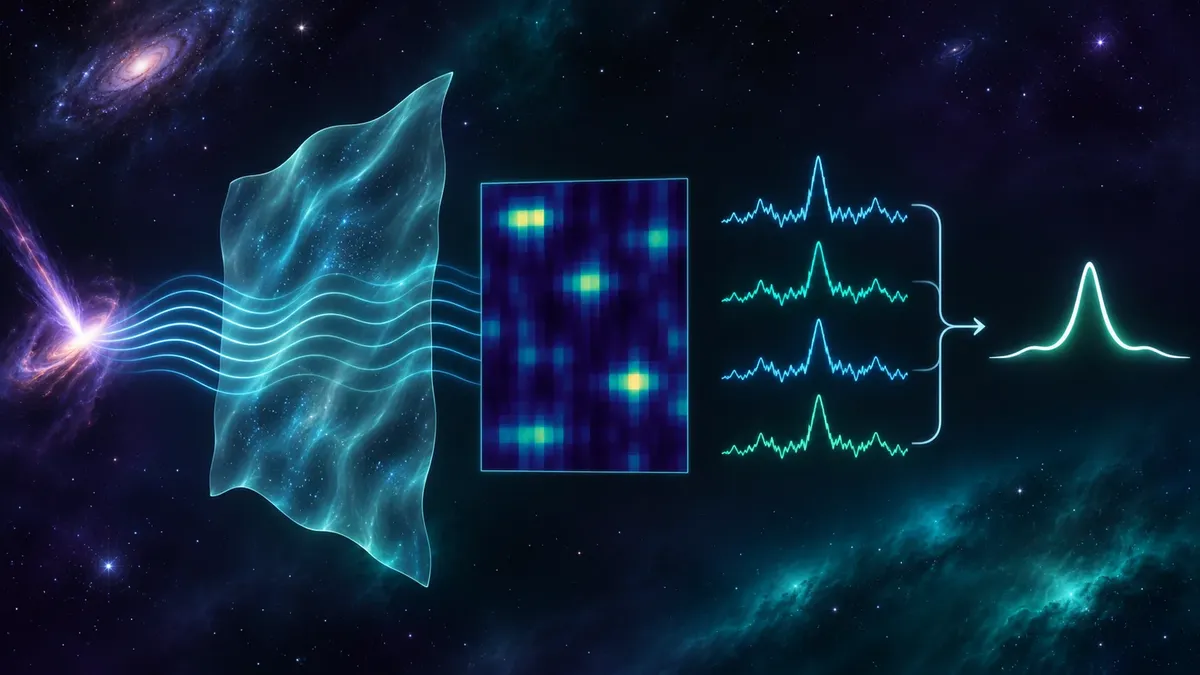
Fast radio bursts flicker across radio frequencies as their signals pass through ionised gas. A study examines why that flicker can be difficult to measure when a burst’s observing band contains only a few bright patches, and tests whether combining bursts improves the estimate.
Fast radio bursts (FRBs) are brief, bright radio signals from beyond the Milky Way. As their waves travel through unevenly distributed ionised gas, they can take multiple paths to Earth and interfere with one another. The result is scintillation: frequency-dependent bright and dim patches in a burst’s spectrum, known as scintles.
The characteristic frequency scale of those variations, called the scintillation bandwidth, can help researchers study scattering material along the signal’s path. But estimating that scale is tricky when the observed spectrum contains only a few scintles. In that situation, irregular structure can interfere with a standard measurement method.
Measuring a curve from a flickering spectrum
The researchers estimate scintillation bandwidth by calculating a frequency autocorrelation function, or ACF. In simple terms, the ACF compares a spectrum with shifted versions of itself: it shows how quickly the pattern of intensity changes as the frequency separation grows. For an idealised, single scattering screen, the expected ACF has a smooth Lorentzian shape. Its width provides an estimate of the scintillation bandwidth.
The team used simulated spectra with a known input bandwidth to test how this measurement behaves as the number of scintles across the observing band changes. They examined individual ACFs, the scatter in recovered bandwidth estimates, and the effect of averaging ACFs from independent spectra. They also applied their analysis to Effelsberg observations of the repeating FRB 20240114A, focusing on 33 selected bursts in one receiver band.
Few scintles mean less reliable individual estimates
In the simulations, ACFs became more irregular as the number of scintles fell. Their outer frequency lags developed prominent wiggles that departed from the smooth Lorentzian expectation. These distortions were associated with greater scatter in bandwidth estimates from individual spectra.
That matters for a commonly used uncertainty estimate called the finite-scintle error (FSE). In the better-constrained simulations, the authors found that a filling-factor parameter of about 0.055 was more suitable than the commonly used values they tested. But at 25 scintles or fewer, the simulated scatter could not be described by the FSE using any physically meaningful filling factor. In these simulations, the prescription was therefore unreliable in the low-scintle regime.
The researchers also tested averaging ACFs from multiple independent spectra. Averaging reduced fluctuations in the measured ACF and made it more closely resemble the expected Lorentzian, with the clearest improvement in simulations containing few scintles. For the Effelsberg data, a weighted average of the selected bursts produced a more stable ACF than the individual burst measurements. A bootstrap procedure—repeating the analysis on resampled sets of bursts—was used to estimate uncertainty for the combined result.
For that averaged ACF, a single-Lorentzian fit gave a scintillation bandwidth of about 17.5 megahertz in the receiver band studied. A two-Lorentzian fit also described the data and suggested two characteristic scales, but the authors leave detailed modelling of that possibility for future work. The observation demonstrates the analysis approach; it does not settle the physical origin of both scales.
What the result does—and does not—show
The study’s main contribution is methodological: it shows that the number of scintles in the usable bandwidth affects how dependable an individual ACF-based estimate is, and that averaging independent measurements can help for repeating sources. A wiggle in an ACF does not, by itself, prove that the scattering environment has extra complexity; the simulations show that sparse scintillation patterns can produce such structure.
There are important limits. The simulations use a simplified, single-screen model with constant scintillation bandwidth across the observing band. Real data can also be affected by noise, radio-frequency interference, and intrinsic spectral structure. The uncertainty analysis does not include thermal noise, and the authors describe remaining uncertainties as systematic. Bursts may also be correlated if they occur within the same scintillation timescale, whereas the simulations of averaging focus on independent realisations.
The study tests its framework on one repeating FRB and one selected Effelsberg observing epoch, so its results are not a universal calibration for every source or instrument. The supplied manuscript is labelled “A&A proofs”; its received and accepted date fields remain placeholders. That source information does not establish a publication status beyond what is stated there. The practical message is narrower: when a spectrum contains few scintles, a precise-looking fit to one burst may understate uncertainty, while combining sufficiently independent bursts can offer a steadier measurement.
- fast radio bursts
- scintillation
- radio astronomy
- autocorrelation function
- measurement uncertainty
- Effelsberg
Related reading
Automatically matched by shared topic keywords. These links do not imply that the sources agree or establish a consensus.
A compact Bayesian model captures MeerKAT’s changing radio beam
Source published
Shared keywords: radio astronomy
Radio surveys reveal a faint signal from IX Velorum
Source published
Shared keywords: radio astronomy
A black-hole system reaches record radio lows after decades of activity
Source published
Shared keywords: radio astronomy
A Cross-Signal Search for the Universe’s Missing Baryons
Source published
Shared keywords: fast radio bursts
Radio bursts offer tentative clues to gas around nearby galaxies
Source published
Shared keywords: fast radio bursts