TRANSMISSION // 2611.27523v1
A sharper filter for correlated photon pairs
Source published
Two actively stabilized optical cavities filter central-frequency light from photon pairs made in cold atoms, raising the measured correlation parameter while revealing limits that still need work.
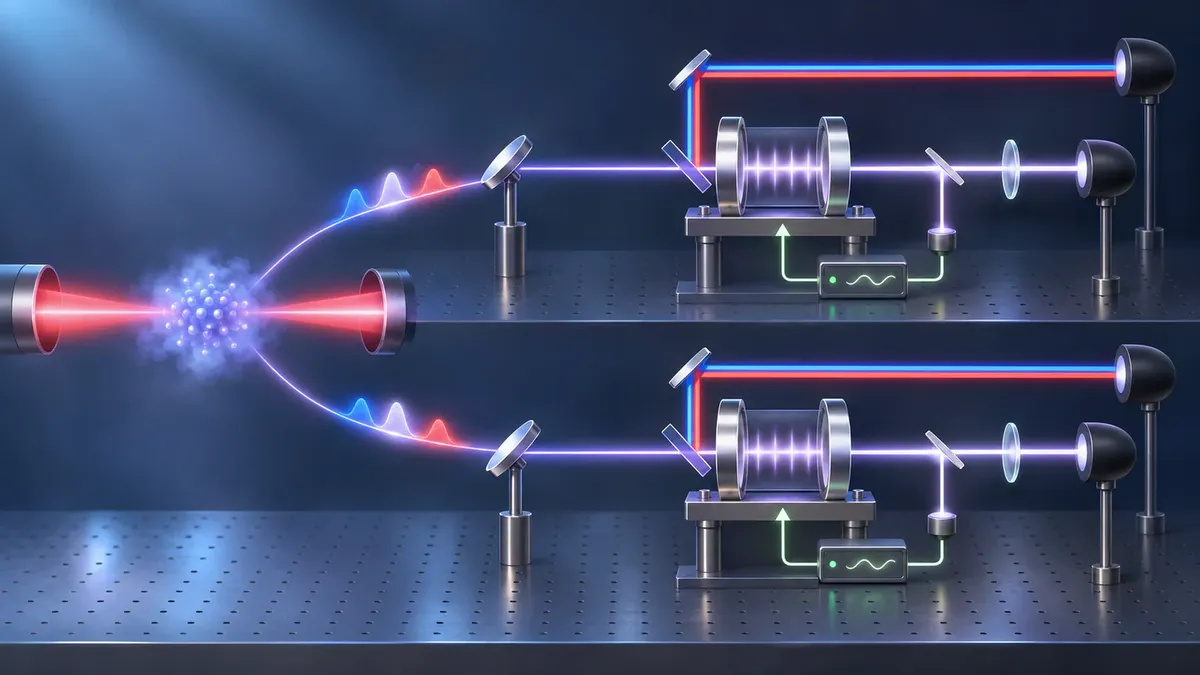
Photon-pair experiments can be swamped by light at the pump frequency. A new two-cavity filtering setup rejects some of that light while keeping frequency-shifted photons for detection—and stays locked long enough for correlation measurements.
In experiments that generate pairs of correlated photons, unwanted light can obscure the very relationship researchers hope to measure. A team has tested a way to suppress one important source of that background: light scattered by cold atoms at the same frequency as the laser driving them. Their approach uses two actively stabilized optical cavities, one in each photon-collection path.
The work focuses on photon pairs produced through spontaneous four-wave mixing, a process in which atoms scatter light in a way that can generate correlated photons. In the experiment, cold rubidium atoms are driven by two counterpropagating laser beams. The desired photon correlations appear in frequency-shifted sidebands, but the atoms also produce elastic, or Rayleigh, scattering at the laser’s original frequency. That central-frequency light raises detector counts and accidental coincidences, making correlations harder to distinguish.
A narrow notch, held in place
Each cavity acts as a reflection-mode notch filter. The researchers tune it to the laser frequency: light at that frequency passes through the cavity, while light at other frequencies is reflected toward the photon detectors. In this arrangement, the sidebands are kept for measurement and the central component is diverted away.
The cavities have a measured linewidth of about 2 megahertz. Because such a narrow resonance can drift with small changes in cavity length, the team actively stabilizes each one. An auxiliary laser beam travels through the same optical path as the photon field. An acousto-optic modulator periodically shifts its frequency; the researchers use changes in transmitted light to generate a feedback signal that adjusts the cavity length. The bright auxiliary beam is blocked during the photon-counting interval, so it does not directly contaminate those measurements. The two cavities have separate control loops, though they share an electronic timing reference.
To test the filters, the team compared photon-correlation measurements with and without them. They recorded detection events in four detectors and calculated a Cauchy–Schwarz parameter, a test that compares measured correlations with a classical bound. In the paper’s convention, a value above one indicates a violation of that bound. The reported central value was 4.15 ± 0.93 with filtering and 2.33 ± 0.20 without it. Both measurements exceeded one; the filtered result was higher, with a larger uncertainty.
The cavities also showed sustained operation: one was recorded locked for more than 24 hours in continuous operation, while time-multiplexed operation—when the reference beam was interrupted during photon counting—lasted about seven hours before lock was lost in the reported run. These durations exceed a typical correlation acquisition, according to the authors.
A useful improvement, not a finished filter
The gain is meaningful but not a complete solution. The authors say the measured increase remains too small for the more complex applications they have in mind. A narrow reference beam showed about 70% rejection at the cavity notch, but the single-photon detection rate fell by only about 30%. They suggest the central-frequency component may be broader than the notch, so part of it escapes rejection; they say they do not yet fully understand this behavior and propose testing cavities with different linewidths.
There is also a detection trade-off. Intensity modulators protect the single-photon detectors from the auxiliary reference beam, but the authors report that detector saturation and slow recovery raise noise during measurement. They identify alternative detector or reference-beam arrangements as possible future remedies. Filter losses are another potential target for improvement.
The result is a demonstration of a practical, stabilized way to reject a narrow spectral region in two separate photon paths—not evidence that the setup is ready for a quantum network or that it removes all background light. The article is a version-one arXiv preprint, which may not have undergone peer review. This account is based on the supplied paper text; extracted equations and layout can be imperfect, and the accompanying search results are incomplete rather than an independent assessment of the work.
- quantum optics
- correlated photons
- Fabry–Pérot cavity
- spectral filtering
- cold atoms
- four-wave mixing
Related reading
Automatically matched by shared topic keywords. These links do not imply that the sources agree or establish a consensus.
How Two Optical Cavities Could Switch Molecular Vibrations
Source published
Shared keywords: fabry pérot cavity
Repeated measurements enable rational quantum spectral filters
Source published
Shared keywords: spectral filtering
How Chiral Transmons Reshape Light in a Waveguide
Source published
Shared keywords: quantum optics
A decades-old matrix conjecture fails over the reals
Source published
Shared keywords: quantum optics
A hybrid cavity could let light read a molecule’s vibrations
Source published
Shared keywords: quantum optics