TRANSMISSION // 2611.27522v1
Two young super-Earth-sized planets orbit TOI-2079
Source published
A preprint reports two validated, close-orbiting planets around the M-dwarf star TOI-2079, whose estimated age is 1–2 billion years. Their measured sizes and estimated temperatures add a young multi-planet system to the study of planets around M dwarfs.
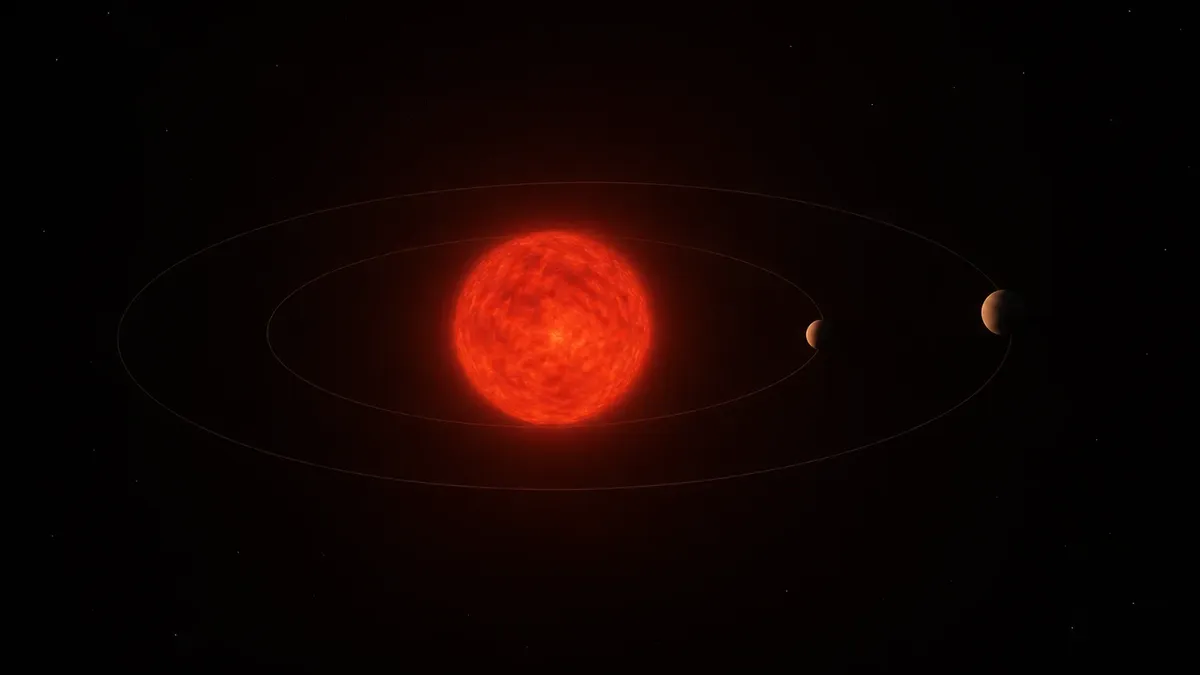
How do small planets around M-dwarf stars fit into the story of planetary systems as they age? A preprint reports two planets orbiting TOI-2079, an M dwarf with a well-determined estimated age of 1–2 billion years. The authors describe it as the first multi-planet M-dwarf system with super-Earth-sized planets and an age established within that range.
A two-planet system around a young star
TOI-2079 is an M-type star estimated to be 1–2 billion years old. In a preprint, A. Peláez-Torres and colleagues report two planets orbiting it. They describe the system as the first multi-planet system around an M dwarf with super-Earth-sized planets and a well-determined age in this range.
The inner planet, TOI-2079 b, completes an orbit every 1.492 days; the outer planet, TOI-2079 c, takes about 9.317 days. Their reported radii are 1.320 and 1.671 times Earth’s radius, respectively. “Super-Earth” describes a size category. It does not establish that either planet resembles Earth in composition or conditions.
How the team assessed the signals
The researchers characterized the host star using spectroscopic observations. Their analysis classifies TOI-2079 between M1.5 and M3.5, with an effective temperature of 3,695 kelvin. They also report a stellar rotation period of about 17.33 days.
To assess whether the planet signals might have other astrophysical explanations, the team combined multiple ground-based follow-up observations with a validation procedure. The abstract reports that this work ruled out possible astrophysical false-positive scenarios and validated both objects as planets. The supplied abstract does not provide enough detail to assess the procedure or its evidence independently.
The planets’ estimated equilibrium temperatures are 867 kelvin for TOI-2079 b and 473 kelvin for TOI-2079 c. These are reported estimates, not direct measurements of surface temperatures. The abstract does not establish whether either planet has an atmosphere or describe its surface conditions.
What the finding can tell us
A system with two small planets and a reported age of 1–2 billion years gives researchers a case for studying planets around a comparatively young M dwarf. The reported properties establish the planets’ orbital periods and estimated sizes and temperatures; they do not, on their own, reveal how the planets formed, whether they are rocky, or how their properties have changed over time.
The “first” description should also be understood as the authors’ framing of the system. The evidence available for this article is the paper’s abstract, not its full text, so the underlying comparison and its scope cannot be checked here.
That source limitation matters for the reported results, too. Without the full paper, the methods, data, uncertainty analysis and discussion cannot be examined in detail, and the measurements and validation cannot be independently assessed from the supplied material. The paper is an arXiv preprint; its availability there does not establish that it has been peer reviewed. These findings are best read as the authors’ reported results, subject to fuller evaluation.
- TOI-2079
- exoplanets
- M dwarfs
- super-Earths
- planetary systems
- astronomy
Related reading
Automatically matched by shared topic keywords. These links do not imply that the sources agree or establish a consensus.
Gaia links outer companions with small planets
Source published
Shared keywords: super earths
Stellar spin clocks suggest small planets keep changing for billions of years
Source published
Shared keywords: super earths
Why Near-Resonant Planet Systems Can Be Less Ordered
Source published
Shared keywords: planetary systems