TRANSMISSION // 2611.27521v1
Testing Vision-Language AI Across Seven Languages
Source published
PaMuk-Bench compares vision-language models across English and six translated languages, finding that fine-tuning often improves non-English results—but does not close every gap.
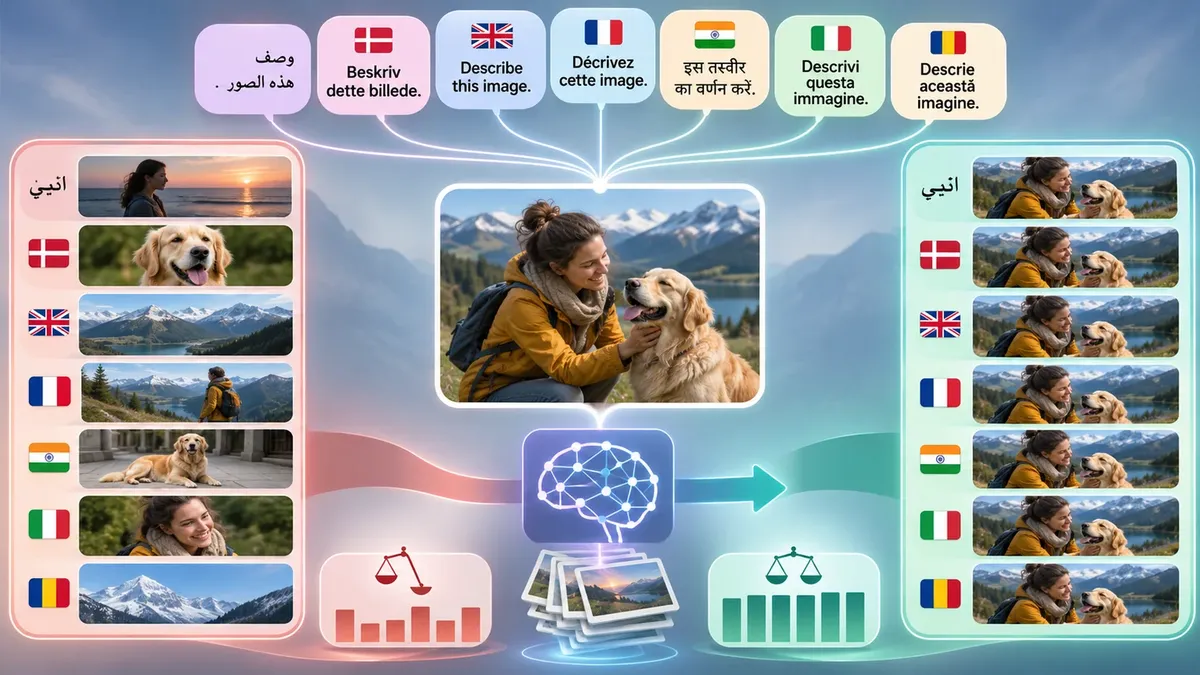
A model may describe an image or find it in a collection when asked in English, yet struggle when the same request is translated. PaMuk-Bench gives researchers a shared way to test that difference across several vision-and-language tasks. Its early results point to a broad benefit from language-specific fine-tuning, with important limits on what the benchmark can establish.
A vision-language model can be asked to describe a photograph, find an image matching a phrase, or create a picture from a written prompt. But does it perform these tasks equally well when the prompt is in a language other than English? And can additional training on examples in that language narrow any gap?
A new benchmark, PaMuk-Bench, is designed to help researchers investigate those questions. It pairs equivalent prompts across seven languages and covers five tasks: generating images from text, captioning images, retrieving images from text queries, and estimating how difficult prompts will be for image generation or retrieval. In experiments reported in a preprint, the authors found that performance often fell when models moved from English to other languages, while fine-tuning on language-specific benchmark data usually improved results.
A shared test across languages
PaMuk-Bench starts with 10,200 English prompts drawn from PQPP, a benchmark built from prompts associated with MS COCO and DrawBench. Each prompt has versions in Arabic, Danish, French, Hindi, Italian and Romanian, making 71,400 prompts in total. Because each language version corresponds to the same English prompt, researchers can compare how a model handles equivalent requests rather than unrelated collections of text.
The translations were produced through a semi-automatic process. Machine translation systems proposed versions; when a set of proposals met the authors’ agreement rule, the selected translation could be used without human review. Other prompts were reviewed or translated by proficient speakers. The paper reports that 49,505 prompts were manually handled and 11,695 passed the machine-translation voting process. The authors also describe checking sample translations against human translations and comparing multiple Romanian annotators on a shared set.
The prompts are linked to natural images from MS COCO and generated images from SDXL and GLIDE, along with relevance judgments and difficulty annotations inherited from the source benchmark. The researchers use the same training, validation and test split across languages. For fine-tuning, they generally use LoRA, a method that adapts a model by training smaller added components rather than changing all its original weights.
What the experiments found
The team evaluated models suited to each task, comparing zero-shot performance—using a pre-trained model without task-specific training on PaMuk-Bench—with performance after fine-tuning. Across the five tasks, the overall pattern was that non-English prompts often led to weaker results than English prompts. The gap appeared even for some models with multilingual pre-training, though its size and consistency varied by model and task.
Fine-tuning on the benchmark’s language-specific training data improved results in many settings. For image generation, all tested models improved on every reported metric in the aggregate language comparison; for some models, the authors say the English-to-other-language gap was almost entirely recovered. Captioning and image retrieval also generally improved after fine-tuning. For the difficulty-prediction tasks, results were more mixed: some predictors were already relatively resilient to language changes, and fine-tuning did not help every model or metric equally.
The findings do not show that one training recipe fixes multilingual performance in general. They show that, for the tested models, tasks, languages and data, fine-tuning on parallel examples often narrowed the measured gap. The paper itself notes that the gap was not fully closed in every case.
What to keep in mind
PaMuk-Bench’s parallel structure makes comparisons easier, but its scope is limited. It covers six translated languages beyond English, not the full range of languages or dialects people use. Its prompts and annotations come from an existing English-language benchmark, so the test inherits that source’s choices about what to ask and which images or judgments to include. The authors also note that some languages require grammatical gender choices that the English prompts leave open; machine translation can carry biases into the resulting data.
Scores depend on the selected models, metrics and fine-tuning setup. Automated measures are not the same as human judgments of whether an image is useful or a caption is natural. Better benchmark scores after fine-tuning also do not establish that the same gains will transfer to other datasets, real-world use or languages not included here.
PaMuk-Bench is presented in an arXiv preprint, which should be treated as preliminary research rather than as settled evidence. Its value is chiefly as a reusable testbed: it gives researchers a way to compare languages on matched prompts and to examine whether adaptation helps, while leaving broader questions about language coverage and real-world performance open.
- vision-language models
- multilingual AI
- AI benchmarks
- image generation
- image captioning
- image retrieval
Related reading
Automatically matched by shared topic keywords. These links do not imply that the sources agree or establish a consensus.
Can AI solve riddles rooted in different cultures?
Source published
Shared keywords: ai benchmarks, multilingual ai
An image-caption evaluator adds uncertainty to its scores
Source published
Shared keywords: image captioning, vision language models
When AI says less, does it see better?
Source published
Shared keywords: image captioning, vision language models
Why image search can miss left and right
Source published
Shared keywords: image retrieval, vision language models
MMCOMET gives commonsense knowledge a visual anchor
Source published
Shared keywords: vision language models