TRANSMISSION // 2611.27516v1
PhiJEPA tests whether AI can infer hidden visual features
Source published
A two-stage image-learning method improves segmentation and simulated planning under some combinations of occlusion and blur, but its evidence is limited to controlled tests.
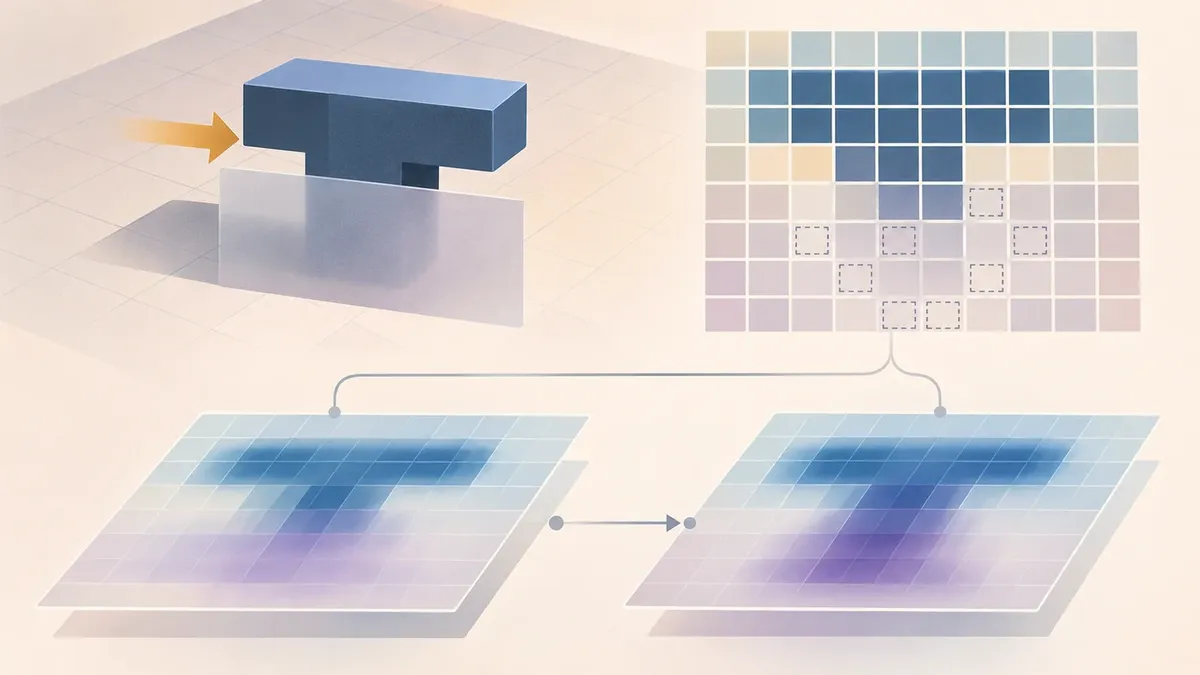
When part of an image is blocked or blurred, can a planning system still use the visible information effectively? PhiJEPA trains a vision model to predict features for hidden image regions, then reuses that predictor in a simulated planning task. The results are encouraging in specific settings, but do not show that hidden content can always be recovered.
A planner that relies on camera images may face blocked or degraded views. A robot arm could cover an object, for example, or blur could make its edges harder to distinguish. Makoto Yamada and Yao-Hung Hubert Tsai introduce PhiJEPA, a method for learning visual features that remain useful in some such conditions. Their study asks both whether the method improves image representations and whether a predictor learned during training can help a planner when an object is partly hidden.
PhiJEPA builds on joint-embedding predictive architectures (JEPAs). Instead of trying to reproduce every pixel, these models learn to predict a target image’s features—numerical summaries of visual content—from features extracted from visible parts. PhiJEPA adds two prediction stages and trains with photometric changes such as blur, colour shifts and noise.
During training, the image is divided into patches, and the student model sees only a sparse subset. A first predictor estimates features for hidden patches using the visible context, with its targets taken from a separately corrupted view of the same image. A token-wise network then maps those predictions toward features from the clean image. The authors’ design rationale is that independent corruptions may encourage predictions of content shared across views rather than reproduction of a particular distortion; the experiments do not by themselves establish that as the mechanism behind the results.
The researchers trained models on ImageNet-1K and tested their frozen features with classification and segmentation probes. They also placed the encoders in DINO-WM, a latent world model, for the simulated PushT task, in which an agent must push a T-shaped block. For PhiJEPA’s planning completion, both its pretrained first predictor and the token-wise CA1 head are used to estimate hidden features. This does not require fine-tuning, but it does require the occluded locations to be identified.
Segmentation results favored the two-stage design in the tested comparisons. On PASCAL VOC, PhiJEPA scored 69.3 mean intersection over union (mIoU), compared with 66.2 for the study’s Simple I-JEPA baseline. When the models predicted features for hidden regions from the same visible patches, a segmentation head read labels from PhiJEPA’s predictions at 49.1 mIoU, versus 44.3 for Simple I-JEPA. These scores measure semantic information accessible in the features; they are not direct measures of planning ability.
PhiJEPA also scored higher on PASCAL VOC segmentation than the evaluated I-JEPA and DSeq-JEPA checkpoints, with 25% fewer reported training FLOPs than the evaluated I-JEPA run. This is a comparison among particular checkpoints, not an equal-compute experiment: training schedules and setups differed, and some comparison costs were estimated. Performance was not uniformly better across tasks. For example, PhiJEPA performed less well than Simple I-JEPA in one classification test with a large image occluder.
Planning gains depended on the kind of image degradation. The world models were trained on PushT for 15 epochs, with the same schedule and batch size across the compared encoders. When the block was occluded and the starting view also had Gaussian blur at σ = 2 pixels, PhiJEPA’s planning success was 33% without completion and 65% when its pretrained predictor and CA1 head completed the hidden tokens. In this same combined test condition, Simple I-JEPA’s predictor reached 25%, while iBOT with pixel inpainting reached 40%. These figures describe this particular setup, not general performance across tasks. With occlusion alone, Simple I-JEPA’s predictor slightly outperformed PhiJEPA’s; with stronger blur plus occlusion, iBOT with inpainting did better than PhiJEPA.
There are important limits to the evidence. Planning was tested in one simulated environment, using synthetic occluders and three planning seeds per condition. The study did not measure variation across independently trained world models. It also used open-loop plans: the system executed a plan without replanning during the episode. Tests with natural or moving occluders, real robots and closed-loop replanning remain future work. The authors caution that when visible context cannot determine what is hidden, a predictor can produce plausible but incorrect features.
The work is available as an arXiv preprint; the supplied source does not establish its peer-review status. Its results suggest that a training-time predictor can be reused for feature completion and that two-stage prediction may help under selected conditions. They do not yet show reliable recovery of hidden objects in real-world settings.
- PhiJEPA
- computer vision
- self-supervised learning
- visual representations
- image occlusion
- robot planning
Reviewed cross-references
These connections were reviewed by a model, not independently fact-checked by a human. Similarity does not imply agreement; consult the original papers and the evidence below.
S-JEPA learns several possible answers to a hidden image region
Shared method: Both study JEPA-style prediction of masked image-region representations from visible context. PhiJEPA uses sequential predictors with independently corrupted and clean teacher targets, while S-JEPA models completion uncertainty with a stochastic latent; this is a shared masked latent-prediction approach, not evidence that their distinct objectives have equivalent effects.
Model review: · openai-codex/gpt-6-luna
Evidence and provenance
Selected excerpts, not complete papers. PDF extraction can omit figures or damage equations, tables and reading order; sources may be preprints.
2611.27516v1 — Original paper
Excerpt reference:
static/papers/2611.27516v1.md:159-203
Basis: Paper text
Source SHA-256:2125eeeaef7d5795c89d602f48ed1c58bd12ad12220e978d08617f3071e66f5f2611.09302v1 — Original paper
Excerpt reference:
static/papers/2611.09302v1.md:78-123
Basis: Paper text
Source SHA-256:a84447b581e019ee228eb3c95eec6adbf89ee206c34ddda717cc1aaa72f2a955
Related reading
Automatically matched by shared topic keywords. These links do not imply that the sources agree or establish a consensus.
LEF-JEPA targets object structure without preserving every visual detail
Source published
Shared keywords: computer vision, self supervised learning
S-JEPA learns several possible answers to a hidden image region
Source published
Shared keywords: computer vision, self supervised learning
How Event Cameras Learn Depth Without Dense Labels
Source published
Shared keywords: computer vision, self supervised learning
How robots can plan their own adaptations
Source published
Shared keywords: robot planning
When searching harder makes a robot worse
Source published
Shared keywords: robot planning