TRANSMISSION // 2611.27509v1
How Event Cameras Learn Depth Without Dense Labels
Source published
A self-supervised method predicts depth for individual camera events and estimates camera motion from their alignment, without dense depth labels for training.
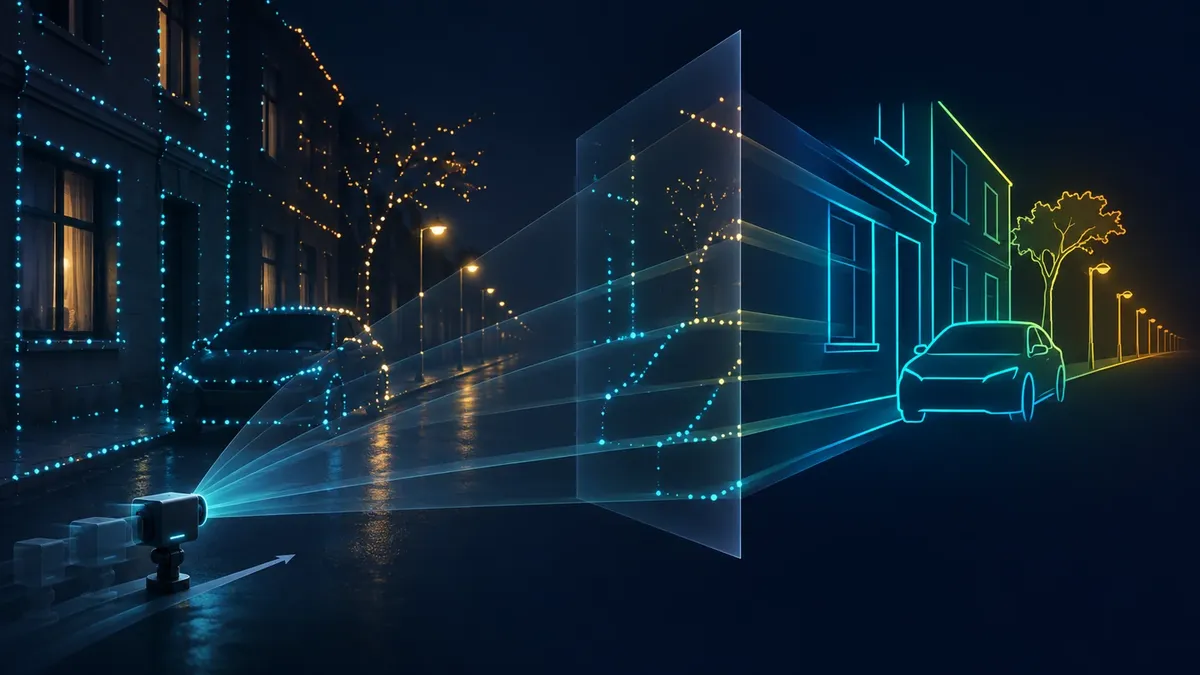
Event cameras record brightness changes as they happen, rather than taking conventional snapshots. A new method uses those precise timestamps to estimate scene depth and camera motion together, testing whether geometry inferred from events can explain how they move.
Why keep the timestamps?
An ordinary camera records images at set intervals. An event camera instead reports individual changes in brightness, with very fine timing. That can preserve useful information during rapid motion or in low light, but it creates a challenge for depth estimation: dense reference depth is costly to collect and is generally available only at selected moments, not for every event.
A common workaround is to bundle events into frames or other time-binned representations before learning. That makes the data easier to handle with familiar image-processing methods, but can discard some of the timing that makes event cameras distinctive. In this study, Sadiq O. Macaulay, Dipon Kumar Ghosh and Simon Hadfield ask whether event timing itself can help provide supervision for depth and camera-motion estimates.
Learning from alignment
The proposed method predicts a depth for each event, rather than assigning all events in a time window the same depth map. It also estimates the camera’s motion over that window. Using predicted depth and the camera’s estimated position when an event occurred, the system projects the event into three-dimensional space and moves it to a shared time and viewpoint.
The geometric intuition is straightforward: events produced by the same visible edge should line up after the motion is accounted for. If they spread out instead, the depth estimate, the motion estimate, or both may be wrong. The researchers turn this alignment into a training signal, avoiding dense depth labels as training targets.
The model combines a sequence-processing component, which tracks temporal context, with a local component that represents relationships between nearby events in the image. A differentiable renderer gathers the per-event estimates into depth maps at chosen times. Its occlusion-aware procedure is designed to avoid blending measurements from different surfaces, such as a foreground edge and the background behind it. Pixels without supporting warped events are left empty: the method does not claim to measure depth where the event stream provides no support.
This does not mean the method uses no image information. When an endpoint intensity image is available, the training objective includes an edge-aware smoothness regularizer based on that image. The paper says the image is used to weight this regularizer, not as an encoder input or a source of metric depth.
The approach also predicts camera motion from the same event data. In the experiments, motion is represented as a constant six-degree-of-freedom velocity over each 50-millisecond window, with rotation and translation interpolated within the window.
What the tests found
The team evaluated the method on MVSEC, a dataset containing synchronised event streams, images, depth, camera poses and calibration. Training used one outdoor daytime sequence; quantitative testing used another daytime sequence and three nighttime sequences. Metric depth was held back for evaluation, not used as the training target. The main comparisons were against event-only self-supervised approaches.
Across the reported distance ranges, the method had the lowest error among those event-only comparisons at the 20-metre cutoff, and at three of four cutoffs each for 10 and 30 metres. The paper reports its largest margins in nighttime tests. One prior method that used intensity-frame information during training was included as a separate cross-modal reference, not in the event-only ranking; its errors were lower than the new method’s in the reported comparisons.
The motion results are more limited. Against an earlier method that reported comparable measurements, the new approach had a lower rotation error on the daytime test sequence, while translation-direction error was similar. The authors note that this comparison is influenced by a vehicle-motion prior used by their system. The earlier method did not report results for the nighttime sequences, so the paper does not establish a nighttime comparison with it.
Ablations—tests that remove or change parts of a system—suggest that both local spatial context and the event-alignment objective matter for depth accuracy. The paper also reports that its sequence model processes the tested windows faster than recurrent alternatives evaluated at a matched parameter budget. These findings apply to the study’s experimental setup, not necessarily to other hardware or datasets.
What remains uncertain
The method assumes a mostly static scene and smooth camera motion within a short window. The authors removed parts of the training sequence with considerable independent object motion, although moving objects were included in testing. The method also relies on calibrated, synchronised sensors. Its depth maps are supported only where events land, and qualitative examples show that distant street structure can be placed too close.
The evaluation is limited to MVSEC and a particular training-and-testing arrangement. Before calculating reported errors, predictions are aligned to reference depth using a single median scale factor, reflecting the global scale ambiguity of self-supervised monocular depth estimation. The results therefore do not establish fully scale-accurate depth in an uncalibrated deployment.
The work is available as an arXiv manuscript. The evidence summarized here does not establish its peer-review status. Its results suggest that event-by-event geometric alignment can support depth and motion estimation, but evaluation on other datasets and settings would help clarify how broadly the approach works.
- event cameras
- depth estimation
- ego-motion
- self-supervised learning
- computer vision
Related reading
Automatically matched by shared topic keywords. These links do not imply that the sources agree or establish a consensus.
ADEPT lets a depth model help tune its camera
Source published
Shared keywords: computer vision
A 360-degree image can map a room—but not every surface
Source published
Shared keywords: computer vision, depth estimation
LEF-JEPA targets object structure without preserving every visual detail
Source published
Shared keywords: computer vision, self supervised learning
S-JEPA learns several possible answers to a hidden image region
Source published
Shared keywords: computer vision, self supervised learning
Learning from unlabelled smart-glasses signals improves facial-expression recognition
Source published
Shared keywords: self supervised learning