TRANSMISSION // 2611.27508v1
Changing accretion, similar X-ray temperatures
Source published
NuSTAR observations of IGR J19552+0044 reveal changing accretion onto a white dwarf and hard-X-ray reflection. The fitted maximum plasma temperature showed no significant change across the observation.
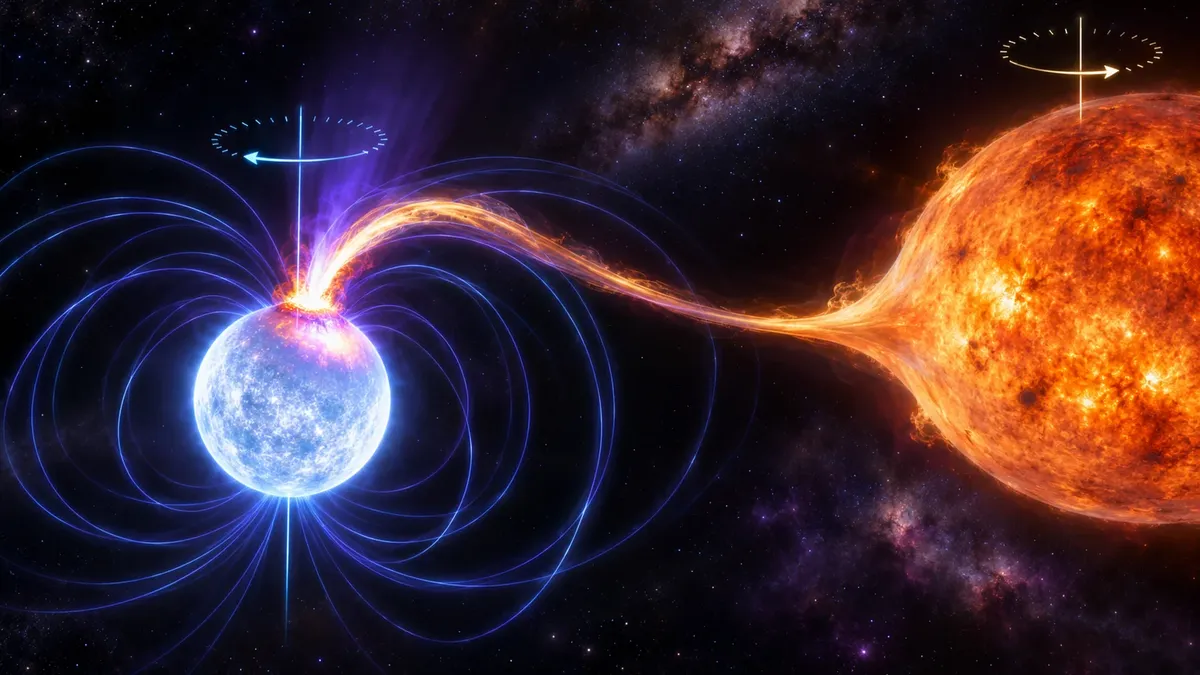
A white dwarf in IGR J19552+0044 spins slightly out of step with its orbit. NuSTAR’s hard-X-ray observations let researchers examine how the accretion flow changes—and whether the fitted temperature of the resulting hot gas changes with it.
In some close binary stars, a white dwarf pulls gas from a companion. If the white dwarf has a strong magnetic field, the gas can be guided toward its magnetic poles, where it crashes into the star and heats up enough to emit X-rays. IGR J19552+0044 is an “asynchronous polar”: its white dwarf’s spin is not quite synchronized with the binary orbit. This mismatch produces a repeating beat pattern as the magnetic field’s orientation shifts relative to the incoming gas stream.
Akash Agarwal and Vikram Rana used NuSTAR, a space telescope that observes X-rays, to investigate how changing accretion relates to the hot region above the white dwarf’s surface. Their study analyzes one observation, taken in March 2024. It lasted about 107,000 seconds, but interruptions reduced the useful exposure to 53,400 seconds. The observation covered about 61% of the system’s roughly two-day beat cycle, rather than a complete cycle.
Reading the X-ray spectrum
The team analyzed NuSTAR’s two detector modules together and fitted models to the system’s X-ray spectrum. Their main model represented a cooling flow with a range of gas temperatures, rather than treating the emitting gas as having just one temperature. They also included modeled absorption, an iron emission line, and hard X-rays reflected from the white dwarf’s surface.
Reflection leaves telltale features: an iron line near 6.4 kiloelectronvolts and a broad excess, or “hump,” at higher energies. Including reflection improved the fit. From the modeled spectrum, the researchers estimated a maximum plasma temperature of about 44.5 keV. Because this temperature is linked to the white dwarf’s gravitational pull, it can help estimate the star’s mass. The resulting estimate is about 0.88 times the Sun’s mass; allowing for effects that could make the estimate too low, the authors give a lower limit of 0.85 solar masses.
The spectrum also yielded an average accretion rate of about 3 × 10⁻¹¹ solar masses per year. The authors inferred a shock height of roughly 0.3 times the white dwarf’s radius from the strength of the reflection signal. This is not a direct measurement: it depends on the model and the assumed viewing angle of the reflecting surface. The paper reports that varying the assumed angle gives a broader range, about 0.14 to 0.57 white-dwarf radii.
The flow changes; fitted temperatures are similar
The X-ray brightness varied during the observation. The researchers divided the data into three time intervals and fitted each separately. The fitted model normalization—a quantity related to the amount of emitting material and, in their interpretation, the accretion rate—varied by a factor of about 4.5. In contrast, the fitted maximum plasma temperatures in the three intervals were consistent with one another within their uncertainties. The hardness ratio, which compares higher- and lower-energy X-rays, also showed no significant change.
The authors interpret the changing X-ray output as evidence for a “magnetic valve.” In this proposed mechanism, changing alignment between the white dwarf’s magnetic field and the gas stream can raise or reduce the rate at which matter reaches the star. X-rays from the hot accretion region offer a way to track changes in the flow. But this observation samples only part of the beat cycle, and the result is evidence consistent with the mechanism, not a direct view of gas moving through the system.
Why might the fitted temperature show no significant change as the inferred accretion rate varies? In a simple picture, a lower flow rate could make the shock taller, which would tend to lower its temperature. The authors suggest that the area on the white dwarf receiving the gas may also change. If the flow becomes concentrated onto a smaller area as its overall rate falls, the local rate per unit area—and potentially the shock structure—could remain more stable. This is a possible explanation, not something the observation directly measures. The magnetic-field strength is also not known precisely enough to assess its role in cooling the shock.
The findings combine spectral measurements with model-dependent deductions. In particular, reflection strength and inferred shock height are entangled with viewing geometry, while changes in the accretion area are proposed rather than observed. A longer observation covering a full beat cycle, alongside measurements that better constrain the geometry and magnetic field, could help test these interpretations.
This account is based on the authors’ November 2026 arXiv preprint, a draft that may not have been peer reviewed. The results describe one NuSTAR observation; they do not establish how the system behaves throughout every beat cycle.
- IGR J19552+0044
- white dwarfs
- NuSTAR
- hard X-rays
- asynchronous polars
- magnetic accretion
- X-ray reflection
Related reading
Automatically matched by shared topic keywords. These links do not imply that the sources agree or establish a consensus.
A white dwarf’s two clocks in 47 Tuc
Source published
Shared keywords: asynchronous polars, white dwarfs
Weighing a magnetic white dwarf through hot gas and a companion’s motion
Source published
Shared keywords: white dwarfs
Did two stars become one? Clues from the heaviest white dwarfs
Source published
Shared keywords: white dwarfs
Planetary debris leaves hydrogen behind in white dwarf atmospheres
Source published
Shared keywords: white dwarfs
Small white dwarf explosions could resemble the faintest Type Iax supernovae
Source published
Shared keywords: white dwarfs