TRANSMISSION // 2611.27486v1
Why quantum machine-learning models can lose sensitivity
Source published
A comparison of three quantum machine-learning approaches finds that richer circuits can make measured outputs less responsive to input differences. Bandwidth scaling helps in some settings, but not all.
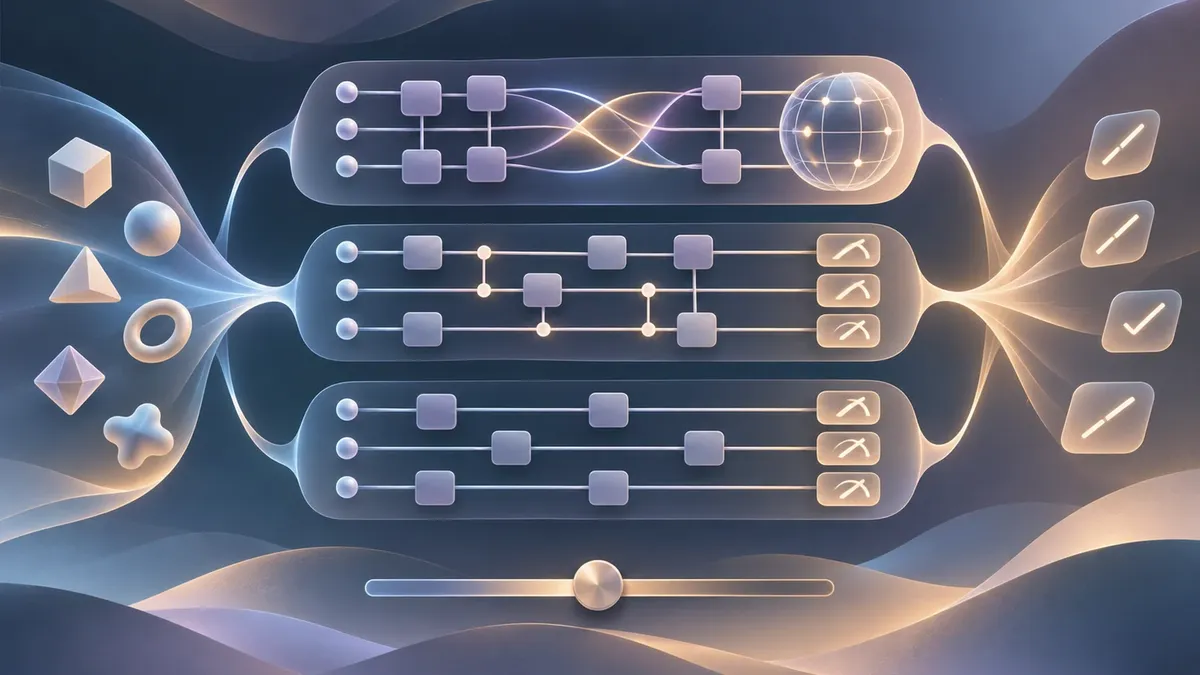
Quantum circuits can represent information in vast mathematical spaces—but that does not guarantee their measurements will distinguish one input from another. A study of three quantum machine-learning approaches examines when measured values become less variable and whether scaling inputs can limit that effect.
In quantum machine learning, a circuit transforms data into a quantum state, and measurements turn that state into numbers a learning algorithm can use. A potential problem is exponential concentration: as a system grows, measurements across different inputs may yield increasingly similar values. The authors use declining variation in measured values as an indicator of concentration, which may make inputs harder to distinguish and increase the measurements needed to resolve differences.
Fernando Mondragon-Sampedro and Diego Alvarez-Estevez compare this effect in three approaches: Fidelity Quantum Kernels (FQK), Projected Quantum Kernels (PQK), and Quantum Extreme Learning (QEL). They ask how measurement design, entanglement and circuit complexity relate to concentration—and whether changing the scale of encoded inputs can reduce it.
A shared way to study concentration
The authors compare the approaches using the variance of observable expectation values across inputs. In plain language, they measure how much a quantity produced by the circuit varies across the dataset. In this study’s framework, lower variance indicates stronger concentration. It is used as a proxy for reduced sensitivity to input differences, not as a direct measure of learning performance.
FQK compares quantum states using their fidelity, or overlap. The authors represent this kernel value as the probability of a particular measurement outcome: a global measurement involving the full system. PQK methods generally construct features from local observables on selected subsets of qubits; in these experiments, the authors measure single-qubit Pauli observables. QEL also uses measured features, but first evolves the encoded state through a fixed quantum circuit, called a reservoir, before a classical model processes the results.
The researchers ran ideal, noiseless simulations on a synthetic dataset of 1,000 points, generated from a two-dimensional manifold embedded in 30 dimensions. They used principal component analysis to reduce the data to match the qubit count in each experiment. Their three tested encodings were a single-qubit RZ-rotation Z map, which introduces no entangling operations; a ZZ map with two-qubit ZZ interactions; and a 3D+CNOT map combining rotations and CNOT gates.
They varied the number of qubits and, for QEL, the reservoir’s depth and number of auxiliary qubits. They also tested bandwidth scaling: multiplying input values by 0.1 before encoding. Simulations used 1,000 measurement shots. The paper reports 30 repetitions per configuration for the kernel methods and three for QEL.
What the comparison found
For FQK, measured variance fell as the number of qubits increased across all three encodings. The ZZ map showed the fastest concentration. Scaling the inputs mitigated concentration for the Z and 3D+CNOT maps within the explored range, but the ZZ map continued to show it.
For PQK, the results depended on the encoding. The tested Z map showed no clear exponential concentration in the explored range. The ZZ and 3D+CNOT maps both showed variance declining as qubit count grew, though the paper reports different patterns across their observables. Scaling slowed the decline in configurations already prone to concentration, but did not eliminate it. With the scaled ZZ map, all measured observables ultimately showed concentration.
QEL results depended on both encoding and reservoir complexity. Shallow, less expressive reservoirs showed patterns resembling PQK, while deeper random reservoirs produced stronger concentration across the tested encodings. In these experiments, increasing reservoir depth had a stronger effect than adding auxiliary qubits alone. Bandwidth scaling had weaker effects in QEL than in the kernel approaches, and deep reservoirs showed similar concentration patterns with and without scaling.
Overall, the tested local-measurement approaches showed that locality can mitigate some concentration effects but does not guarantee stable sensitivity. Scaling also helped in some moderate settings, yet its effect weakened as circuit expressivity increased. This suggests a design trade-off: restricting expressivity may stabilize measured features, but could also limit the complexity of the representation.
What remains uncertain
These results do not show that one approach learns better on real-world tasks or achieves a quantum advantage. The experiments use one synthetic dataset, ideal noiseless simulations and system sizes the authors describe as classically tractable. They measure observable variance, not downstream classification or generalization performance. The authors also note that other datasets, observables, noise conditions and larger systems could produce different results.
This account is based on the paper text for an arXiv preprint, which is not necessarily peer-reviewed. The findings provide evidence about the configurations tested, not a universal rule for quantum machine learning. Whether these design choices improve useful learning tasks remains an open question.
- quantum machine learning
- exponential concentration
- quantum kernels
- quantum extreme learning
- quantum circuits
- bandwidth scaling
Reviewed cross-references
These connections were reviewed by a model, not independently fact-checked by a human. Similarity does not imply agreement; consult the original papers and the evidence below.
Can fractal dimension help choose quantum-kernel width?
Supporting evidence: Both studies report that reducing encoding bandwidth can delay concentration in the settings they tested: Mondragon-Sampedro and Alvarez-Estevez report reduced concentration in moderate regimes, while Appel reports that shrinking the angle scale moves the one-layer ZZ-kernel collapse point later. This supports only a bounded connection, not a general guarantee: the first study used a single synthetic dataset and noiseless, classically tractable simulations and did not assess downstream learning performance; the second reports simulator results and a small hardware experiment in an arXiv preprint.
Model review: · openai-codex/gpt-6-luna
Evidence and provenance
Selected excerpts, not complete papers. PDF extraction can omit figures or damage equations, tables and reading order; sources may be preprints.
2611.27486v1 — Original paper
Excerpt reference:
static/papers/2611.27486v1.md:15-95
Basis: Paper text
Source SHA-256:35a8e8c8ba0e00bfe2fededff7ee70a453425d735589b1ed7cb2e2bc91cfb34e2611.27486v1 — Original paper
Excerpt reference:
static/papers/2611.27486v1.md:886-916
Basis: Paper text
Source SHA-256:35a8e8c8ba0e00bfe2fededff7ee70a453425d735589b1ed7cb2e2bc91cfb34e2609.00475v3 — Original paper
Excerpt reference:
static/papers/2609.00475v3.md:13-46
Basis: Paper text
Source SHA-256:1c9cf96dea46db5ac34b2b8d978584f384126fb0caf8b71b8ef9fc6213d4af3f
Related reading
Automatically matched by shared topic keywords. These links do not imply that the sources agree or establish a consensus.
Choosing a quantum data encoding, with help from an agent
Source published
Shared keywords: quantum kernels, quantum machine learning
Can fractal dimension help choose quantum-kernel width?
Source published
Shared keywords: quantum kernels, quantum machine learning
Selecting training examples for quantum machine learning
Source published
Shared keywords: quantum circuits, quantum machine learning
A lean new layer could help quantum neural networks learn more
Source published
Shared keywords: quantum circuits, quantum machine learning
A feature-aware search for quantum data encodings
Source published
Shared keywords: quantum circuits, quantum machine learning