TRANSMISSION // 2611.27483v1
Turning Factory Event Logs Into Simulations With AI
Source published
GenAI4SimPy uses a locally run language model and human review to turn manufacturing event logs into SimPy simulations. A three-block test found good activity-time estimates, but also showed that accurate parameters alone do not guarantee realistic system behavior.
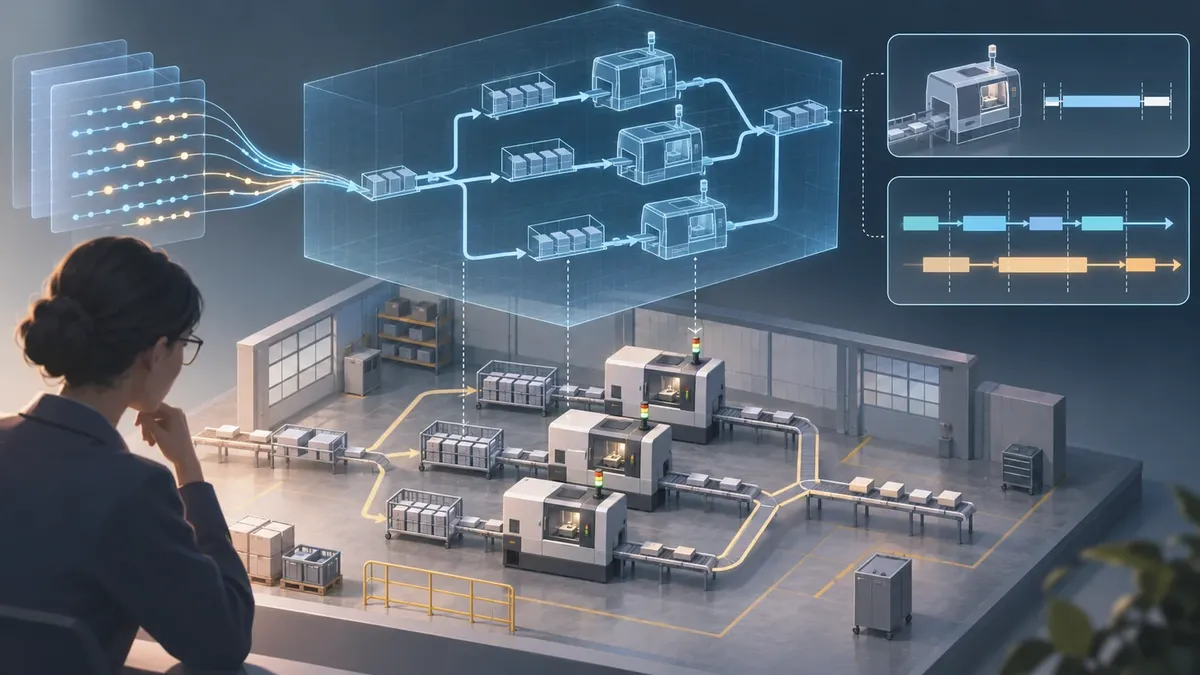
Could AI help smaller manufacturers build simulations from the data their factories already collect? GenAI4SimPy offers an early test of that idea—and reveals why a model that runs, or estimates individual process times well, may still misrepresent the factory as a whole.
Discrete-event simulation (DES) lets researchers and manufacturers explore how a production system might behave: where queues form, how busy equipment becomes, or what happens when processes change. But building such a model can require specialized knowledge and software. The authors of a new study ask whether an AI system can turn factory event logs into working simulations, while keeping the data and model local rather than sending them to a cloud service.
Their prototype, GenAI4SimPy, uses Qwen 3.6, an open-weight language model with 27 billion parameters. It divides the task among agents that analyze data, infer the factory’s structure, estimate process parameters and generate simulation code for SimPy, a Python library. Purpose-built tools handle statistical calculations and data exploration, rather than asking the language model to interpret the entire raw log in its text window.
The workflow also includes human review. At each of four stages, the system creates a report and waits for a user to confirm it before proceeding. In the study’s evaluation runs, the researchers prepared context prompts in an initial pilot, then ran the full pipeline without further human input. The paper says this preparation was limited to clarifying how to interpret the data; it was not intended to supply simulation-modeling decisions.
The test used three time-bounded blocks from a public Fischertechnik smart-factory dataset. Each block represented activity on a different recording day. The system inferred resources, product routes and process timings, then produced an executable model. The researchers compared the simulations with the logged operation using measures including activity duration, failure rate, throughput and flow time. Each simulation was run 30 times to assess variation.
One result was encouraging: the mean absolute percentage error for activity-duration estimates was 7.9% across the three blocks. Failure-rate estimates fell within the study’s coverage criterion in all three, and throughput did so in two. But results varied sharply by block and metric. In Block A, simulated throughput was 500% above the observed count. In Block C, mean flow time was underestimated by 38.7%. These differences matter because matching individual machine times is not the same as reproducing the behavior of an interconnected production system.
The authors call this gap a “micro–macro fidelity paradox.” Errors in inferred routes, arrival timing or the interpretation of incomplete records can change queues and resource contention, even when estimated processing times are reasonably close. In particular, the system sometimes treated activities missing from records as optional when cases had actually been cut off at the observation-window boundary. It also made other structural mistakes, such as changing the order of steps or simplifying routes. The paper argues that parameter extraction is necessary, but not sufficient, for a behaviorally faithful simulation; system-level calibration against aggregate measures is still needed.
There are important limits to what this demonstration establishes. It evaluates one model and one framework on three blocks from a single public dataset, with one end-to-end run per block. The authors themselves call it a proof of concept and identify tests across more datasets, models and repeated runs as priorities. The local setup also required about 56 GB of graphics memory, a substantial hardware requirement that complicates claims of affordability for smaller firms. Human review did not catch all the errors, and the paper proposes stronger behavioral checks and independent evaluation as next steps.
The work is presented in the proceedings of the 2026 Winter Simulation Conference, and the authors provide source code and results online. The available source describes a limited benchmark evaluation, not evidence that the approach is ready for unsupervised industrial decisions or generalizes across factories. Its clearest contribution is a practical warning alongside a promising workflow: AI can help translate logs into simulation code, but a working model still needs to be checked against how the whole system behaves.
- discrete-event simulation
- manufacturing
- event logs
- SimPy
- agentic AI
- open-weight language models
- simulation validation
Reviewed cross-references
These connections were reviewed by a model, not independently fact-checked by a human. Similarity does not imply agreement; consult the original papers and the evidence below.
AI agents can build factory simulations—but running successfully does not mean being right
Supporting evidence: Both studies show that checking extracted parameters or confirming a model runs is not enough to establish behavioral fidelity: Reider et al. report system-level KPI errors despite accurate process-level parameters, while Pernas-Álvarez and Crespo-Pereira report silent errors in models that build and run. Their manufacturing settings and validation approaches differ, so this supports the bounded point that behavioral comparison against independent references or observed outcomes is important, not a direct performance comparison.
Model review: · openai-codex/gpt-6-luna
Evidence and provenance
Selected excerpts, not complete papers. PDF extraction can omit figures or damage equations, tables and reading order; sources may be preprints.
2611.27483v1 — Original paper
Excerpt reference:
static/papers/2611.27483v1.md:574-616
Basis: Paper text
Source SHA-256:7c70b1cd1f871aec2fc34a27b305f22ed20792b5cc708935be7a0b55fc2968af2611.10602v1 — Original paper
Excerpt reference:
static/papers/2611.10602v1.md:2427-2497
Basis: Paper text
Source SHA-256:a1d3cb74484c20c1d168d33eaf9a5351547405825c5e855507978f842300e522
Related reading
Automatically matched by shared topic keywords. These links do not imply that the sources agree or establish a consensus.
AI agents can build factory simulations—but running successfully does not mean being right
Source published
Shared keywords: discrete event simulation
A Python toolkit for building and testing supply-chain simulations
Source published
Shared keywords: discrete event simulation
A defense that lets an AI answer—and makes the answer unreliable
Source published
Shared keywords: open weight language models
AI claims-analysis preprint tests policy citations and privacy safeguards on synthetic data
Source published
Shared keywords: agentic ai
AI can do the work—but surveyed users still want a say
Source published
Shared keywords: agentic ai