TRANSMISSION // 2611.27467v1
Why computer-savvy AI struggles with a real keyboard
Source published
ROSWORLD tests whether models can turn desktop know-how into physical keyboard and mouse actions, tracing missed presses and other execution failures.
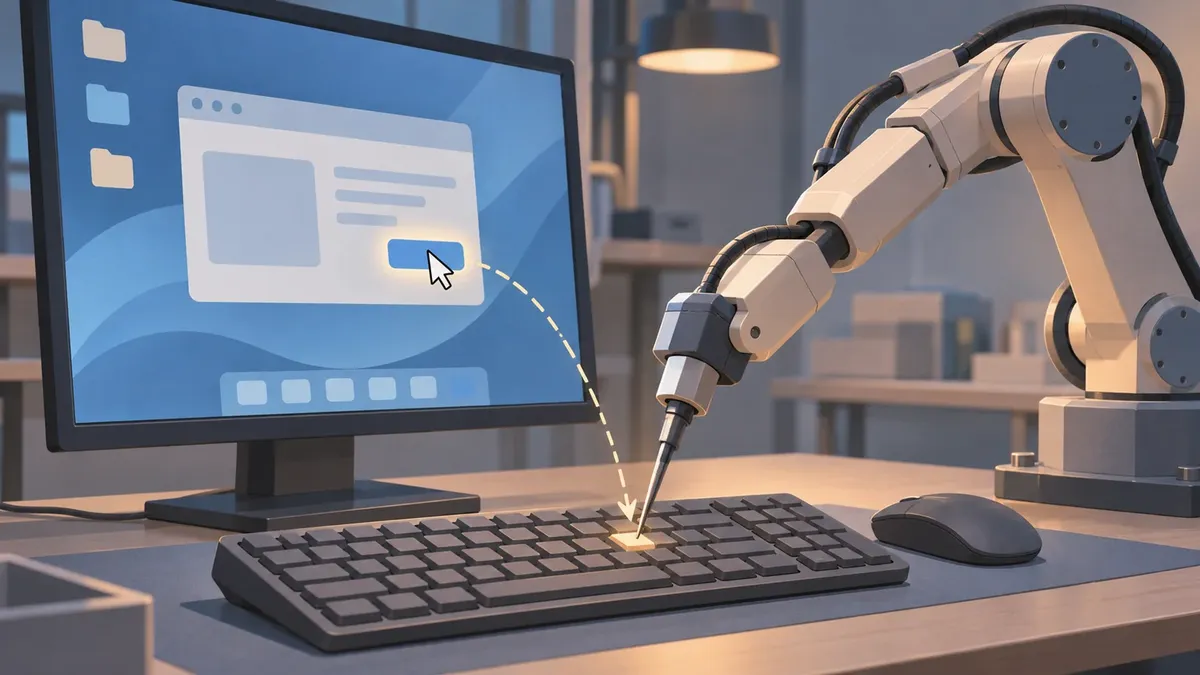
An AI can know which menu to open and still fail to press the right key. ROSWORLD tests that gap by asking models to complete familiar computer tasks through simulated robot arms or hands, rather than direct software controls.
Knowing the steps is not the same as doing them
A computer-use agent can open menus, edit files and navigate applications by sending keyboard and mouse commands directly to software. But a robot using the same computer has to turn an intended input into physical contact: locate the key, press it far enough, then check whether the screen changed as expected. A small mistake can alter what needs to happen next.
That distinction is the focus of ROSWORLD: When Digital Task Competence Meets Physical Execution, a preprint presenting a benchmark for comparing digital computer use with robot-operated peripherals. The question is how much of a model’s desktop-task performance carries over when it must act through a robot.
A desktop connected to simulated robot contact
The researchers linked a physically simulated workstation to a live OSWorld desktop. Contact with the keyboard and mouse generates input for the desktop, whose updated screen appears on the workstation monitor. The model receives workstation camera images, robot status, and measurements such as joint and tool poses and contact forces. It does not receive key coordinates or direct commands to operate the desktop.
Five models attempted the same 40 tasks across ten application domains. Researchers compared direct desktop input with two simulated embodiments: a single arm with a rigid probe, or dual arms fitted with dexterous hands. Runs used shared task definitions and official outcome evaluators, but the observation and action interfaces differed between desktop and robot conditions. The comparison therefore measures performance across these complete setups; it does not isolate one cause for the performance gap. Each run allowed up to 100 model decisions, including decisions spent positioning and recovering.
The team also analyzed trajectories, device events and application outcomes. This made it possible to compare what a model intended, what the robot caused the keyboard or mouse to register, and what happened in the software.
The physical gap—and where it appears
On the desktop, the models completed 31–39 of the 40 tasks. With the probe, they completed zero to 23; with the hands, zero to 28. GPT-6 Astra completed 23 tasks with the probe and 28 with the hands, while Claude Opus 5.5 completed 11 and three, respectively. Two other models completed no tasks in either physical setup. These figures describe this benchmark, not general intelligence or every form of computer use.
The route analysis needs a qualification: it covers runs that reached the corresponding OSWorld operation. Among those, many operations were attempted through a different input method, often replacing mouse actions with keyboard actions. Across all 400 paired model-task comparisons, however, none reproduced every OSWorld operation unchanged.
The hands enabled more attempted and delivered key combinations than the probe, which cannot hold one key while pressing another. But the hands did not reliably deliver every attempted combination, and mouse input remained rare in both robot setups. More dexterity did not consistently mean more completed tasks: outcomes varied by model.
The most common operation-level fault was a missed input: an intended press that produced no device event. Other problems included pressing a wrong or neighboring key, accidental contact by another part of the robot, and keys held long enough to repeat. One illustrated probe attempt touched a key but moved it only 1.4 millimetres—short of the 2-millimetre actuation threshold. That example shows one way a press can fail, not the cause of every miss. In another example, the robot’s forearm pressed keys while the model moved the probe. Some intended keys were registered but did not produce the expected software change because the application state differed from what the model assumed.
Of 304 failed episodes, 239 exhausted the 100-decision budget. Among those budget-exhausted runs, 217 made no new OSWorld-route progress in their final 20 decisions, and 166 included at least three consecutive failed attempts at the same target. The result highlights how physical execution, feedback and recovery can all matter—not just selecting a plausible sequence of computer operations.
What the benchmark can—and cannot—show
ROSWORLD’s paired goals and event records offer a way to inspect where an end-to-end attempt breaks, rather than treating every failed task as the same kind of error. The authors suggest that training could benefit from examples involving contact, near-misses, awareness of the whole robot body and checks that confirm an action worked. Those are implications proposed by the paper, not outcomes tested by the benchmark.
The robot workstation is simulated, even though it interacts with a live desktop. The study covers 40 selected tasks, five models and two simulated robot configurations, so its results may not carry over to other tasks, models or devices. It also cannot establish how the same systems would perform on physical hardware.
This is an arXiv preprint; the supplied source does not establish whether it has been peer reviewed. Its findings are best treated as a benchmark result to scrutinize and test further, rather than a settled measure of real-world robot capability. The narrower takeaway is that success through software input does not guarantee reliable reproduction through physical contact.
- ROSWORLD
- robotics
- computer-use agents
- embodied AI
- OSWorld
- robot manipulation
- AI benchmarks
Reviewed cross-references
These connections were reviewed by a model, not independently fact-checked by a human. Similarity does not imply agreement; consult the original papers and the evidence below.
Robot-coding agents need better failure diagnosis, not just more feedback
Supporting evidence: Both studies report difficulties translating intended or observed information into reliable physical behavior: ROSWorld’s paired trajectories show desktop task routes but frequent execution failures such as missed presses and unintended contacts; the controlled manipulation study finds agents often fail to turn feedback and spatial information into effective policy updates. This is complementary evidence, not a direct replication: the tasks, agents and evaluation settings differ, and the supplied excerpts are selective preprint material.
Model review: · openai-codex/gpt-6-luna
Evidence and provenance
Selected excerpts, not complete papers. PDF extraction can omit figures or damage equations, tables and reading order; sources may be preprints.
2611.27467v1 — Original paper
Excerpt reference:
static/papers/2611.27467v1.md:76-165
Basis: Paper text
Source SHA-256:0f329d71e06589f33e6805dd8279fe1102d6b9bc76724272b9ca3a26559712d62611.27467v1 — Original paper
Excerpt reference:
static/papers/2611.27467v1.md:166-244
Basis: Paper text
Source SHA-256:0f329d71e06589f33e6805dd8279fe1102d6b9bc76724272b9ca3a26559712d62611.09030v1 — Original paper
Excerpt reference:
static/papers/2611.09030v1.md:89-124
Basis: Paper text
Source SHA-256:c6a0598cf7fcdf6b55fd5429102e358e9a23bc01e2396d1f023447d9652fb036
Related reading
Automatically matched by shared topic keywords. These links do not imply that the sources agree or establish a consensus.
WorldFlow predicts motion in both pixels and 3D
Source published
Shared keywords: embodied ai
AI coding agents build a robotics simulation benchmark
Source published
Shared keywords: embodied ai
Robot-coding agents need better failure diagnosis, not just more feedback
Source published
Shared keywords: robot manipulation
Can a drone help a ground robot find the right vehicle?
Source published
Shared keywords: embodied ai
A robot twin built from first-person video
Source published
Shared keywords: robot manipulation