TRANSMISSION // 2611.27465v1
A Compact Way to Preserve More of a Music Score
Source published
Cecilia-OMR is designed to recognize notes, lyrics and page-layout instructions together. It improves on a baseline in some tests, but results vary by dataset and measure.
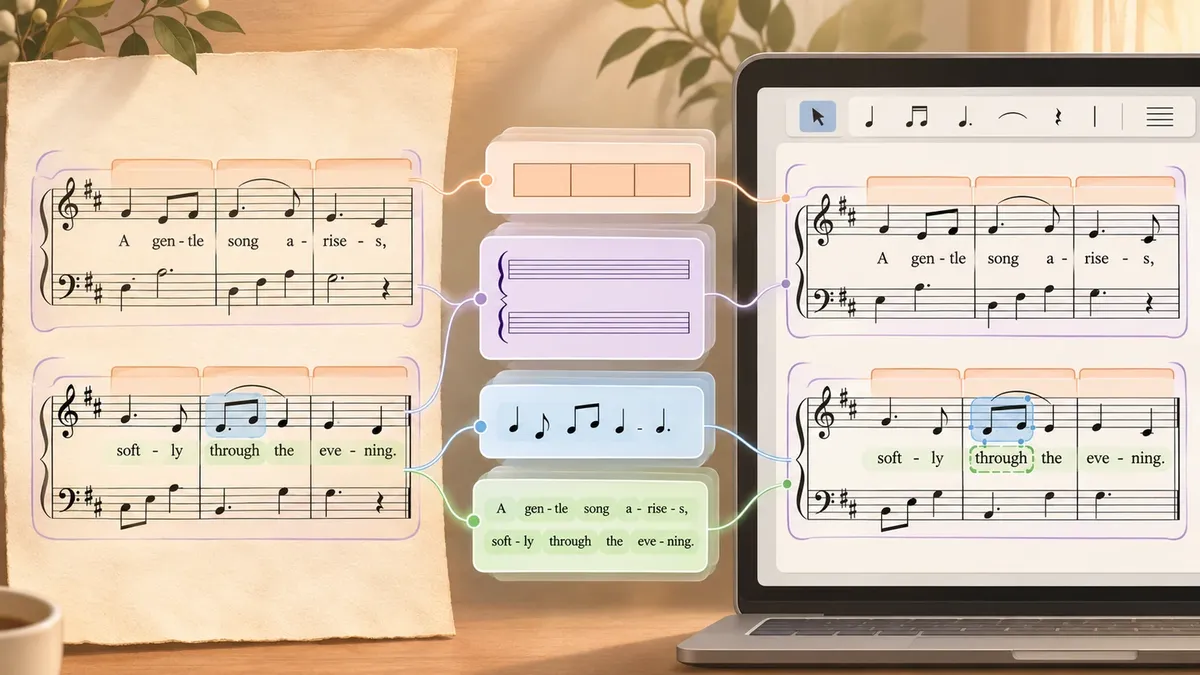
A score is more than a sequence of notes: lyrics attach to particular notes, and layout shows how music is grouped on the page. Cecilia-OMR aims to recover those details together in an editable score, with results that are promising on some tests but mixed across others.
Optical music recognition (OMR) turns sheet-music images into digital notation. A transcription might capture the notes yet omit which syllable belongs to which note, or where measures and systems fall on the page. Those details matter when the goal is an editable score that preserves both musical content and written organisation.
An arXiv paper introduces Cecilia, a compact notation for representing scores, and Cecilia-OMR, a model that predicts scores in that notation from images. The approach asks whether a shorter output can retain notes, lyrics and layout instructions without repeating the extensive structural markup used by MusicXML.
Compact notation, structured output
MusicXML can store details such as notes, lyrics, measure widths and page or system breaks. Its repeated tags and attributes can make a score lengthy to represent. Cecilia uses compact codes for common structures and a general-purpose fallback for less common ones. It is designed to reconstruct a canonicalised MusicXML tree, while excluding some source-provenance and playback information.
The authors compared complete scores represented as MusicXML and Cecilia using the same tokenizer. In 1,000 paired scores, the mean MusicXML sequence was 27.73 times as long as the Cecilia sequence. This is a comparison of representation length, not recognition accuracy; the ratio may change with a different tokenizer.
Cecilia-OMR encodes the score image into shared visual information, then predicts metadata and music separately. Music is divided at measure boundaries into segments, and a learned count head estimates how many segments are needed. The model was pretrained on rendered symbolic scores, then adapted using OpenScore and handwritten-score data, followed by group-relative policy optimisation (GRPO).
Results depend on the test
The evaluations covered rendered and camera images of OpenScore string quartets and Lieder, as well as handwritten pages from CVC-MUSCIMA. Additional Lieder tests retained vocal staves and lyrics. The authors assessed notation edits, lyric transcription, notation-tree similarity and rendered page layout. These measures reflect different aspects of reconstruction: a good score on one does not guarantee a good score on another.
On three of the four standard OpenScore conditions with published Legato 2 results, Cecilia-OMR had lower normalised edit distance: camera string quartets and both Lieder conditions. Averaged equally across those four conditions, Cecilia-OMR scored 0.2232 versus 0.2998 for Legato 2; lower is better. Legato 2 did better on rendered string quartets. On the added Lieder tests with lyrics, Cecilia-OMR scored better than a direct-MusicXML AI baseline on rendered pages, while the baseline scored better on camera pages. On handwritten CVC-MUSCIMA, that baseline also had the lower notation-edit score.
The researchers also tested the role of layout instructions by rendering the same 48 predictions with and without them. Keeping the predicted instructions improved several layout measures, including system-break agreement and measure overlap. Automatic layout did better on some others, including page-break agreement. Layout performance varied: for example, text-word overlap was low in the reported conditions, and overlap and position metrics do not measure exactly the same thing.
What remains uncertain
The results show that Cecilia’s compact representation can retain selected layout and lyric information, and that predicted layout instructions can improve some measures of the rendered output. They do not establish that the system is best across score types or evaluation measures. Lyric character error also differed by image condition: the paper reports 21.03% for rendered images and 50.61% for camera images in its lyric-specific evaluation.
For handwriting, the authors held out two of 20 musical scores, comprising 100 test pages, in a work-disjoint split. Cecilia-OMR’s notation-edit score on that test was higher than the direct-MusicXML baseline’s. These results describe the stated dataset and split; they do not by themselves settle how the method will perform on other material.
This work is an arXiv preprint, and the evidence available here does not establish peer review. Its comparisons apply to the specified datasets, baselines and metrics—not arbitrary scores or routine use. The authors identify page geometry, lyric alignment and musical-state prediction as areas for further work. Broader testing and independent replication would help clarify how well the system generalises.
- optical music recognition
- sheet music
- Cecilia-OMR
- MusicXML
- machine learning
- score layout
Related reading
Automatically matched by shared topic keywords. These links do not imply that the sources agree or establish a consensus.
One Energy Lens for Many Kinds of Machine Learning
Source published
Shared keywords: machine learning
Machine learning connects atomic physics to simulations of stellar winds
Source published
Shared keywords: machine learning
PHISHREV+ uses explicit rules to reconsider phishing alerts
Source published
Shared keywords: machine learning
A lean new layer could help quantum neural networks learn more
Source published
Shared keywords: machine learning
sorAI uses sequence patterns to estimate fern ploidy
Source published
Shared keywords: machine learning