TRANSMISSION // 2611.27458v1
How an unstable quantum oscillator can be rebuilt from resonances
Source published
A theoretical study shows how two time-limited expansions of discrete resonance states reproduce the inverted harmonic oscillator’s exact propagator, despite its continuous real spectrum.
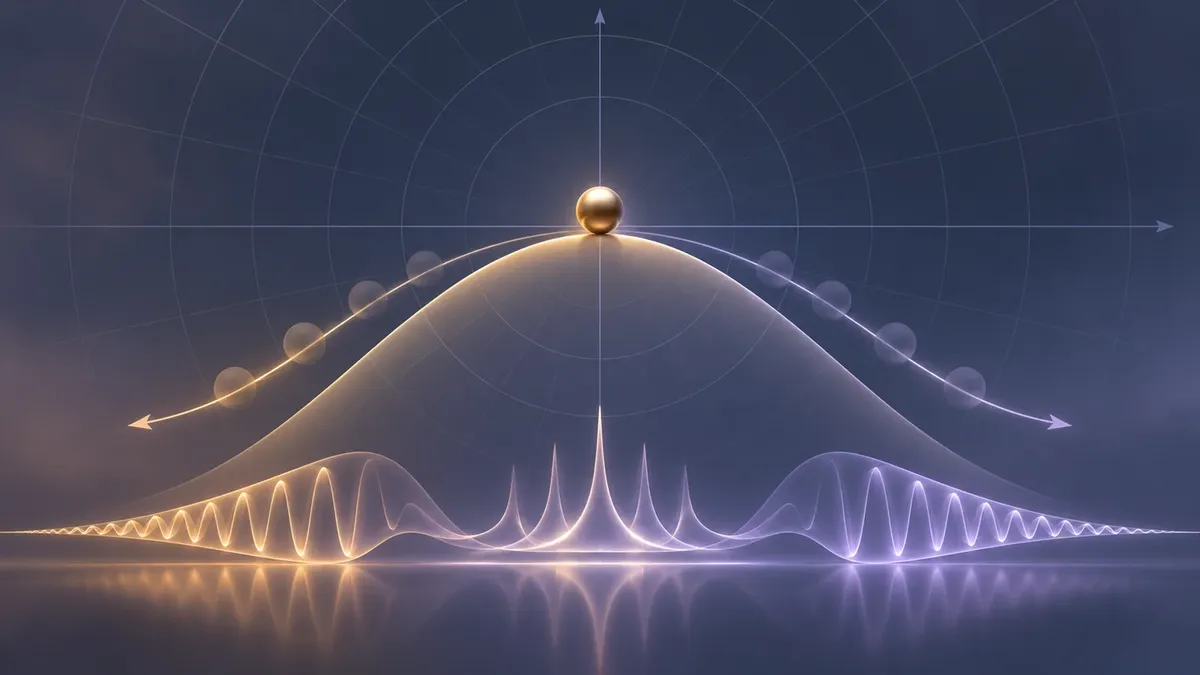
An inverted harmonic oscillator is a model of motion away from an unstable point, rather than oscillation around a stable one. Ding, Liu and Liang investigate how its quantum time evolution can be described using discrete resonance states—even though the standard Hamiltonian has a continuous real spectrum.
An ordinary harmonic oscillator is like a ball rolling in a bowl: displaced from the bottom, it tends to move back. The inverted harmonic oscillator (IHO) is more like a ball balanced at the top of a hill. A small displacement sends it accelerating away, following a hyperbolic trajectory rather than a repeating oscillation.
That instability creates an apparent puzzle in quantum mechanics. The IHO’s self-adjoint Hamiltonian on the usual space of square-integrable wavefunctions has a continuous, real spectrum. Yet physicists also describe the system with discrete resonance states whose energies are purely imaginary. These generalized states are not ordinary, normalizable wavefunctions: they lie outside that Hilbert space and describe exponential growth or decay. How, then, can they help reconstruct the system’s exact quantum evolution?
In this theoretical paper, Hongze Ding, Ni Liu and J.-Q. Liang work out that reconstruction and develop a complementary description using Segal–Bargmann space, a mathematical setting in which wavefunctions are represented by entire functions of a complex variable.
Two routes to the propagator
The authors first derive the IHO’s real-time Feynman propagator—the mathematical object that describes how a quantum particle can evolve from one position to another. They use a path-integral calculation, adapting a coordinate-and-time transformation associated with Moriconi. This gives them a closed-form result to compare against their resonance-based calculations.
They then express the propagator as a sum over discrete resonance states. To evaluate those sums, they use Mehler’s formula, a relationship for summing series involving Hermite polynomials. The relevant coordinate-space states involve complex Hermite polynomials and are paired as dual sets: the usual inner product does not work for these non-normalizable states, so the authors use a Fresnel-regularized pairing instead.
The central mathematical result is that each of two expansions reproduces the same exact propagator, but only on one side of time. The branch associated with decaying Gamow–Siegert resonances converges for forward time, while the branch associated with growing antiresonances converges for backward time. In the authors’ derivation, the sums reproduce the full kernel without an explicit contribution from the continuous scattering spectrum.
This does not mean the ordinary continuous spectrum disappears or that the resonances are ordinary bound states. The reconstruction depends on generalized states, their dual pairing, and the conditions under which the infinite sums converge. The standard real-axis Hamiltonian remains associated with its continuous real spectrum.
A complex-space explanation
The paper also uses complex scaling: a rotation of the coordinate into the complex plane. Combined with the Segal–Bargmann transform, this makes the resonance problem easier to express. In that representation, the Hamiltonians take a simple form involving the operator that generates rescaling of the complex coordinate. Requiring the wavefunctions to be entire—well-behaved across the whole complex plane—selects a discrete sequence of monomial eigenfunctions.
The time evolution in this representation acts like a complex dilation. The authors interpret the forward- and backward-time convergence limits as one-sided contraction semigroups: in each direction, one branch contracts, while the opposite branch does not provide the corresponding bounded evolution. This offers a mathematical account of why the two resonance expansions have different time domains.
A further result concerns bi-coherent states, paired states built from the dual resonance families. Under the paper’s biorthogonal pairing, their position and momentum second cumulants are imaginary and conjugate to one another; their uncertainty product has the minimum value stated by the authors. The states’ mean position and momentum follow the IHO’s classical hyperbolic trajectories for arbitrary real initial conditions. These are analytical results within the model, not experimental measurements.
What the result does—and does not—show
The work is a mathematical treatment of a specific quadratic potential. Its authors note that the especially neat summation and Segal–Bargmann description rely on that potential’s structure. For more general, non-quadratic barriers, they say, one may need different methods, and contributions from the continuum may remain. The paper’s connection to topics such as black-hole quasinormal modes is a possible area of relevance: it does not demonstrate that the same exact reconstruction applies to a full black-hole system.
The evidence here is a theoretical preprint, not a reported experiment. Its conclusions depend on mathematical constructions involving complex scaling, generalized eigenstates and regularized integrals. The supplied source does not establish independent verification or peer-review status, and search excerpts are not a substitute for a broader assessment of the work. The result is best read as an exact framework for the ideal inverted oscillator, rather than a general recipe for unstable quantum systems.
- inverted harmonic oscillator
- quantum mechanics
- resonance states
- Feynman propagator
- Segal–Bargmann space
- complex scaling
Related reading
Automatically matched by shared topic keywords. These links do not imply that the sources agree or establish a consensus.