TRANSMISSION // 2611.27447v1
A convincing simulation can still fool a driving model
Source published
A study proposes checking not just whether simulated driving scenes look real or produce matching predictions, but whether perception models rely on similar visual evidence in both.
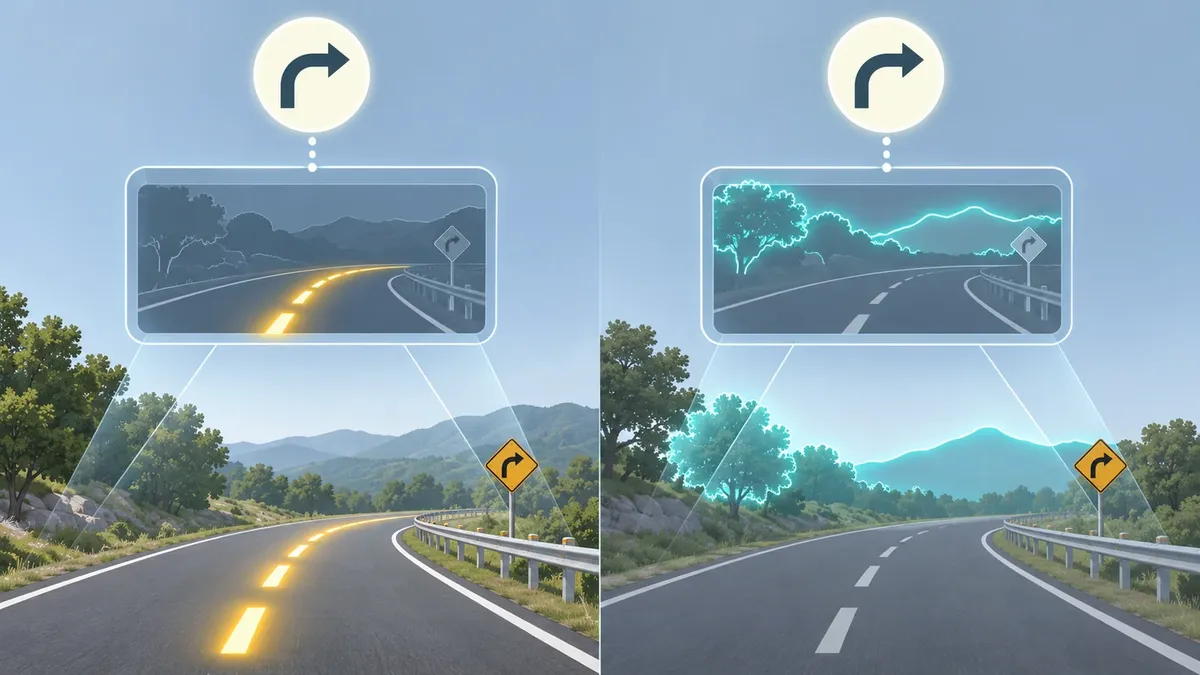
If an autonomous-driving model makes the same prediction from a real image and a simulated one, did it reach that answer for the same reasons? A new framework probes that question by comparing the visual evidence models rely on, while emphasizing that this diagnostic is not a safety certificate.
Simulation lets researchers test driving systems in repeatable scenes that might be risky or difficult to encounter on the road. But a simulated image can look convincing, and a model can produce the same output on real and simulated images, without using the same clues in each. A system might, for example, rely on lane markings in one image and an incidental background feature in another. If those clues behave differently outside the test setting, matching predictions alone may give an incomplete picture of simulation quality.
A paper by Danial Safaei and colleagues proposes a way to investigate this gap, which they call mechanism parity. The central question is not only whether a perception model’s prediction transfers from a real scene to its simulated counterpart, but whether the evidence that appears decisive to the model also transfers.
Comparing evidence, not just answers
The researchers introduce two related diagnostics. Decisive-Feature Fidelity (DFF) compares maps that estimate which parts of an image are important to a model’s output. The maps are generated with a counterfactual procedure: the researchers alter an input image and examine whether the model’s output changes. Differences between the maps for a matched real and synthetic image are summarized as a distance; a smaller distance indicates closer agreement under this measure.
Concept-Decisive Feature Fidelity (C-DFF) adds a semantic interpretation. It groups decisive evidence into scene categories, such as road, sky or vegetation, using a separate, frozen image-segmentation model. This can help describe which kinds of scene content gained or lost importance in the synthetic image. The semantic step also introduces a dependency: its results rely on the segmenter and the categories it recognizes.
The study evaluates these measures on paired images drawn from KITTI and Virtual KITTI 2, a real-world and simulated driving-dataset pairing. The main benchmark contains 96 image pairs from three Virtual KITTI scenes. The team tested ten retrained image generators and three frozen systems under test: a steering-angle model and two YOLOP segmentation heads, for drivable area and lane lines. Generated images were prepared on a padded canvas and cropped back to match the real images’ dimensions before evaluation.
The researchers also compared image appearance and model outputs, used bootstrap analyses to assess uncertainty, tested sensitivity to diagnostic thresholds, and checked whether the measures responded to a deliberately planted visual cue. A separate check used two Virtual KITTI scenes withheld from generator training. Those scenes provide a within-dataset replication, not evidence of transfer to an independent dataset.
Agreement can hide different evidence
Across the tested systems, appearance and output agreement were only weakly and inconsistently related to the measured mechanism distance. In practical terms, a good-looking synthetic image or a similar model prediction did not reliably indicate that the model’s decisive evidence was similar too. The authors present examples where images and outputs appear relatively close while the evidence maps shift.
The planted-cue test offers a further, specific check. Researchers trained a steering-model copy to rely on an artificial cue and compared it with a road-reliant model. When the models produced matched outputs, the diagnostic localized decisive evidence on the planted cue and distinguished the cue-reliant model from the road-reliant one. This supports the measure’s sensitivity in that constructed steering example; it does not establish equivalent sensitivity for every model or real-world shortcut. The paper reports that an analogous positive-control construction did not transfer to the dense YOLOP outputs.
The study also tested whether training generators with the proposed calibration objective improved the mechanism measures. On this benchmark, no system showed a statistically significant improvement after correction for multiple comparisons. The authors describe this as a negative result with limited statistical power, not proof that calibration can never help. They note that changes in the calibration method and evaluation protocol make it difficult to identify why an earlier study reported an improvement while this one did not.
A diagnostic, not a verdict
The findings are bounded by the benchmark: paired monocular images, three frozen systems, ten generators and a small set of Virtual KITTI scenes. The authors explicitly do not claim that low DFF or C-DFF establishes safety, validates other sensors, or predicts performance in full driving sequences. Counterfactual evidence maps are approximations and can depend on how they are calculated; C-DFF adds uncertainty from its semantic segmentation scaffold. The paper also reports that different explanation methods agree unevenly, which limits confidence in fine-grained rankings of individual generators.
The work is a preprint submitted to the IEEE for possible publication, so it should not be treated as peer-reviewed evidence. Its central contribution is a proposed additional check for simulation validation: alongside asking whether synthetic scenes look right and produce similar predictions, ask whether the model appears to rely on similar evidence. That question may help researchers identify cases for closer inspection, but answering it is only one part of a broader safety assessment.
- autonomous driving
- simulation validation
- synthetic data
- explainable AI
- computer vision
- mechanism parity
Reviewed cross-references
These connections were reviewed by a model, not independently fact-checked by a human. Similarity does not imply agreement; consult the original papers and the evidence below.
Can AI-generated worlds keep up with robots and self-driving cars?
Supporting evidence: Both papers caution that evaluating a simulator requires more than assessing generated observations: Safaei et al. test whether paired synthetic scenes preserve a perception model’s decisive evidence, while the Cosmos authors state that policy-driven simulator utility requires separate closed-loop validation. These are complementary evaluation concerns, not the same metric or a shared benchmark; the Cosmos excerpt does not assess mechanism parity.
Model review: · openai-codex/gpt-6-luna
Evidence and provenance
Selected excerpts, not complete papers. PDF extraction can omit figures or damage equations, tables and reading order; sources may be preprints.
2611.27447v1 — Original paper
Excerpt reference:
static/papers/2611.27447v1.md:16-67
Basis: Paper text
Source SHA-256:a3da33359414a1af45999dce51375ff3ef35ee7e876fe6e0ce0c01bc433e58db2611.06627v1 — Original paper
Excerpt reference:
static/papers/2611.06627v1.md:217-267
Basis: Paper text
Source SHA-256:4e86d4e9d02d7002ead6a16fd7d5ec5409564a81cb5883775380b90df3baf467
Related reading
Automatically matched by shared topic keywords. These links do not imply that the sources agree or establish a consensus.
AI claims-analysis preprint tests policy citations and privacy safeguards on synthetic data
Source published
Shared keywords: explainable ai, synthetic data
JEPAhead predicts future driving features, but practical benefits remain unproven
Source published
Shared keywords: autonomous driving, computer vision
A driving planner that looks where each route leads
Source published
Shared keywords: autonomous driving, computer vision
Turning Factory Event Logs Into Simulations With AI
Source published
Shared keywords: simulation validation
Teaching Motion-Prediction Models the Near Future First
Source published
Shared keywords: computer vision