TRANSMISSION // 2611.27442v1
A relativistic balance law for binaries in matter
Source published
A theoretical framework relates changes in an inspiralling object's orbit to surrounding relativistic matter and gravitational-wave fluxes, without calculating matter-sourced gravitational perturbations.
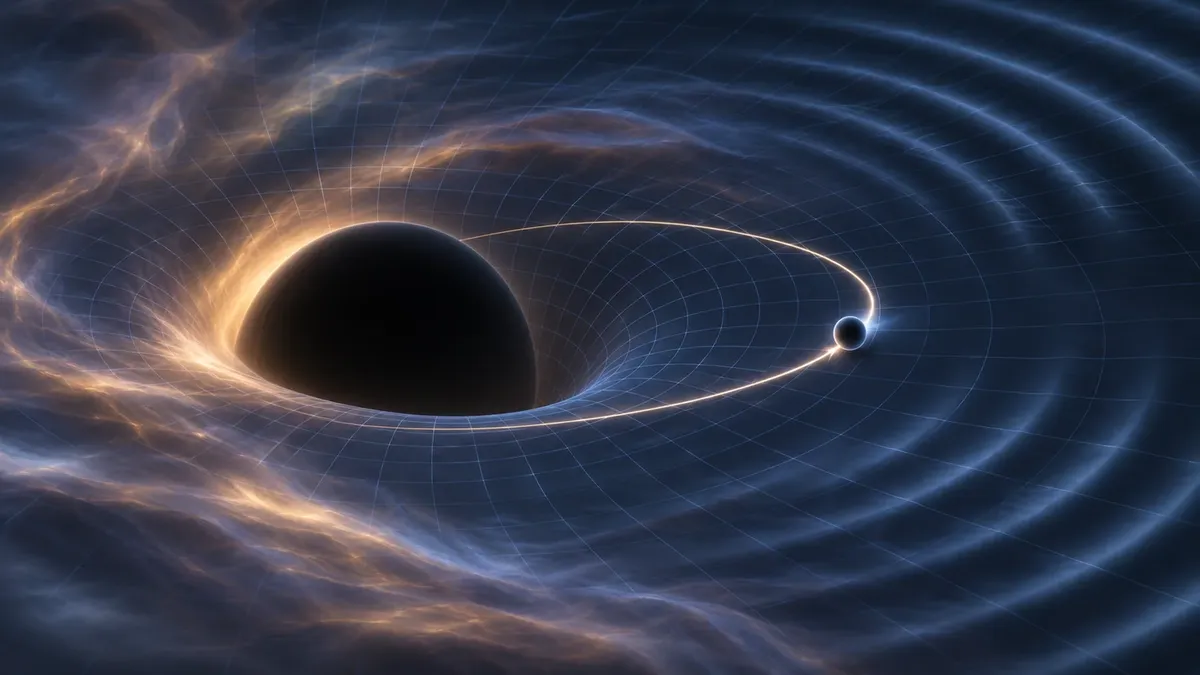
How does surrounding matter affect a compact object's orbit as it spirals around a more massive companion? A new theoretical treatment derives balance laws connecting orbital changes with changes in the matter and gravitational-wave fluxes, while making clear that the result depends on an expansion and specific assumptions.
When a compact object spirals around a much more massive companion, its orbital energy and angular momentum change. Gravitational waves carry energy and angular momentum away, while surrounding matter can also influence the system. A central challenge is to account for these effects without directly calculating every gravitational perturbation sourced by matter that is itself changing over time.
In this theoretical paper, Conor Dyson and colleagues derive a relativistic balance law for binaries interacting with surrounding relativistic matter fields. The title invokes Newton’s third law, but the abstract describes a formulation that resembles integrated forces acting on the environment. It does not claim a literal equal-and-opposite force pair in general relativity. Instead, the work relates the evolution of the smaller object's orbit to changes in the matter and to gravitational-wave fluxes.
The systems considered include intermediate- and extreme-mass-ratio inspirals: binaries in which one object is much less massive than its companion. The abstract does not specify that the more massive object must be a black hole, or that the surrounding matter must be gas.
Deriving the balance
The authors use a two-parameter expansion, a mathematical method for organizing effects at different orders. They rewrite the evolution of the secondary’s orbital elements—the quantities that describe its orbit—in a form resembling integrated forces acting on the environment. According to the abstract, this avoids the need to calculate gravitational perturbations sourced by the dynamical matter content.
They use retarded and advanced Green’s functions, mathematical tools for describing how disturbances propagate, to derive instantaneous and orbit-averaged relations. These connect the rates of change of the secondary’s orbital energy and angular momentum with corresponding changes in the matter and with gravitational-wave fluxes, at the order considered.
The abstract presents two forms of the results. A leading-order formulation is intended for fast evaluation alongside complex relativistic matter simulations. A first-post-adiabatic formulation describes energy and angular-momentum evolution when the environment is stationary and axisymmetric at leading order—that is, when its baseline description does not change with time and has rotational symmetry.
What the result establishes—and what remains open
The authors say their results clarify and correct a mixture of ad hoc balance prescriptions used in the literature. Their stated contribution is a first-principles way to specify forcing functions for the secondary’s orbital elements in two forms. The abstract does not report observations, a specific simulated system, or numerical predictions for a particular matter distribution.
The conclusions are bounded by the method’s assumptions. The relations hold at the orders retained in the two-parameter expansion; the abstract does not say that they capture every possible effect. The first-post-adiabatic form requires a stationary, axisymmetric environment at leading order, and the abstract does not establish that this condition applies to every astrophysical setting. Although the leading-order formulation is described as suitable for use with complex simulations, the abstract does not provide performance tests or examples.
This account is based on the paper’s abstract, not its full text. We therefore cannot assess the detailed derivation, equations, examples, or the precise scope of the claimed corrections. The paper is an arXiv preprint; the supplied source information does not establish whether it has undergone peer review. The findings should be understood as the authors’ theoretical results, not as an observational conclusion or settled consensus.
The framework offers a way to organize how orbital evolution, matter, and gravitational-wave fluxes are related in these binaries. Its value for particular systems will depend on the full derivation and on whether the assumptions used in each formulation fit the environment being modeled.
- general relativity
- gravitational waves
- intermediate-mass-ratio inspirals
- extreme-mass-ratio inspirals
- relativistic matter
- orbital dynamics
Related reading
Automatically matched by shared topic keywords. These links do not imply that the sources agree or establish a consensus.
When a gravitational wave meets a binary’s rhythm
Source published
Shared keywords: gravitational waves, orbital dynamics
Separating black hole signals from glitches in simulated LISA data
Source published
Shared keywords: gravitational waves
Two cosmic signals could reveal how massive black holes grow
Source published
Shared keywords: extreme mass ratio inspirals, gravitational waves
Neutron Star Tides Could Complicate Tests of Einstein’s Gravity
Source published
Shared keywords: general relativity, gravitational waves
Using a black hole’s ringdown to examine nonlinear gravity
Source published
Shared keywords: general relativity, gravitational waves