TRANSMISSION // 2611.27441v1
Globular-cluster patterns in diffuse galaxies
Source published
In a selected KiDS sample, group- and cluster-associated ultra-diffuse galaxies tend to have richer globular-cluster systems than field examples, but the groups overlap substantially.
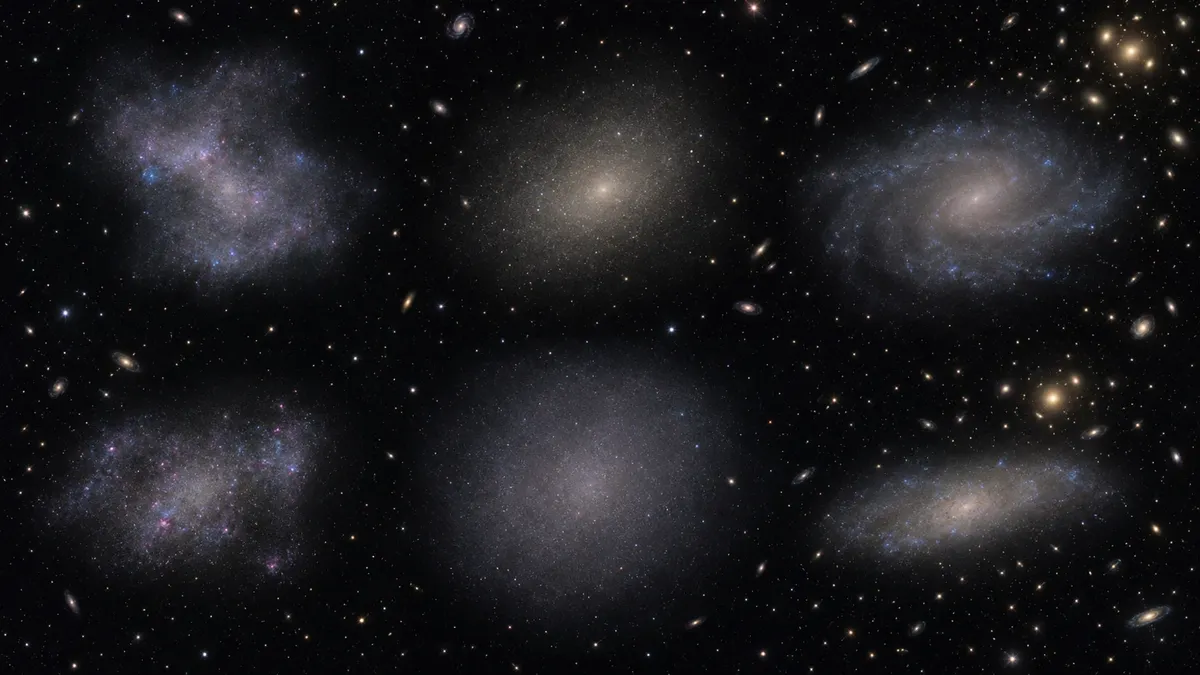
Ultra-diffuse galaxies are defined by their low surface brightness and large size, and their origins remain debated. A Kilo-Degree Survey study examined globular clusters in 24 selected candidates—not the full parent sample—and found modest environmental trends that leave many questions open.
Ultra-diffuse galaxies (UDGs) have very low surface brightness and large effective radii: their light is spread thinly across a broad area. They often have stellar masses more typical of dwarf galaxies. Whether they occupy ordinary dwarf-galaxy halos or unusually massive dark-matter halos is one of several open questions about how these systems form.
Globular clusters—compact groups of old stars—can offer clues. Their numbers are thought to relate to the early assembly of a galaxy’s dark-matter halo. Hao Su and colleagues asked whether globular-cluster populations differ between UDGs associated with groups or clusters and those classified as field galaxies. Their results describe a selected set of candidates, not UDGs as a whole.
How the researchers searched
The team started with 545 high-quality UDG candidates identified in optical images from the Kilo-Degree Survey (KiDS). They applied a dedicated pipeline to search for compact sources within twice each galaxy’s effective radius. The pipeline detected sources in the r band, then used colors from other optical bands to select likely globular clusters. Nearby control regions provided estimates of foreground and background contamination.
The researchers checked the pipeline against previously studied systems, including comparisons with existing cluster measurements. These checks support the method’s use for finding candidates, but the study notes that KiDS has limits in depth and resolution: it can miss faint or diffuse clusters, and its counts are not complete measurements of every system.
To account for that missing faint population, the team used an assumed globular-cluster luminosity function—the distribution of cluster brightnesses—to correct the observed counts. They also used the luminosity function to estimate distances and, from those, physical galaxy sizes. Because the data do not fully sample the faint end, these corrected counts and derived distances depend on assumptions and should not be read as direct, complete tallies.
At least three detected cluster candidates were required to attempt a luminosity-function-based distance estimate. This produced 55 candidates for which such estimates could be attempted; the researchers then retained 24 with estimated physical effective radii above 1.3 kiloparsecs. That size threshold is somewhat below the commonly used 1.5-kiloparsec boundary. The final sample included 14 candidates associated with groups or clusters and 10 classified as field systems. It is a small, selected subset of the original 545.
A modest trend, with considerable overlap
Within this sample, group- and cluster-associated UDGs tended to have somewhat more globular clusters and higher specific frequencies than field UDGs. Specific frequency expresses the number of clusters relative to a galaxy’s brightness. At a given stellar mass, associated galaxies also more often appeared near the upper edge of the observed relationship between stellar mass and cluster number.
The distributions overlap substantially. Some field candidates have relatively rich cluster systems, and some group- or cluster-associated candidates do not. The authors describe the differences as mild and descriptive for this sample—not evidence of a clean divide or a rule that predicts an individual galaxy’s cluster population.
The team also estimated halo masses by applying an empirical relation between globular-cluster abundance and halo mass. Most sample galaxies fall above an extrapolated reference relationship between stellar mass and halo mass, suggesting higher inferred halo mass relative to stellar mass. This is an indirect result, not an independent measurement of each halo. It relies on the cluster counts and the assumed cluster-to-halo relation. The reference relation is extrapolated into the low-mass regime, where its scatter increases, and the authors identify uncertainties in cluster selection and calibration as important caveats.
Histories remain interpretations
One possible explanation, consistent with the observations, is that UDGs formed globular clusters efficiently early in their histories but later formed fewer field stars because star formation was suppressed or stopped. That would leave a relatively large cluster population compared with the galaxy’s stellar mass. The study does not establish this sequence as the cause of the observed patterns.
The authors discuss several possible influences, including early assembly, quenching, prior environmental processing, infall timing, and survival. A galaxy’s current location may not capture its full history: some field systems may have experienced earlier environmental effects, while some cluster members may have arrived relatively recently. The comparison cannot determine which histories produced the differences, or show that environment directly increased cluster numbers.
The findings therefore add a useful comparison of field and denser environments, while remaining limited by sample selection, small numbers, incomplete cluster detection, and the assumptions used to infer distances and halo masses. The authors suggest that combining optical data with near-infrared observations may improve cluster selection in future work.
The source is an arXiv preprint whose manuscript text is labeled A&A proofs. The supplied evidence does not establish peer-review status. Its conclusions are best read as tentative observational trends and interpretations, rather than settled explanations of how UDGs form.
- ultra-diffuse galaxies
- globular clusters
- Kilo-Degree Survey
- galaxy environments
- dark-matter halos
- galaxy formation
Related reading
Automatically matched by shared topic keywords. These links do not imply that the sources agree or establish a consensus.
What Star Clusters Could Reveal About Faint Galaxies
Source published
Shared keywords: galaxy formation, globular clusters, ultra diffuse galaxies
A giant galaxy’s stellar layers preserve clues to its dark halo’s past
Source published
Shared keywords: dark matter halos, galaxy formation
How gravitational turbulence may help galaxies settle down
Source published
Shared keywords: galaxy formation
A Faster Way to Follow Stars Escaping a Globular Cluster
Source published
Shared keywords: globular clusters
Early Galaxies Narrow a Search for Neutrino Interactions
Source published
Shared keywords: dark matter halos