TRANSMISSION // 2611.27434v1
Can Documents Adapt This Speech Recognizer?
Source published
In two corpora, researchers tested whether documents alone can adapt one LLM-based speech recognizer without target audio or transcripts. Results depended on speaking style and text volume.
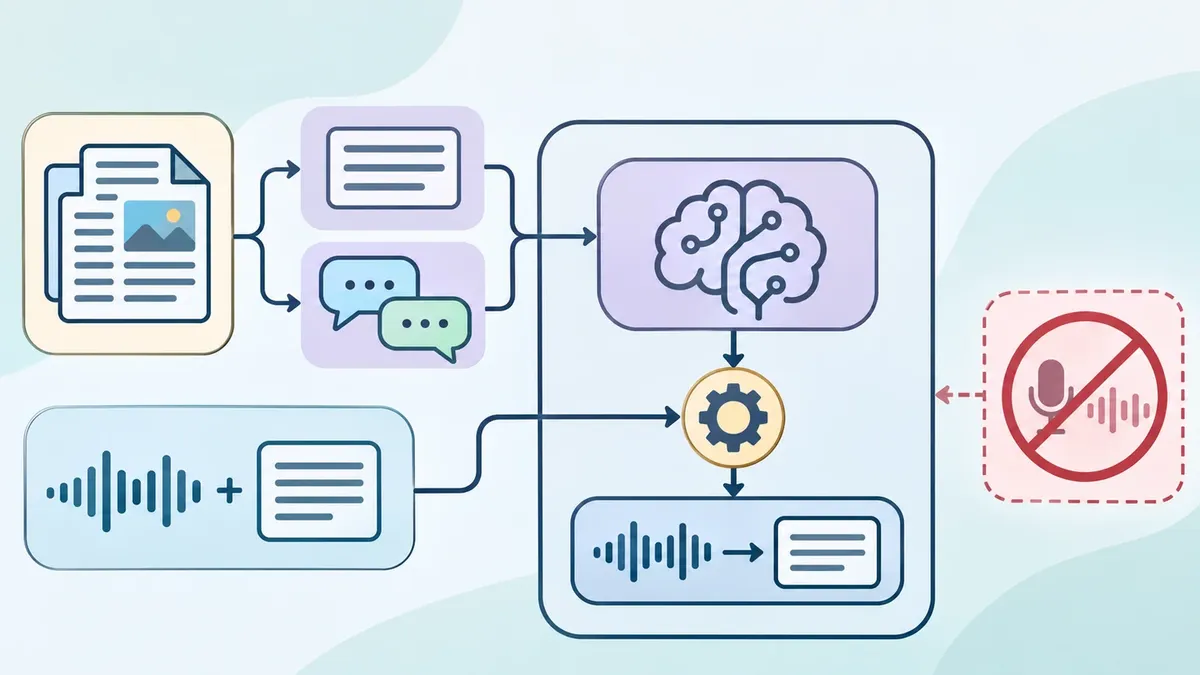
A new organization may have product manuals and policies but no recorded, transcribed conversations. Could those documents help tailor speech recognition anyway? Researchers tested two document-to-text approaches with one adaptation method and an LLM-based recognizer.
The adaptation problem
Automatic speech recognition (ASR) can struggle with unfamiliar names, terminology and speaking styles. Adapting a system with examples from a new domain can help, but collecting and transcribing speech takes effort, and conversations can be sensitive. Text-only adaptation avoids needing target-domain audio, yet prior approaches generally assume transcripts are available. In many onboarding situations, the available material is instead written documentation: manuals, policies or product descriptions.
This study asks whether raw documents can help adapt an LLM-based speech recognizer when there is no target-domain audio or transcript. The researchers tried two ways to turn documents into adaptation text: use their sentences as written, or have a large language model render them as synthetic spoken dialogue.
How they tested it
The recognizer combines a speech encoder, a large-language-model decoder and a learned connector between them. Adaptation used a previously proposed text-denoising method. In simplified terms, it trains the system to restore deliberately corrupted text. To help maintain the learned relationship between speech and text, its training batches include several source-domain views: source audio paired with transcripts, audio-derived noisy transcripts, and synthetically corrupted transcripts, alongside the target adaptation text.
The researchers compared an unadapted model with versions adapted using real target transcripts, written document sentences or generated dialogue. Real transcripts served as a reference condition; they were not used in the document-only adaptations. Performance was measured with word error rate (WER), which counts differences between recognized words and reference transcripts. Lower WER is better.
The experiments used two contrasting corpora. DefinedAI is a proprietary corpus of manually transcribed customer–agent telephone calls. SlideSpeech is an open corpus of online conference talks and lectures. The team tested adaptation within each corpus and across them, including adapting a model trained on DefinedAI to SlideSpeech. They also tested generating more dialogue for two SlideSpeech domains.
Because no existing corpus paired documents with audio and transcripts, the researchers constructed benchmark documents from training transcripts. They used extracted topics and terminology rather than the original transcript wording; validation and test material was excluded. This enabled controlled comparisons, but differs from evaluating naturally supplied customer documents.
What they found
For DefinedAI’s telephone conversations, synthetic dialogue generally worked better than using written sentences directly. Across the five tested domains, dialogue-based adaptation came close to the real-transcript condition; in Retail, its WER was slightly lower. Written-text adaptation was less consistent: it offered little benefit in some domains and performed worse than the unadapted baseline in Healthcare.
The pattern was different for SlideSpeech. Its talks and lectures are more expository, making written sentences a more competitive fit. Real transcripts provided only small gains there, leaving less room for any text-only approach to improve. The default generated-dialog sets were also small relative to the real training text. When the researchers generated many more dialogues for Agriculture and Animation, WER improved and moved closer to the transcript-based results.
In the cross-corpus test, all three text sources improved substantially on the starting model, and document-only results were broadly close to the transcript condition. This shows feasibility in that particular transfer experiment, not that equivalent results will hold for other recognizers, domains or document collections.
What remains uncertain
The findings are specific to one LLM-based ASR system, one denoising adaptation method and two corpora. Which document rendering worked best depended on speaking style and, in some cases, how much synthetic text was generated. Generated dialogue also relies on a language model to produce useful, document-grounded text; the study does not establish that such dialogue will always accurately represent real conversations.
The benchmark documents were constructed from training transcripts, rather than gathered from organizations independently, and the DefinedAI corpus is proprietary. Real-world documentation may cover terminology differently or omit information relevant to speech. The authors describe this as the first study of document-only adaptation for LLM-based ASR, and report releasing code and SlideSpeech documents and synthetic dialogues. The work is an arXiv preprint; its results should be treated as preliminary evidence from the reported experiments, not as a general guarantee.
Source: The study on arXiv.
- speech recognition
- ASR adaptation
- large language models
- document-only adaptation
- synthetic dialogue
- word error rate
Reviewed cross-references
These connections were reviewed by a model, not independently fact-checked by a human. Similarity does not imply agreement; consult the original papers and the evidence below.
A Small Study Compares Approaches to Hausa Medical Speech Recognition
Supporting evidence: Both papers report ASR gains using text without target-domain speech: the origin study says document-derived adaptation text can match or approach real-transcription results, while the Hausa study reports lower WER with language-model fusion. This supports the bounded proposition that text-only resources can improve ASR in the evaluated settings, not that the methods or gains are interchangeable: the origin uses denoising adaptation for LLM-based ASR, whereas the Hausa study keeps its acoustic model fixed and evaluates read prompts.
Model review: · openai-codex/gpt-6-luna
Evidence and provenance
Selected excerpts, not complete papers. PDF extraction can omit figures or damage equations, tables and reading order; sources may be preprints.
2611.27434v1 — Original paper
Excerpt reference:
static/papers/2611.27434v1.md:13-64
Basis: Paper text
Source SHA-256:fa8a68cce6aab7da4d3efbe16c0dafe3bfbf3d17fd9fd15556f16e112e212bb72611.05744v1 — Original paper
Excerpt reference:
static/papers/2611.05744v1.md:29-51
Basis: Paper text
Source SHA-256:0278235874d97129d773e849ac824d8d339c8cffbd672fb5fb0afa6bc02710ab2611.05744v1 — Original paper
Excerpt reference:
static/papers/2611.05744v1.md:674-706
Basis: Paper text
Source SHA-256:0278235874d97129d773e849ac824d8d339c8cffbd672fb5fb0afa6bc02710ab
Related reading
Automatically matched by shared topic keywords. These links do not imply that the sources agree or establish a consensus.
A speech recognizer built to fit in your browser
Source published
Shared keywords: speech recognition
Clips2Story assembles keyword-guided storyboards from shuffled video
Source published
Shared keywords: large language models
How Moral Concepts Are Organized Inside Language Models
Source published
Shared keywords: large language models
Can language models reason strategically? GENSTRAT tests them in generated games
Source published
Shared keywords: large language models
When LLMs Choose Their Own Bets, Risky Patterns Grow
Source published
Shared keywords: large language models