TRANSMISSION // 2611.27427v1
An AI That Weighs Evidence Between Brain Disorders
Source published
KnowSR combines brain scans and clinical measurements with structured medical knowledge to compare six diagnostic categories. In a study of 331 people, it outperformed 19 comparison models, but the results do not establish clinical readiness.
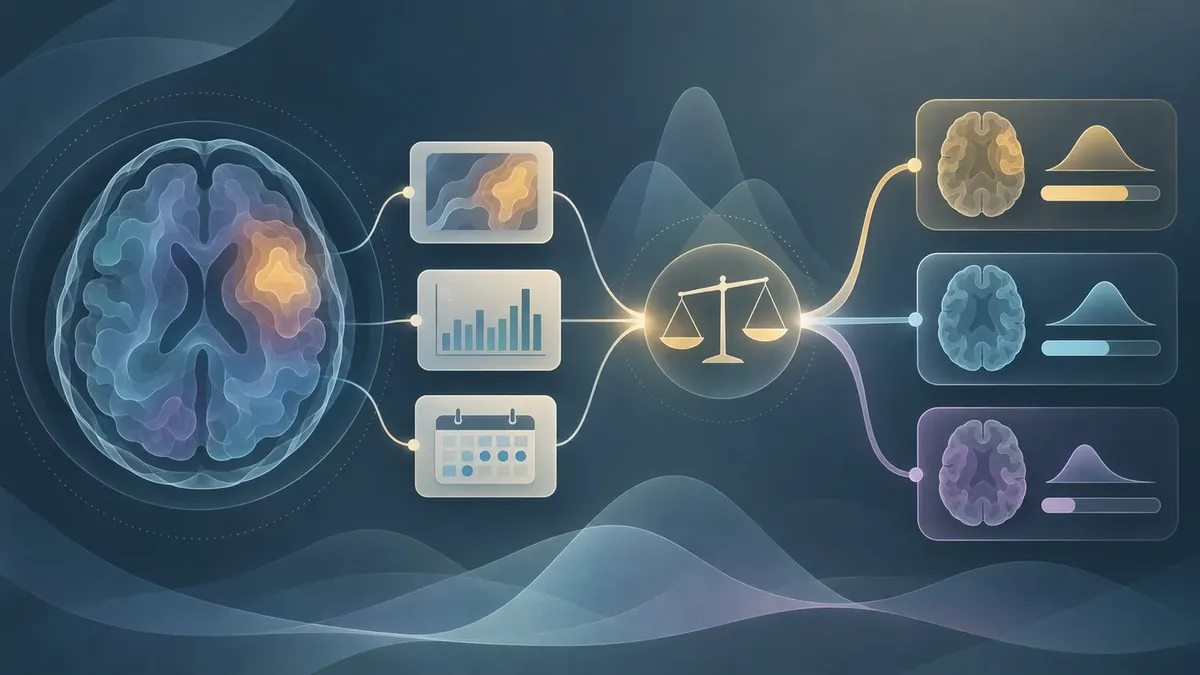
When several neurodegenerative disorders can produce similar symptoms, a diagnostic model must weigh which findings distinguish one possibility from another. KnowSR is designed to do this by combining patient data with a structured bank of disease evidence and relationships between competing diagnoses.
Why compare diagnoses, not just classify them?
Alzheimer’s disease, Parkinson’s disease, frontotemporal dementia, progressive supranuclear palsy and corticobasal syndrome can share clinical features. Diagnosis is harder when some measurements are unavailable. The authors of a new preprint argue that many AI systems combine imaging and clinical data without explicitly organizing findings around the diseases they support—or the alternatives they help distinguish.
Their proposed system, Knowledge-enhanced Structural Reasoning (KnowSR), tests whether a model can make those comparisons more directly. It was evaluated on six categories: the five disorders above and normal cognition. This is a research evaluation of classification, not a trial of an AI assistant diagnosing patients in clinical care.
How KnowSR works
The system processes resting-state functional MRI (rs-fMRI), which records changes in brain activity over time, alongside as many as 51 non-imaging measurements. These include demographic, cognitive, behavioral, functional, motor and molecular information. The model represents brain-region signals and available measurements, while masking unavailable measurements so they are not treated as observed evidence.
KnowSR also uses a fixed bank of 36 structured “Cards”: summaries of disease patterns, expected directions of evidence and relationships between pairs of diagnoses. The authors say the Cards were assembled offline through AI-assisted synthesis of medical literature. A retrospective source audit linked the finalized bank to 38 supporting publications. The Cards remained unchanged across evaluation folds; the model did not retrieve new literature for each patient.
The system uses the Cards to align patient data with disease-related evidence and form an initial prediction. It then uses a sparse graph of diagnostic relationships to reconcile pairwise evidence margins with that patient-specific diagnostic anchor. In other words, it adjusts the relative prediction scores for linked diagnoses according to the modeled evidence; this is a computational step, not an independent clinical judgment.
What the study found
The evaluation used data from four controlled-access research databases. The final cohort included 331 participants and 763 rs-fMRI scans. Researchers used five-fold testing, keeping each participant’s scans together so that a person’s data could not appear in both training and test sets. They compared KnowSR with 19 other methods, including conventional machine-learning models and neural networks designed for brain data or multimodal medical information.
For six-class, patient-level diagnosis, KnowSR reported a mean balanced accuracy of 91.94% across the five test folds. Balanced accuracy averages how well a model identifies each class, rather than allowing more common classes to dominate. The authors report that this was 6.27 percentage points above the strongest comparison model on that measure. They also report higher macro-F1 and macro-AUC scores than the comparison methods.
Several analyses tested which parts of the design mattered. Performance fell when the Cards used incorrect disease mappings, and it also fell when the pairwise refinement step was removed. In analyses within individual databases, KnowSR had the highest balanced accuracy in three of four comparisons; it was not the top model for normal cognition versus frontotemporal dementia. These results support the authors’ view that structured evidence and pairwise refinement contributed to performance in this dataset. They do not establish that the same gains would occur in other populations.
What remains uncertain
The study is limited in size for a six-category diagnostic task, and the data come from four research databases rather than a prospective, independent clinical evaluation. The databases cover different diagnostic groups in different combinations. The authors report additional tests intended to assess whether database identity alone explains performance, but those checks cannot replace validation in new and varied patient populations.
The knowledge bank is another source of uncertainty: it was synthesized with AI assistance and mapped to predefined brain regions and measurements. Its quality and coverage may affect the system’s results. Strong performance on this classification task does not show that KnowSR improves clinical decisions, handles every kind of missing data, or can safely guide patient care.
The work is a preprint submitted to a journal, not a confirmed peer-reviewed publication. The findings suggest that explicitly structuring medical knowledge may help a model compare similar diagnoses in this dataset. Independent testing and prospective clinical evaluation are still needed.
- neurodegenerative disorders
- medical AI
- differential diagnosis
- multimodal learning
- functional MRI
- clinical research
Reviewed cross-references
These connections were reviewed by a model, not independently fact-checked by a human. Similarity does not imply agreement; consult the original papers and the evidence below.
Short, targeted clues help AI separate medical exam answers
Supporting evidence: Both papers report better performance when evidence is organized to distinguish competing diagnoses or answers: KnowSR aligns patient evidence with disease-specific and pairwise knowledge for six-class diagnosis, while Xiao et al. retrieve and distill option-specific evidence for medical multiple-choice questions. These results are compatible but come from different tasks, methods, and evaluation settings; they do not establish comparative or clinical effectiveness.
Model review: · openai-codex/gpt-6-luna
Evidence and provenance
Selected excerpts, not complete papers. PDF extraction can omit figures or damage equations, tables and reading order; sources may be preprints.
2611.27427v1 — Original paper
Excerpt reference:
static/papers/2611.27427v1.md:13-72
Basis: Paper text
Source SHA-256:2dca5546b1196347c515f3d1633f384437e8154691e82c882e39546107e6876c2611.13233v1 — Original paper
Excerpt reference:
static/papers/2611.13233v1.md:13-83
Basis: Paper text
Source SHA-256:5aa4f3a3a3ad654a40272caf10b6ed5d1cb308422769a6a8c7c91ad335c3486d
Related reading
Automatically matched by shared topic keywords. These links do not imply that the sources agree or establish a consensus.
A broader test for medical AI recommendations
Source published
Shared keywords: medical ai
Teaching reinforcement-learning agents to predict across sensors
Source published
Shared keywords: multimodal learning
Can multimodal AI learn to use its inputs together?
Source published
Shared keywords: multimodal learning
Combining reviews, photos and descriptions helps recommend less-popular products
Source published
Shared keywords: multimodal learning
Can language help a video detector spot unusual events?
Source published
Shared keywords: multimodal learning