TRANSMISSION // 2611.27423v1
ADEPT lets a depth model help tune its camera
Source published
A robot camera’s exposure and gain can make or blur the details a depth model needs. ADEPT uses learned feedback to adjust them, with promising results in tests on one mobile-robot setup.
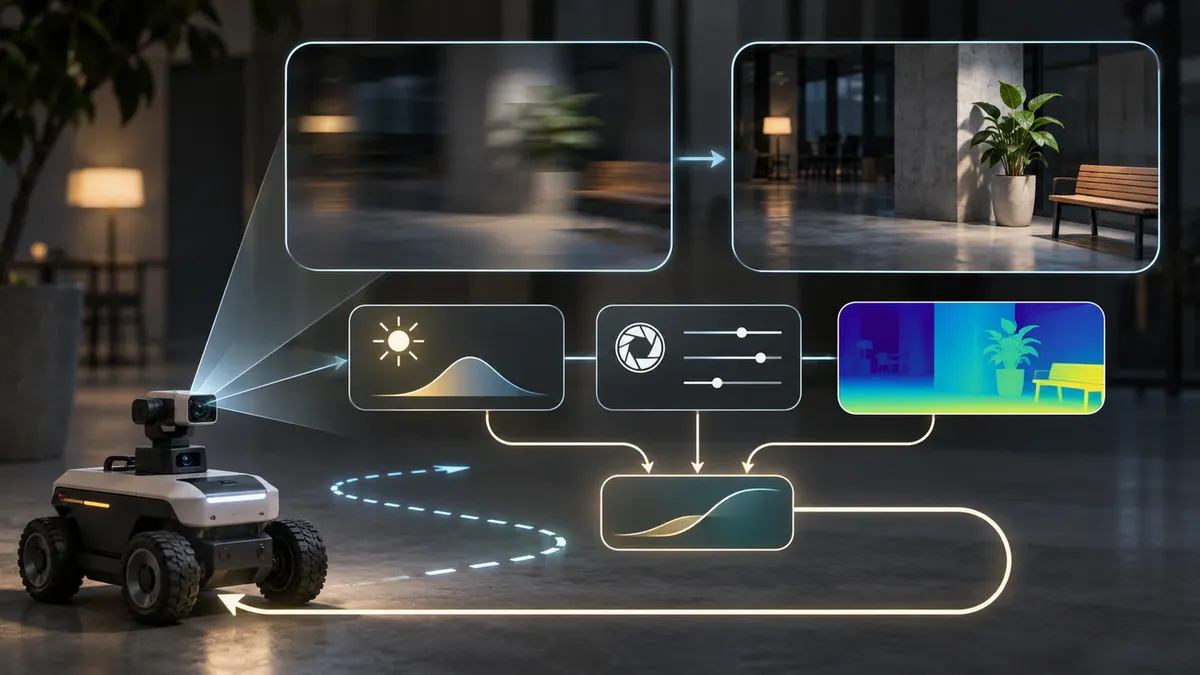
A camera can undermine a depth estimate before the AI ever sees the image: too little light hides detail, while long exposures can smear it during motion. ADEPT, a system described in a new preprint, uses feedback from a frozen depth model to choose camera exposure and gain as conditions change.
The camera is part of the perception system
A robot estimating depth from one RGB image depends not only on its depth model but also on how that image was captured. Exposure controls how long the sensor collects light; gain amplifies the signal. In a dim scene, more light can reveal useful detail. But while a robot moves, a longer exposure can blur edges and textures. Those trade-offs may be especially tricky during turns or under changing illumination.
ADEPT, developed by GiHyun Kim, JinMo Yang and Hyung-Sin Kim, asks whether a robot can tune exposure and gain for the needs of its depth-estimation model—not merely for a generally bright-looking image. The system keeps the depth model fixed and learns a separate signal to guide camera settings.
Learning which captures are preferable
The researchers collected RGB-D sequences with a mobile robot, capturing scenes at different combinations of exposure and gain. Ground-truth depth—a reference measurement of distance—let them compare depth predictions from different camera settings at approximately matched viewpoints. For each group, they identified the setting with the lowest measured depth error.
ADEPT’s compact predictor learns to estimate reference-relative disagreement, or RRD: how much the depth model’s prediction for a candidate capture differs from its prediction for that best-performing reference. A ranking loss also trains it to order candidate settings. In this way, the predictor learns a practical proxy for capture quality without being asked to estimate the exact depth error directly.
At deployment, the system has no ground-truth depth or reference image to consult. It scores the image the robot has actually captured, using features from the frozen depth model together with camera settings and information about motion and illumination. A contextual Gaussian-process controller uses recent scores to choose a subsequent exposure and gain setting. Motion and image-brightness constraints restrict which settings it can try. The controller therefore adapts through successive captures rather than evaluating a set of hypothetical images in advance.
The team tested camera selection offline with both relative-depth and metric-depth versions of Depth Anything V2. They also ran online control with the model’s affine-invariant version on a mobile robot. Their camera-sweep dataset contained roughly 51,000 frames, with training and validation divided by scene configuration. The online comparisons covered three validation scenes and three illumination categories, with five repetitions per condition.
What the tests found—and what they don’t establish
Across the nine scene-and-illumination conditions, weighted equally, ADEPT’s mean scale-and-shift-aligned relative depth error was 14.6% lower than the camera’s built-in auto-exposure and 10.0% lower than the best-performing evaluated prior controller. It had the lowest mean error in eight of the nine conditions. These are results for the reported setup and evaluation, not a guarantee that the system will improve depth estimates in every environment or with every camera and model.
The training choices mattered in validation tests: reference-relative disagreement produced lower selection regret than direct supervision using ground-truth error, and removing the ranking loss worsened validation results. The authors also report that motion and photometric safeguards improved performance in an ablation conducted in one scene under dark illumination. Those tests support the design within the configurations examined; they do not show that each component will help equally in other settings.
There are practical costs as well. ADEPT’s reported end-to-end latency was about 298 milliseconds per frame, slower than built-in auto-exposure in the comparison. Most of that time came from depth-model inference, which was shared across the evaluated controllers. The study thus demonstrates an approach to camera control, not a cost-free upgrade.
The central uncertainty is how well the learned signal transfers beyond the tested scenes, motion patterns, lighting and discrete camera settings. RRD is a surrogate for relative capture quality, not a calibrated probability that a depth prediction is wrong. Its usefulness depends on how well that surrogate ranks settings in new conditions. The authors themselves caution that their results support practical utility under the evaluated conditions, rather than mathematical equivalence between disagreement and depth error.
The source is an arXiv preprint, a research manuscript posted publicly and not necessarily peer-reviewed. Its reported findings should be read as preliminary evidence from a particular robot and experimental design, pending independent replication and broader testing.
- robotics
- monocular depth estimation
- camera exposure
- computer vision
- robot perception
- adaptive control
Related reading
Automatically matched by shared topic keywords. These links do not imply that the sources agree or establish a consensus.
HALO trains a humanoid in simulated rooms before testing it in unfamiliar spaces
Source published
Shared keywords: robot perception
A robot reads the recipe—and finds its ingredients
Source published
Shared keywords: computer vision
How Event Cameras Learn Depth Without Dense Labels
Source published
Shared keywords: computer vision
Quantum sensing proposal aims to stop gravitational-wave signals cancelling out
Source published
Shared keywords: adaptive control
How LiDAR Range Images Help Legged Robots Transfer Skills
Source published
Shared keywords: robot perception