TRANSMISSION // 2611.27413v1
Choosing Bell tests for useful quantum randomness
Source published
A geometric analysis identifies Bell tests sharing a chosen quantum behavior and uses that freedom to design tests that, in the authors’ analysis, certify more randomness than CHSH at specified detector efficiencies.
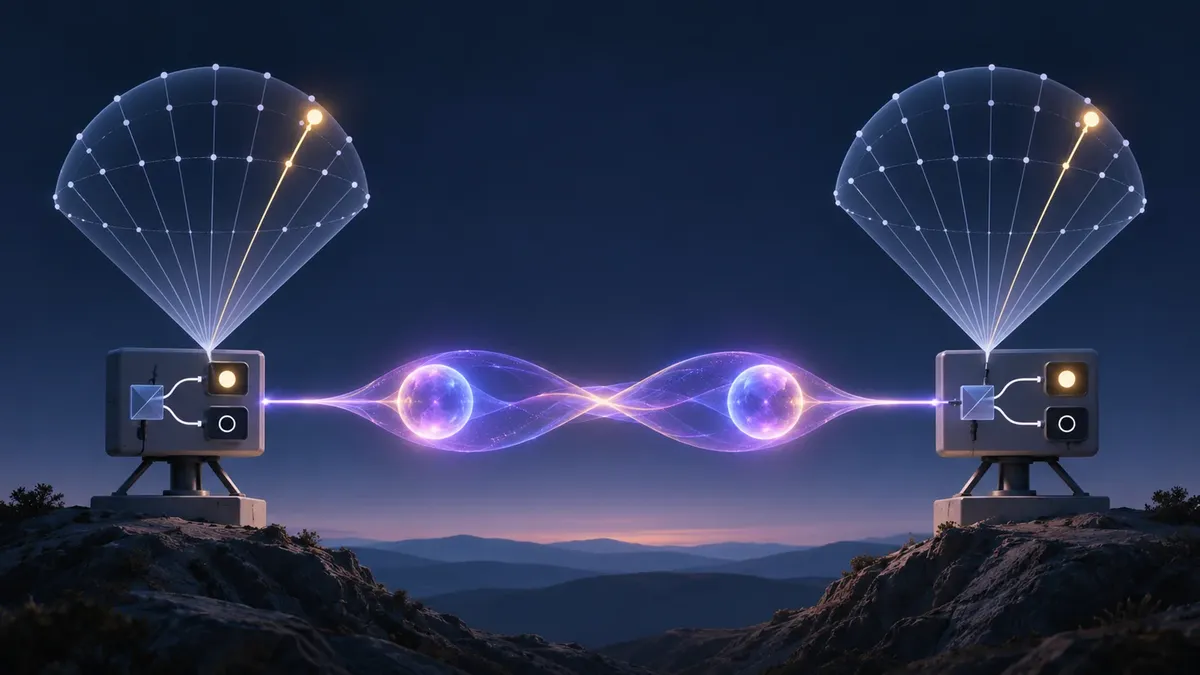
Bell tests can reveal correlations that classical physics cannot explain, but different tests can be better suited to real experiments. This preprint develops a way to systematically choose among tests that have the same ideal quantum behavior.
Why look beyond CHSH?
Bell tests compare measurement outcomes from two separated parties. In the simplest scenario considered here, each party chooses between two binary measurements. The CHSH inequality is a familiar test in this setting, but it is not the only Bell expression that a particular quantum behavior can maximize.
That matters for device-independent randomness certification: researchers use observed Bell-test scores to bound how predictable the outcomes could be, without relying on a detailed model of the devices. A test that works well in ideal conditions may not be the most useful when detectors miss events.
Mapping the available tests
Yutian Wu, Xie Sicheng and Ravishankar Ramanathan study the geometry of the set of quantum correlations in this two-party, two-setting, two-outcome scenario, denoted (\mathcal{Q}_{2222}). They characterize the full “normal cone” at every nonlocal extremal quantum behavior. In accessible terms, this identifies all Bell expressions that are maximized by a given such behavior—rather than just one expression.
The authors also derive an exact variational formula for the quantum bound of an arbitrary Bell expression in this scenario. They illustrate the construction by finding the normal cone for a family of extremal behaviors previously studied in connection with device-independent randomness certification. The abstract does not provide the formula or enough technical detail to assess its derivation here.
What the authors report
The paper then applies this framework to randomness generation under imperfect detection. For each specified detector efficiency from 0.75 to 0.98, the authors say they construct Bell tests and two-qubit experiments that certify more single-round min-entropy from one Bell score than any CHSH score can certify at the same efficiency, even when the quantum devices for the CHSH test are optimized.
Min-entropy describes unpredictability: greater certified min-entropy means a stronger lower bound on how difficult it is to guess an outcome. The comparison is specifically about the paper’s stated setting, efficiency range and one-score, single-round certification—not a general claim that the proposed tests outperform CHSH in every experiment or application.
What remains uncertain
This account is based on the paper’s abstract, not its full text. It therefore cannot explain the construction details, assumptions behind the comparison, or how sensitive the result is to other experimental imperfections. The reported experiments are constructions, not evidence here of a laboratory demonstration. The source is an arXiv preprint; the supplied material does not establish that it has been peer reviewed. The results should be read as the authors’ theoretical claims pending examination of the full paper and any subsequent review.
- quantum physics
- Bell tests
- quantum correlations
- device-independent randomness
- CHSH inequality
- detector efficiency
Reviewed cross-references
These connections were reviewed by a model, not independently fact-checked by a human. Similarity does not imply agreement; consult the original papers and the evidence below.
Could Entangled Spins Reveal Screened Dark Energy?
Shared method: Both studies use the CHSH Bell expression to assess quantum nonlocality: Wu et al. compare randomness certified from a Bell score against CHSH scores, while Feleppa et al. calculate how curved-spacetime spin evolution affects CHSH violation. The shared measure does not make their settings or conclusions directly comparable: one studies device-independent randomness with detector loss, the other a theoretical orbiting-spin scenario.
Model review: · openai-codex/gpt-6-luna
Evidence and provenance
Selected excerpts, not complete papers. PDF extraction can omit figures or damage equations, tables and reading order; sources may be preprints.
2611.27413v1 — Original paper
Excerpt reference:
static/papers/2611.27413v1.md:12-63
Basis: Paper text
Source SHA-256:8d8fa5a870b499acabef8333ba61fdc737cc03be6f38ad9d3d449ba0efd9d7e72508.18448v5 — Original paper
Excerpt reference:
static/papers/2508.18448v5.md:12-59
Basis: Paper text
Source SHA-256:8fe987946db44dd27fc8686917580524fb64d60c803e80757fc92d14b26519e0
Related reading
Automatically matched by shared topic keywords. These links do not imply that the sources agree or establish a consensus.
Could Entangled Spins Reveal Screened Dark Energy?
Source published
Shared keywords: chsh inequality
How phase and spin–orbit interaction shape qubit correlations
Source published
Shared keywords: quantum correlations
Can light reveal a subtly altered phase space?
Source published
Shared keywords: quantum physics
A quantum bound-breaking claim hinges on time evolution
Source published
Shared keywords: quantum physics
Can one principle explain why quantum theory works?
Source published
Shared keywords: quantum correlations