TRANSMISSION // 2611.27409v1
A Model Reexamines Mercury’s Spin-Axis Offset
Source published
An analytical model explores Mercury’s equilibrium spin-axis orientation and how tides, core shape and mantle friction affect predicted offsets, subject to simplifying assumptions.
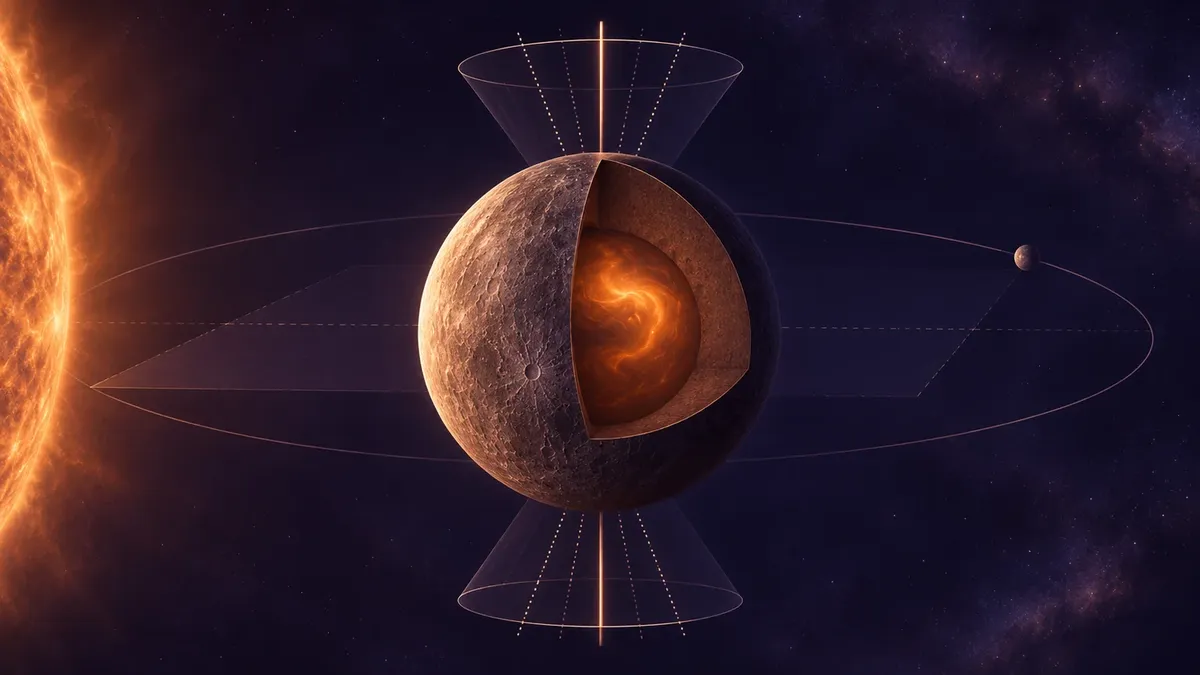
Mercury’s small tilt offers clues about its interior, but interpreting it depends on how the planet’s fluid core and mantle interact. A theoretical study derives approximate analytical equations for the mantle’s equilibrium orientation, revisits an earlier estimate of tidal effects and identifies conditions where a linear approximation may fail.
Mercury’s spin-axis orientation can help researchers investigate the planet’s interior. A fluid core and surrounding mantle may rotate differently, while forces between them and tidal deformation can affect the planet’s equilibrium orientation. Valentin Etienne, Gwenaël Boué and Clodoaldo Ragazzo develop analytical equations for that equilibrium in a model with a fluid core and deformable mantle. The equations address equilibrium orientation, rather than tracing the planet’s rotation through time.
The study asks whether its results match equilibrium positions found in earlier numerical work, and how predicted offsets depend on tides, friction between core and mantle, and core shape. One reference is the Cassini plane, defined by the orbit pole and the normal to the invariant plane. The model considers how far the spin axis lies from this plane.
An analytical model, with constraints
The authors use a Lagrangian formalism and represent the mantle’s orientation with a three-dimensional rotation matrix. The model includes tidal deformation, pressure torques associated with the core’s shape, the orbit’s apsidal precession, and viscous friction at the core–mantle boundary. Other possible coupling mechanisms are left out.
The fluid-core calculation also makes simplifying assumptions: the core and mantle deformation matrices remain proportional, and only a symmetric deformation mode is considered. The authors first compare their formulation with a solid-body case, then add the core. Parts of the analysis use a linear approximation for small orientation changes; the authors also examine nonlinear behavior where that approximation is inadequate.
Under the parameters adopted for comparison, the model reproduces equilibrium positions obtained numerically by Peale and colleagues in 2014. The authors also revisit an earlier analytical estimate of the tidal contribution to the offset from the Cassini plane. In their solid-body calculation, the tidally induced offset is about 100 times smaller than the earlier estimate. They attribute the discrepancy to an incorrect projection of the angular-momentum equations in that analysis. This is a disagreement between calculations, not a new measurement of Mercury’s spin.
In the parameter regimes they explore, the predicted orientation depends on core shape and core–mantle friction. Within the model, sufficiently weak coupling makes it impossible to explain the observed in-plane offset. Some explored cases, particularly those involving a nearly spherical core, also produce a large offset from the Cassini plane. These are conditional results: they do not establish a unique interior structure, and the model’s agreement with observations depends on the chosen parameters.
When the linear approximation breaks down
The authors identify a broader region of parameter space where their linear approximation is no longer valid, involving weak friction and intermediate core flattening. Separately, in the inviscid limit, the nonlinear solution exhibits a bifurcation: the equilibrium behavior branches rather than following a single solution. The paper says this regime involves the core’s angular momentum tilting beyond 30 degrees. It also discusses core obliquities of order 90 degrees in relevant regimes; those refer to the core’s tilt, not the same quantity as the angular momentum tilt. These are model results, not observed core motions.
The leading-order treatment of elastic deformation does not account for the fluid core’s spin obliquity. The authors note that including it could change the direction in which viscous coupling shifts the mantle’s spin axis. Future work could incorporate a solid inner core, more realistic fluid-core rotation, more complex material behavior and a more refined description of Mercury’s orbital motion.
This is a theoretical study, not a report of new spacecraft observations. Its equations may help interpret improved measurements, including those expected from BepiColombo, but cannot by themselves determine Mercury’s interior. The source is an arXiv version of the work; the supplied information does not establish its publication or peer-review status. Its conclusions are model-dependent and should be read alongside the stated assumptions and observational uncertainties.
- Mercury
- planetary rotation
- fluid core
- core–mantle friction
- Cassini plane
- tidal deformation
- BepiColombo
Related reading
Automatically matched by shared topic keywords. These links do not imply that the sources agree or establish a consensus.