TRANSMISSION // 2611.27401v1
Why robot action models can know the target but ignore it
Source published
A preprint finds that making target information easier to read inside a robot action model can improve instruction following in a benchmark test.
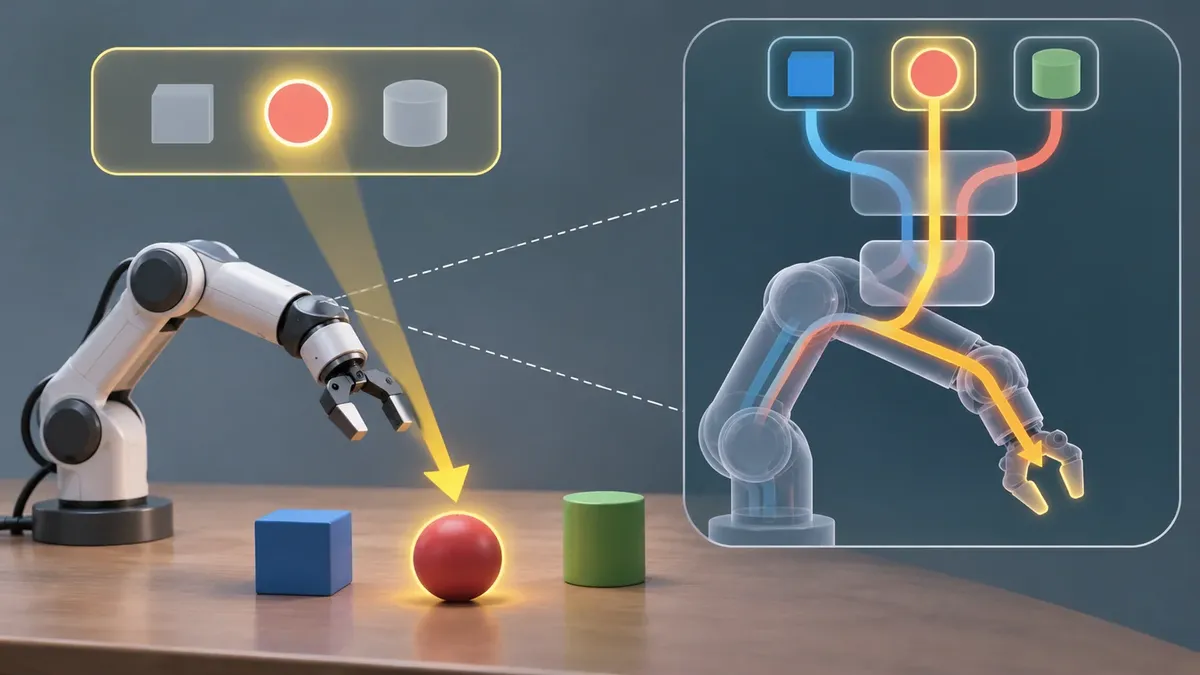
A robot model may represent which object a person named and still act as if that instruction does not matter. A new preprint investigates this gap in world action models and tests a training objective designed to make instruction-related information more accessible.
Knowing the target is not the same as following it
World action models (WAMs) can perform manipulation tasks yet fail to follow language instructions at test time. The authors describe earlier findings that some non-following models still encode information about the instructed target. Their question: might the way that information is represented help explain why it does not reliably guide behavior?
The researchers compare a non-following WAM with an instruction-following counterpart. They report that both encode target information, but it is substantially more linearly decodable in the instruction-following model. In other words, a simple readout can more readily recover the target from that model’s internal representations. This comparison alone does not show that decodability causes better instruction following.
An extra training objective
The team introduces linear decodability supervision (LDS), an auxiliary training objective intended to make information about the instructed target easier to recover from a model’s representations. On the LIBERO-CF benchmark, the abstract reports that InternW0-Δ trained with LDS achieved a 74.6% success rate and an 89.2% grounding rate. The authors say these exceed the strongest baseline by 26.8 and 42.9 percentage points, respectively.
Those are benchmark-specific results. The abstract does not give detailed metric definitions, task-by-task findings, or enough information to evaluate the comparisons independently. The reported figures should not be read as general measures of real-world robot performance.
A proposed explanation—and its limits
The authors propose a prior-instruction competition mechanism: behavior may depend on whether a model’s learned prior or the current instruction signal dominates. They report causal evidence from two training-free interventions derived from this proposal. The abstract does not describe the interventions or their results in enough detail to assess them here. The authors interpret LDS as enhancing the instruction signal, but this account remains a proposed explanation, not proof that the same mechanism applies broadly.
They also report consistent LDS effectiveness in broader evaluations across manipulation tasks and visual domains. The abstract does not specify the full evaluation range or the gains in those settings.
The work suggests that how information is represented may matter, not merely whether it is present. It does not establish that linear decodability is necessary for instruction following or that LDS will transfer to every model, robot, or real-world setting.
This account relies on the paper’s abstract only; it cannot verify training details, comparison fairness, statistical uncertainty, or the methods behind the reported interventions. The work is an arXiv preprint, and its claims should be understood as results reported by the authors pending fuller examination. The full paper and independent testing are needed to judge the evidence and its limits.
- world action models
- robot instruction following
- linear decodability supervision
- robot manipulation
- LIBERO-CF
- arXiv preprint
Related reading
Automatically matched by shared topic keywords. These links do not imply that the sources agree or establish a consensus.
A smarter cache could help robot models act faster
Source published
Shared keywords: robot manipulation, world action models
How a robot model learns from each task
Source published
Shared keywords: world action models
A robot twin built from first-person video
Source published
Shared keywords: robot manipulation
A robot's-eye view, generated from outside video
Source published
Shared keywords: robot manipulation
EgoLAM separates hand motion from camera motion
Source published
Shared keywords: robot manipulation