TRANSMISSION // 2611.27398v1
How TIPO tracks objects as they come apart and fit together
Source published
A new video-tracking approach follows objects through assembly and disassembly, recording how parts and whole objects relate. Its benchmark results are promising, but errors in masks and labels remain important limitations.
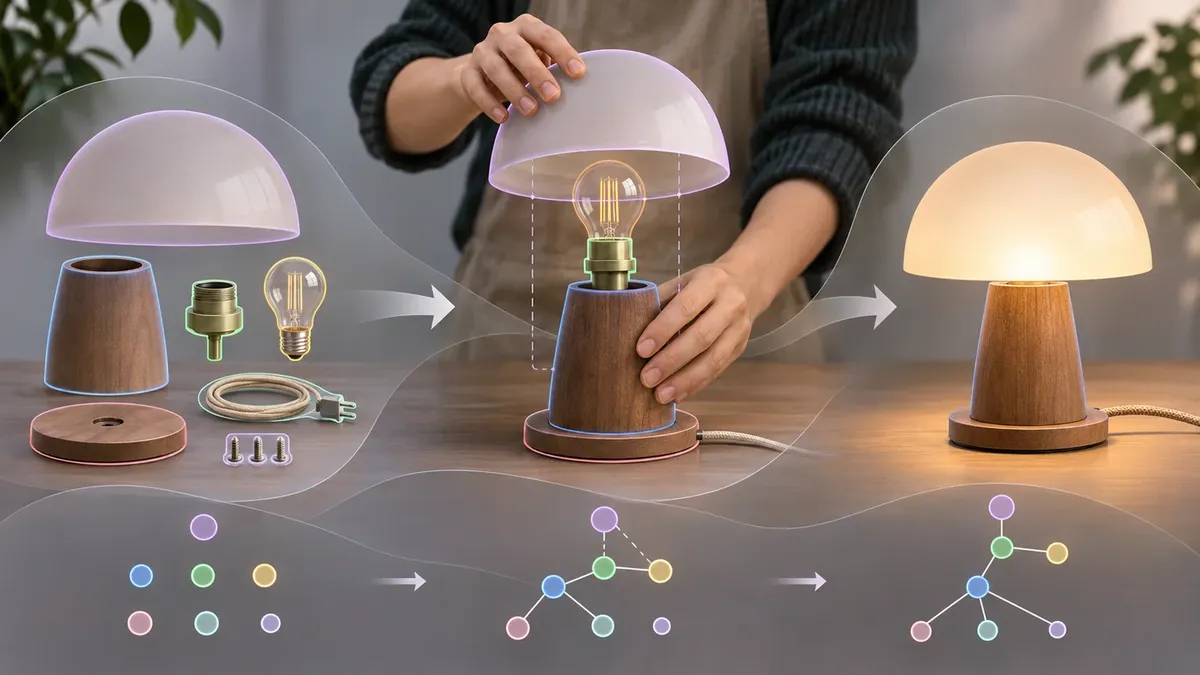
A tracker can follow a mug across a table. But what should it do when the mug is taken apart, or separate pieces are joined into a new object? A preprint introduces a system designed to track these changes and keep a record of which parts become which objects.
When an object changes identity
Many video trackers are built to keep following an object as it moves or changes appearance. Physical transformations pose a different problem: if a person removes a lid, the original object has become separate entities; if pieces are assembled, several objects may become one. Simply preserving the old tracking labels can misrepresent what is happening.
The authors call this broader task Transformation Tracking and Understanding, or TTU. A system must follow object masks through time, detect assemblies and disassemblies, give the resulting objects new identities, and record the relationships in a state graph. The graph links earlier objects to the objects that result, along with descriptions of the changes. In principle, such a record could help a robot check whether an assembly step is complete or help an assistant explain a procedure.
Proposals, overlaps and a visual check
The paper presents TIPO, a training-free framework built on top of video trackers and segmentation models. At each frame, it looks for disconnected pieces within tracked masks and proposes possible splits or merges. It then compares those proposals with masks sampled from a promptable segmentation model, using overlap scores to assess whether the pieces plausibly belong together or to separate objects.
A multimodal language model (MLLM) checks the top-scoring proposal using the current frame and a small selection of earlier frames. If it confirms a transformation, another MLLM step assigns names to the objects and a description to the action. TIPO then updates the graph and tracker. The paper’s claim that the framework requires no additional training refers to TIPO: it still depends on pretrained vision and language models.
To test the approach, the researchers created VISTA, a dataset of 50 video sequences with dense masks and state-graph annotations. The sequences come from existing assembly datasets and new recordings. Together, they contain 124 assembly and 132 disassembly events, across more than 26,000 frames.
Promising results on VISTA
The authors report that TIPO achieved the strongest transformation-tracking and state-graph scores among the compared methods on VISTA, using both SAM 2.1 and SAM 3 as its underlying tracker. In the reported setup, the full system processed video at 1.8 frames per second with SAM 2.1 and 2.4 with SAM 3. The earlier TubeletGraph method ran at 0.2 and 0.4 frames per second, respectively. The paper summarizes this as TIPO being 6 to 15 times faster than prior methods.
TIPO also substantially outscored TubeletGraph on the paper’s structural transformation metric. With SAM 2.1, for example, the reported F1 score was 44.7 for TIPO and 12.5 for TubeletGraph; with SAM 3, it was 42.5 and 3.3. This metric checks not just whether a change was detected, but whether the right objects were linked before and after it. A judge-free version of TIPO was faster, but scored lower on this measure, suggesting that the visual-language check contributed to accuracy in these tests.
These comparisons need context. TubeletGraph is designed for disassembly, not assembly, and its search is triggered by tracking failure. TIPO instead evaluates proposed structural changes at each frame. The paper’s results therefore support its performance on this task and benchmark; they do not establish that it is generally better than all object trackers or more useful in real-world deployments.
What can still go wrong
TIPO depends on the masks produced by its underlying vision models. If a small screw or wheel is missed, the system may miss the transformation involving it. If a mask incorrectly merges a tool with an object, the resulting proposal may create a false transformation. The authors also report that visually ambiguous parts can receive generic or inaccurate names.
There is a further trade-off in the online design: once a transformation is added to the graph, later frames cannot revise it. The paper says subsequent predictions can still return to a state consistent with the visible objects, but an earlier incorrect graph entry remains. In one reported noise test, deliberately corrupted masks reduced transformation-tracking performance, although the MLLM judge helped filter some false proposals.
VISTA is a useful step toward evaluating the task because its annotations connect the inputs and outputs of transformations, rather than recording only the resulting parts. But it contains 50 sequences, and the authors note that missed small parts remain a problem. Performance on this dataset cannot by itself show how the system will behave across the full variety of everyday objects, camera conditions, or longer procedures.
This work is an arXiv preprint, not evidence of peer review in the source provided here. Its findings should be read as the authors’ reported experiments rather than settled conclusions. The central idea is a practical one: tracking a changing object may require tracking not only pixels, but also the evolving relationships between parts and wholes.
- video object tracking
- object assembly
- object disassembly
- computer vision
- multimodal AI
- VISTA benchmark
- TIPO
Related reading
Automatically matched by shared topic keywords. These links do not imply that the sources agree or establish a consensus.
Linked tokens aim to speed multimodal AI
Source published
Shared keywords: multimodal ai
A new way to keep multimodal AI’s interactions in check
Source published
Shared keywords: multimodal ai
Why Multimodal AI Can Forget in Two Places
Source published
Shared keywords: multimodal ai
Tracing and Editing Visual Skills Inside Multimodal AI
Source published
Shared keywords: multimodal ai
Why Multimodal AI Can Forget—and How SAME Tries to Help
Source published
Shared keywords: multimodal ai