TRANSMISSION // 2611.27383v1
Why 360° Drone Tracking Challenges AI
Source published
A benchmark tests whether object trackers can follow targets in panoramic drone video. Its authors identify problems around image seams and latitude, and evaluate a geometry-aware adjustment.
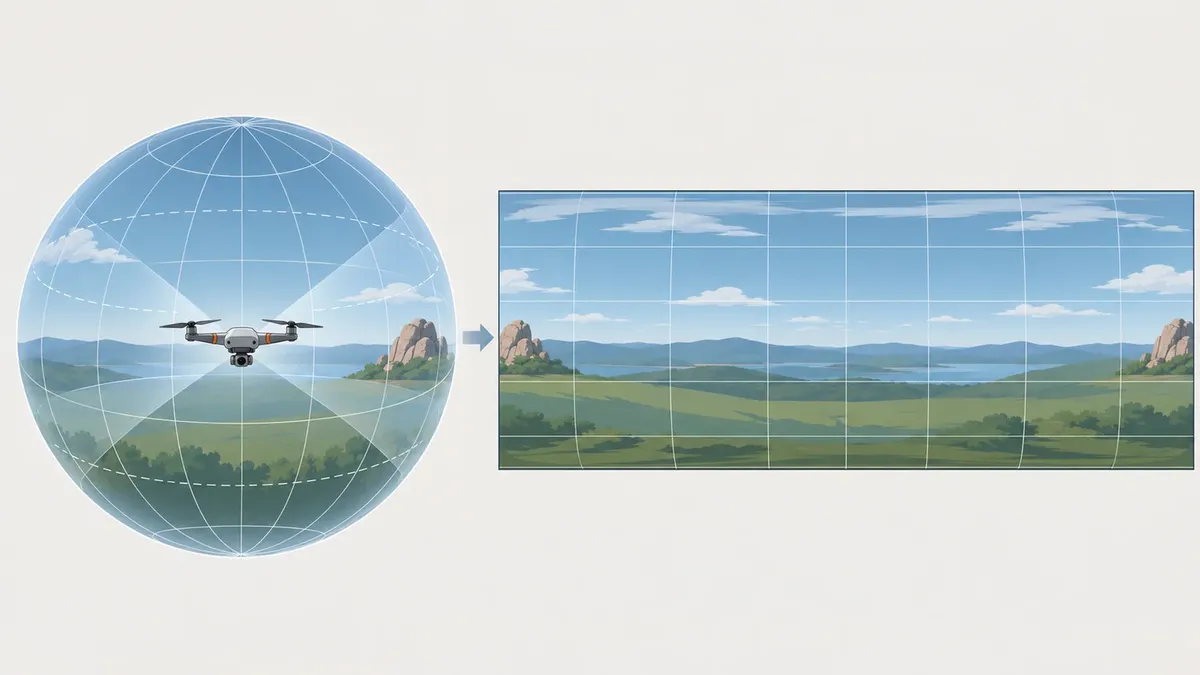
A target can remain in a drone’s surroundings yet slip out of a conventional camera’s view. Panoramic cameras capture a wider field, but flattening their spherical view into a rectangle creates challenges for tracking software. PanoUAV-Track gives researchers a benchmark for studying those challenges.
The challenge of tracking in every direction
Many drone-tracking systems use perspective cameras, which capture a limited field of view. A panoramic camera can capture the surrounding spherical field, but its image is commonly represented as a rectangle using equirectangular projection (ERP). This representation brings geometric complications: the image’s left and right edges correspond to neighboring directions, while distortion varies with latitude.
A target crossing the ERP boundary can therefore appear on opposite sides of the rectangle, even though its movement in the spherical view is continuous. The researchers ask whether trackers developed for perspective images generalize to full-spherical UAV video, and whether adapting their search to the image geometry can help.
Building a benchmark from drone video
Bingyu Li and colleagues introduce PanoUAV-Track, built from about 40 hours of real-world 8K panoramic video recorded using UAV-mounted cameras, supplemented by simulated sequences. The benchmark contains 1,895 sequences, 507,961 frames and 2,872 annotated target trajectories. It covers daytime and nighttime real-world scenes as well as simulation, and supports visual-prompt, language-prompt and joint visual–language tracking. In the paper, visual prompting uses an initial target bounding box; it is not simply an image supplied as a prompt.
For annotation, people selected targets and initial bounding boxes. An existing tracker propagated the boxes, after which annotators inspected and corrected trajectories frame by frame. Language descriptions were first generated with AI assistance, then reviewed and corrected by people. The supplement reports that video was resized to 1920 × 960 for annotation and evaluation.
The team tested trackers in two settings. In zero-shot tests, they used released pretrained checkpoints without fine-tuning on PanoUAV-Track. In in-domain tests, trackers were trained on the benchmark’s training split and evaluated on its test split. Measures included box overlap, calculated with a circular IoU that accounts for ERP’s horizontal wraparound. The researchers also reported Angular Precision: whether the predicted target center was within a fixed 3° of the annotated center on the viewing sphere.
A geometry-aware adjustment
The paper reports that tested perspective trackers generally performed worse on full-spherical UAV observations than on matched perspective views. Its analyses also find performance differences associated with latitude and ERP seam crossings. These are results from the benchmark and its evaluation protocols; they do not establish that projection geometry explains every tracking error.
The proposed method, PanoUAV-Tracker (PUTrack), modifies how an existing tracking network constructs its search image, rather than replacing the network. Latitude-adaptive sampling adjusts the horizontal search area according to the target’s estimated latitude. Seam-aware sampling treats the ERP’s left and right boundaries as neighbors, drawing pixels from the opposite edge when a search region crosses the seam.
In the paper’s main zero-shot comparison, PUTrack achieved 84.75% overall AUC. The strongest baseline on that measure in the comparison was MCITrack, at 77.63%. The authors also report higher seam-related scores for PUTrack, but those results use distinct metrics for targets crossing the seam and for frames around seam events; they should not be treated as interchangeable. The paper reports improvements in its in-domain tests too. These are benchmark results, not evidence that the method will perform equally well with every drone, camera or real-world task.
What remains uncertain
The supplement describes a scene-disjoint split: clips from the same known recording session or simulated episode were kept in one split. That helps limit overlap between training and test data, but does not show how well the benchmark represents every kind of flight, setting or target.
The authors also tested on 360Tracking, a separate panoramic tracking dataset comprising 21 sequences. They report improvements there, especially on seam-related measures, but explicitly caution that the benchmark’s limited scale warrants restraint about broader conclusions.
The perspective comparison has another important qualification. To create perspective sequences, the researchers rendered views from virtual cameras oriented toward the targets. They describe the comparison as a reference between two specified observation setups—not as an independent test of a drone actively steering its camera. PUTrack reduced the reported perspective-to-spherical performance gap in daytime and simulation, while nighttime generalization remained more challenging.
PanoUAV-Track offers a way to study full-spherical tracking from moving UAVs, and PUTrack illustrates how search and sampling can account for image geometry. The evidence described here comes from an arXiv preprint, which should be treated as a research report rather than a conclusion independently established through peer review. The authors say code and benchmark resources will be made available.
- drone tracking
- computer vision
- panoramic video
- equirectangular projection
- object tracking
- UAV
Related reading
Automatically matched by shared topic keywords. These links do not imply that the sources agree or establish a consensus.
How TIPO tracks objects as they come apart and fit together
Source published
Shared keywords: computer vision
A Shortcut for Calling Tools Inside a Language Model
Source published
Shared keywords: object tracking
SplatLab puts an AI research loop to work on 3D scenes
Source published
Shared keywords: computer vision
Why AI explanations should pass through the decoder
Source published
Shared keywords: computer vision
Reading smoke’s motion to find hidden wildfire flames
Source published
Shared keywords: computer vision