TRANSMISSION // 2611.27368v1
A value gap may reveal when AI teammates are out of sync
Source published
A proposed test-selection method uses disagreement between agents’ Q-values to prioritize states that may expose coordination failures in cooperative reinforcement learning.
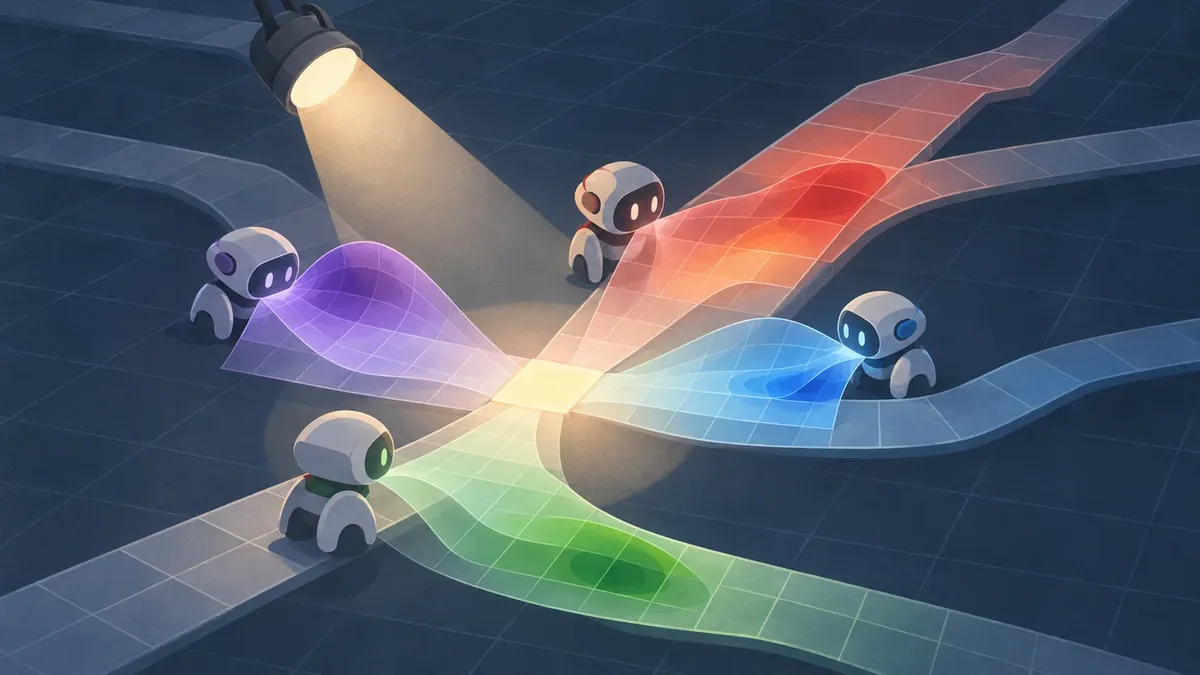
When several AI agents share a goal, a system can still fail because the agents do not coordinate. A new method called DisQ aims to help testers find such failures by looking for disagreement in agents’ estimates of future reward. In four benchmark environments, the authors report improved failure detection in most tested configurations compared with two testing approaches adapted from single-agent reinforcement learning.
Cooperative AI teams can fail even when every agent is trying to achieve the same objective. In multi-agent reinforcement learning, agents learn through interaction, and their shared reward may not capture every safety requirement. A team might earn a good score while still behaving in a way its designers would consider unsafe. Finding the states that lead to such failures is therefore an important testing problem.
In Testing for Coordination Failures in Cooperative Multi-Agent Reinforcement Learning, Dennis Gross, Jørn Eirik Betten and Helge Spieker propose a way to prioritize tests for one kind of learned system: value-based cooperative multi-agent reinforcement learning, or CMARL. Their method, DisQ, looks for states where agents’ estimates of future return diverge.
A disagreement signal for testing
In value-based reinforcement learning, a Q-value is an estimate of the long-term reward associated with a state and action. The paper’s proposed “Q-value gap” uses differences between agents’ estimates as a signal of possible miscoordination. If the gap exceeds a calibrated threshold, DisQ marks the state as worth testing. It skips states without a gap, according to the abstract.
This offers a practical testing idea: use information already available from a trained system to decide which situations to execute, rather than spending the same testing effort on every candidate state. The authors describe the gap as explainable and computable from a single state without running the system. That makes it a way to select tests, not a guarantee that a flagged state will produce a failure—or that an unflagged state is safe.
The researchers evaluated DisQ in four CMARL benchmark environments. They compared its failure detection with random testing and search-based testing using genetic algorithms, both approaches originally associated with single-agent reinforcement-learning testing and applied here to the multi-agent setting. The abstract reports that DisQ improved failure detection in most evaluated configurations.
What the result does—and does not—show
The reported comparison is encouraging, but the available evidence here is limited to the paper’s abstract. It does not give the benchmark names, detailed results, uncertainty estimates, or the configurations in which DisQ did not improve detection. It also does not specify how the threshold is calibrated. Those details matter for judging how consistently the method works and how much effort calibration requires.
A Q-value gap is an indicator of potential coordination trouble, not a direct measurement of safety. The abstract does not establish that the signal identifies every dangerous behavior, or that a flagged state will lead to a harmful outcome. Nor does it show that the method transfers beyond the tested benchmark environments or to systems that do not use the relevant value-based learning setup.
The distinction is important: the proposal is about finding potentially revealing test cases, not preventing failures or certifying a policy as safe. Its usefulness depends on whether the signal helps testers uncover failures they would otherwise miss, and on how well that result holds across tasks and implementations.
The work is an arXiv preprint, and the source material available for this article is the abstract rather than the full paper. The findings should therefore be read as the authors’ summary of experiments, not as independent confirmation or a complete account of the evaluation. DisQ presents a focused approach to a less-studied problem—testing coordination in cooperative AI—but further detail and validation are needed to assess its reach.
- multi-agent reinforcement learning
- AI safety testing
- coordination failures
- Q-values
- DisQ
- reinforcement learning
Related reading
Automatically matched by shared topic keywords. These links do not imply that the sources agree or establish a consensus.
Teaching AI teams to react to adversaries with logic
Source published
Shared keywords: multi agent reinforcement learning
CARGO trains simulated vehicles to distinguish helpful cooperation from avoidable risk
Source published
Shared keywords: multi agent reinforcement learning
An AI city-building game explores the trade-offs of urban resilience
Source published
Shared keywords: multi agent reinforcement learning
AI swarms learn when to share—and when to split the search
Source published
Shared keywords: multi agent reinforcement learning
Can language-model feedback help edge servers share resources?
Source published
Shared keywords: multi agent reinforcement learning