TRANSMISSION // 2611.27365v1
One Pocket-Sized Model, Three Multimodal Skills
Source published
WePM combines image-and-language retrieval, response generation and structured decisions in one model. Its benchmark results are promising, but agentic skills remain a limitation.
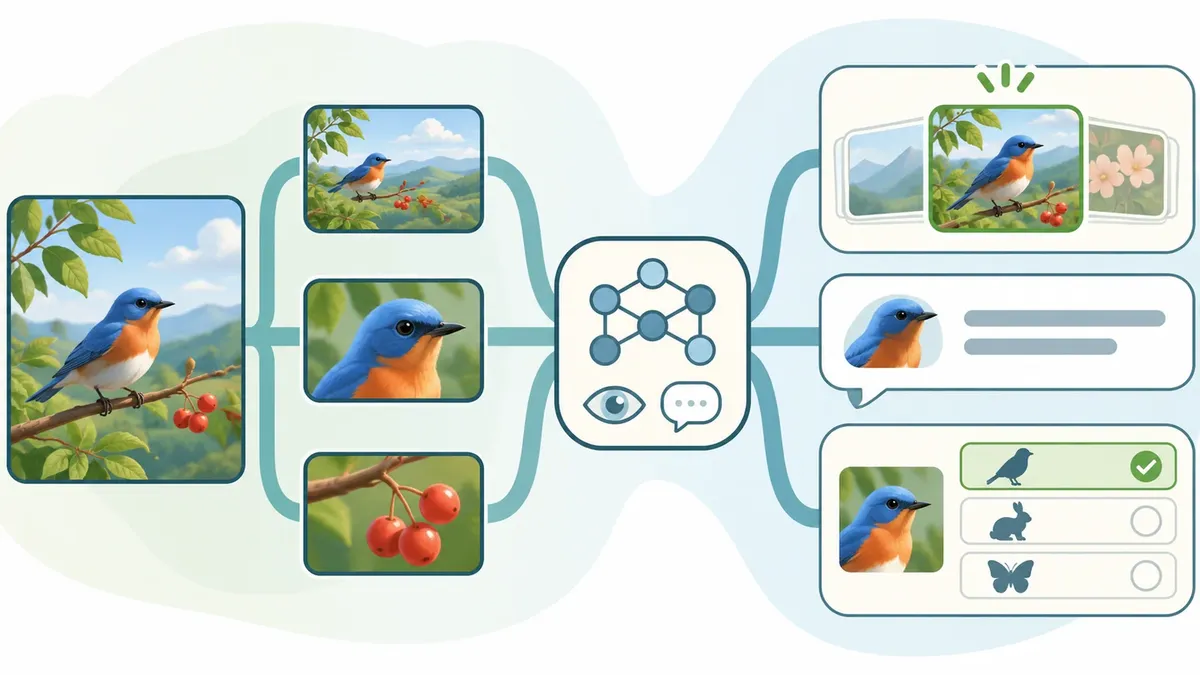
Can one compact vision-language model search, describe and make bounded decisions about visual information without requiring a separate specialist for each job? A new paper introduces WePM, designed to share model capacity across those tasks and reduce the memory needed for model weights.
Why combine these capabilities?
An on-device assistant might need to retrieve a relevant photo, read text in an image, answer a question about it, or choose among options supplied by an app. These jobs use different outputs: retrieval produces an embedding for matching, generation produces text, and a typed decision returns a constrained choice, score or yes/no judgment.
Running separate specialist models can duplicate vision-and-language components, using more memory. But putting several objectives into one shared model creates its own challenges: tasks may need different levels of visual detail, and training updates that help one task may interfere with another. The WeChat AI-led research team presents WePM as an attempt to manage those trade-offs in a compact model family.
The paper proposes a measure called heterogeneous capability density, or HCD. A task family counts toward the measure only if it meets a specified performance threshold. HCD then combines the number of qualifying families with their balanced performance and divides by resident inference memory. In the reported comparison, the three families receive equal weight. HCD is a proposed evaluation measure, not a universal standard; its result depends on the chosen task families, thresholds, weighting and memory assumptions.
Three ways to coordinate shared capacity
WePM uses a shared vision-language backbone but gives each capability an appropriate output path. The authors describe three main strategies:
- Multi-Granularity Visual Budgeting (MGVB) allocates a fixed number of visual tokens among global, regional and fine-detail representations. Text accompanying an image helps select relevant regions and patches; when no text is available, selection is query-independent.
- Unified Listwise Knowledge Distillation (ULKD) uses guidance from separate generation and embedding teachers. Rather than inventing one supposedly correct response for an open-ended retrieval query, it transfers softer preferences: token probabilities for generation and candidate rankings or representation guidance for retrieval. Decision training retains its native typed objective.
- Stable and Efficient Multitask Optimization (SEMO) sets task weights and how often each task contributes to training updates. It accumulates gradients batch by batch, releasing each batch’s computation graph rather than keeping all task graphs in memory at once.
The researchers fine-tuned all parameters of 4-billion- and 2-billion-parameter Qwen3.5-based models. The combined training corpus contained about 100 million cleaned samples. Training used a 7:5:1 sampling ratio for generation, embedding and decision batches in the full-capability setup. Evaluation drew on separate benchmark collections: 30 embedding, 39 generation and seven typed-decision benchmarks. The paper also compared unified systems on a shared retrieval-and-generation test spanning five groups, so those results should not be confused with the broader single-task averages.
What the evaluations report
In the shared retrieval-and-generation comparison, WePM scored 52.74 on the paper’s Joint measure, compared with 38.15 for the strongest listed baseline. That measure averages retrieval and generation aggregates equally. This is a benchmark result, not a measure of everyday usefulness or a guarantee of better performance on every task.
Across the specific selected benchmarks and models compared, WePM-4B had the highest reported average for each capability family: 72.86 for embedding, 62.41 for generation and 61.11 for typed decisions. The paper describes the embedding advantage over one specialist model as narrow, and the decision average as only slightly above a competing model. These averages summarize varied benchmark scores; they do not mean WePM won every benchmark or establish a general ranking across all models.
For the memory comparison, the authors assembled six stacks of separate specialist models, holding the decision component fixed while varying generation and embedding specialists. Under their BF16 weight-memory accounting, WePM used 8 GB of resident weights, compared with 21 GB for the separate stack with the highest HCD. The paper reports WePM’s balanced score as 65.06 and the separate stacks’ scores as 64.21–64.82; it describes the highest-HCD stack as 0.45 points below WePM. WePM’s HCD was reported as 0.244 versus 0.092 for that stack. These results apply to the selected models, benchmarks, equal-family weighting and weight-memory calculation—not total device memory, energy use or all possible deployments.
The component ablations provide limited evidence about the design choices. In controlled tests of the shared representation–generation setting, adding teacher guidance and replacing fixed pseudo-responses with student-generated continuations for distillation improved the Joint score over the hard-label baseline. Visual-token budget tests in that same two-capability setting showed trade-offs: more tokens generally improved the combined score across the tested range, while the most aggressive compression harmed OCR. These results do not establish that the same settings will work best in other models or applications.
What remains uncertain
The authors acknowledge that WePM loses some agentic capability relative to its original Qwen backbone. The work did not include dedicated training to preserve or strengthen tool use and multi-step interaction. SEMO’s weights and exposure schedules are set from the training mixture rather than adapted as learning changes, which may limit flexibility when tasks or data distributions shift.
The source is an arXiv paper; the supplied information does not establish its peer-review status. Benchmark comparisons depend on dataset selection, scoring protocols, model versions and baseline choices. The memory figures cover resident model weights under a specified precision, not every deployment cost. And benchmark performance alone does not establish that the model will protect privacy in practice, run smoothly on a particular device, or make reliable decisions in real-world use.
For now, WePM is best understood as an approach to packing several multimodal functions into one shared model. Its reported results suggest that sharing can be competitive on the authors’ chosen tests while reducing weight memory against their selected specialist stack. How well that balance transfers to real applications remains an open question.
- WePM
- multimodal AI
- vision-language models
- on-device AI
- model memory
- multitask learning
- knowledge distillation
Reviewed cross-references
These connections were reviewed by a model, not independently fact-checked by a human. Similarity does not imply agreement; consult the original papers and the evidence below.
UniCompress packs four vision-language skills into a smaller model
Supporting evidence: Both papers report that one compact vision-language model can serve multiple task types while reducing deployment weight memory: WePM reports slightly higher balanced performance than its best-HCD separate-model stack with 61.9% less resident weight memory, while UniCompress reports retaining most of its consolidated teacher’s performance across four tasks at 2.1 GB rather than 8.9 GB. These are results from different tasks, model setups and evaluation protocols, so they support feasibility in their respective settings, not a direct performance comparison.
Model review: · openai-codex/gpt-6-luna
Evidence and provenance
Selected excerpts, not complete papers. PDF extraction can omit figures or damage equations, tables and reading order; sources may be preprints.
2611.27365v1 — Original paper
Excerpt reference:
static/papers/2611.27365v1.md:1070-1110
Basis: Paper text
Source SHA-256:e5d4deb599d323672e8b8152169a8a82e3bba3df66ee53ba4f185a9ae95f670b2611.06075v1 — Original paper
Excerpt reference:
static/papers/2611.06075v1.md:652-709
Basis: Paper text
Source SHA-256:a95dd41bceb3c51babe1bc390b6b684bf56017c96cce08bb58311057a7c5a41b
Related reading
Automatically matched by shared topic keywords. These links do not imply that the sources agree or establish a consensus.
AI image preferences can transfer through unrelated number training
Source published
Shared keywords: knowledge distillation, multimodal ai, vision language models
Getting language models onto small devices takes more than shrinking them
Source published
Shared keywords: on device ai
Teaching diffusion models to do more with fewer decoding steps
Source published
Shared keywords: knowledge distillation, vision language models
UniCompress packs four vision-language skills into a smaller model
Source published
Shared keywords: knowledge distillation, vision language models
Why a personal AI assistant needs to find the right person first
Source published
Shared keywords: multimodal ai, vision language models