TRANSMISSION // 2611.27352v1
PAVE gives AI a rulebook for mapping intersections
Source published
PAVE combines vision-language models with geometric measurements, traffic rules and network checks to map lanes and make road-network edits.
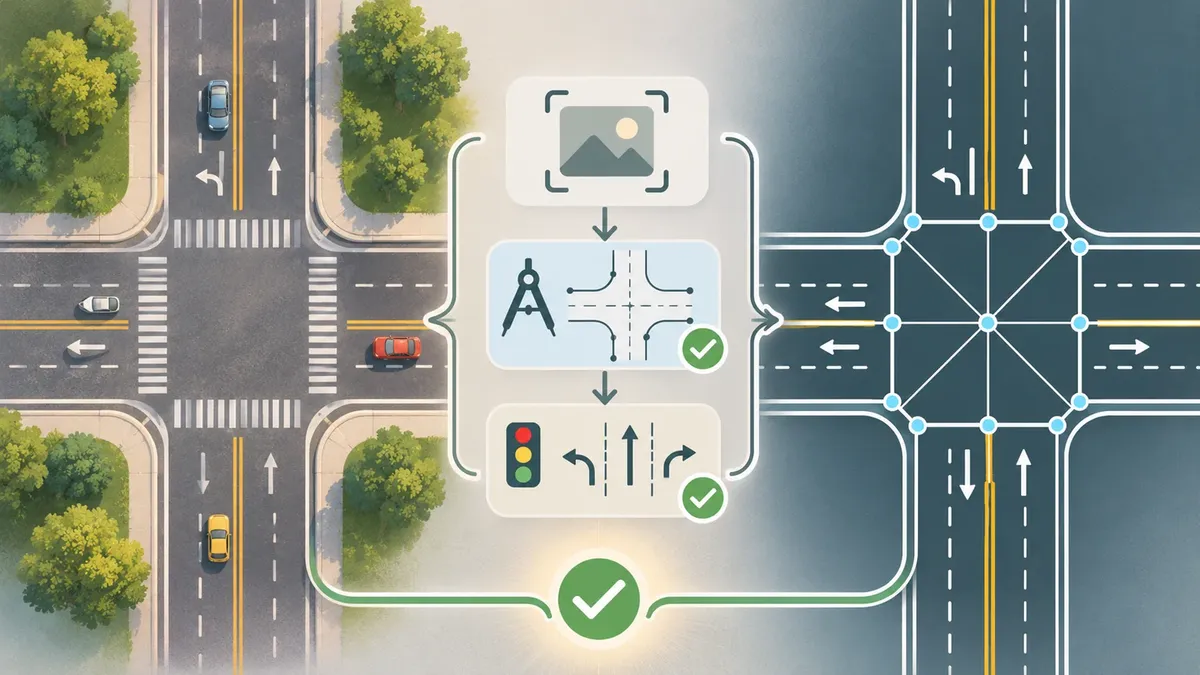
Road-network maps need more than street outlines: they must represent lanes and the turns allowed at intersections. PAVE is a proposed workflow that shares the task between software that measures and checks geometry and vision-language models that interpret images and planning requests.
Why road maps need careful checking
Traffic simulations and planning tools depend on road networks that describe details such as lanes and permitted movements at intersections. Building these details by hand takes work, while open map data can be incomplete or inaccurate. In the test described by the authors, OpenStreetMap lane tags correctly described the layout for 13 of 44 approaches. Satellite and street-level imagery covered all 44, but direct requests to vision-language models (VLMs) could lose geometric consistency across different views and an ID-labelled network.
A division of labor
The researchers present PAVE, short for Perceive, Anchor, Verify, Edit. Instead of asking a VLM to do everything, the workflow uses code for measurable geometry and repeatable checks, traffic-engineering knowledge for general rules, and the model for judgments that require interpreting imagery or a planning brief. Model outputs are tied to network IDs, allowing checks to flag contradictions with measurements, another reading or a traffic rule.
For lane layouts, the approach includes tracing lanes and asking the model to assess one intersection approach at a time. For planning edits, the model identifies relevant network links and nodes; code then builds the change from a design template. Because the available source is only the abstract, it does not provide enough detail to independently assess the imagery, checks or full experimental setup.
What the abstract reports
At signalised intersections, the share of exactly correct lane layouts rose from 49–64% with a single request to 86–91% with PAVE, across two VLMs. The authors say most of the gain came from reading one approach at a time on traced lanes.
In a separate test of 18 planning edits, 16 passed every network check; two contained a design or coding error. The abstract compares this with an approach in which the model wrote its own code: none of those edits passed every check, and seven had a design or coding error. These findings describe the reported tests, not a guarantee that an edit will be safe or suitable in practice.
What remains uncertain
The supplied source is the paper’s abstract, not its full methods or results. It does not give enough information about study sites, evaluation procedures or broader testing to judge how well the findings generalize to other places, images, network types or planning tasks. The reported figures should be read as results from the authors’ evaluations, not as proof of performance in real-world deployment.
The work is an arXiv preprint, and the supplied material does not establish that it has undergone peer review. PAVE’s central idea is to check model judgments against measurements and rules rather than treat them as measurements themselves. How reliably that workflow works beyond the reported tests remains an open question.
- road networks
- vision-language models
- transportation planning
- traffic engineering
- artificial intelligence
Related reading
Automatically matched by shared topic keywords. These links do not imply that the sources agree or establish a consensus.
Can Rewritten Captions Make an AI Stop Recognizing a Face?
Source published
Shared keywords: artificial intelligence, vision language models
A Navigation Memory That Recognizes Similar Routes Across Different Homes
Source published
Shared keywords: artificial intelligence, vision language models
When a Chest X-ray Leads AI to Invent Findings in a Photograph
Source published
Shared keywords: vision language models
Teaching medical AI to stop inventing findings can also expose what it misses
Source published
Shared keywords: vision language models
STAR Gives Task-Relevant Image Pixels Stronger Protection
Source published
Shared keywords: vision language models