TRANSMISSION // 2611.27350v1
When Relevant Facts Still Don’t Add Up
Source published
A controlled GraphRAG benchmark finds that relevant facts may not be sufficient evidence—and tests whether a system can recognise missing support.
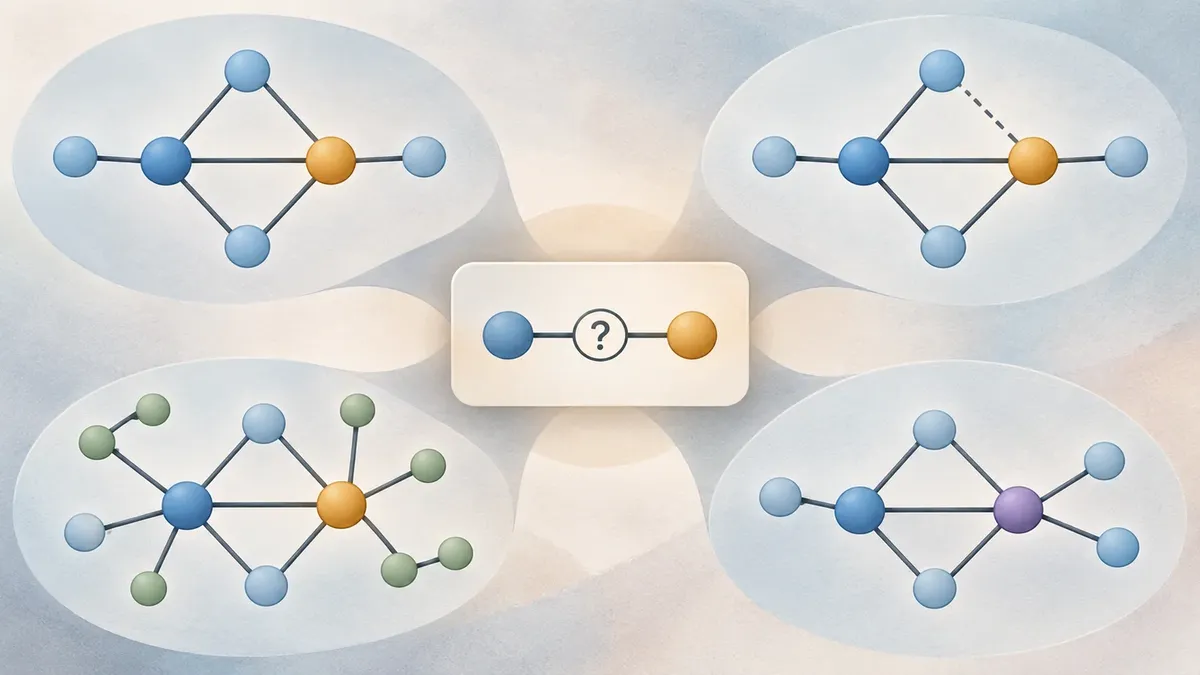
A language model may answer from memory rather than a retrieved knowledge graph. GRACE tests how the same question fares when the graph is intact, incomplete, distracting, or altered to support a different answer.
A knowledge graph can give an AI system a structured trail of facts to follow. But when the system answers correctly, how can we tell whether it used that trail—or simply recalled the answer from its training? And if the evidence is flawed, can it distinguish a missing link from a distracting one?
Those questions motivate GRACE, a benchmark and evaluation method for GraphRAG: systems that combine a language model with information retrieved from a graph. The researchers’ central idea is to keep the question fixed while changing the graph evidence. That makes it easier to examine how a system responds to different evidence conditions, rather than mixing those effects with differences in question difficulty.
Five versions of the same evidence
The team built GRACE from questions in LC-QuAD 2.0, a dataset of questions that can be translated into database queries. They ran those queries against Wikidata, a collaborative knowledge base, to find answers and supporting paths through the graph. For each question, they created five matched graph states: an intact graph; a “broken” one with a necessary link removed; one with plausible, type-compatible distractors; one with highly connected graph nodes added; and one where the supported answer was replaced by a distinct entity in a coherent graph.
The question and positions of four multiple-choice options stayed the same across the five states. The correct choice changed where appropriate: for example, a graph with a severed support path should lead the system to choose “Insufficient information.” The altered-answer state tests whether it follows the supplied graph, even when that graph supports an answer different from the one it may remember.
After validation, the benchmark contained 4,028 questions, each tested in all five states, for 20,140 question–graph pairs. The researchers also evaluated QCFSE, a proposed evidence-organising model, and QCFSE-SA, which adds a separate graph-support gate. That gate estimates whether the graph as a whole supports an answer and can allow the system to abstain when it does not. In the paired comparison, the generator and factual graph context were held fixed; the added system supplied guidance about the evidence and, for QCFSE-SA, whether it seemed sufficient.
Relevance is not proof
One key result is that evidence can be relevant without being enough. QCFSE improved accuracy on the benchmark’s states where the graph still supported an answer. But on broken graphs, it reduced accuracy from 55.41% for the plain generator to 47.39%. The remaining facts could still look useful, even though they no longer formed a complete path to the answer.
Adding the support gate changed that pattern. Across the five states, controlled-state accuracy rose from 57.17% for the plain generator to 62.78% with QCFSE-SA, a gain of 5.61 percentage points. The reported question-clustered 95% confidence interval for that gain was 5.04 to 6.17 points. On broken graphs, accuracy increased from 55.41% to 67.85%.
The improvement was not uniform. On type-compatible distractor graphs, QCFSE-SA scored 60.10%, compared with 62.14% for the plain generator. The authors identify over-abstention on answerable but difficult distractor graphs as an unresolved calibration problem. A system that learns to say “not enough evidence” can also become too cautious.
The benchmark also exposes a limitation of routing decisions made from the question alone. A question-only gate must make the same routing choice for every evidence version of that question, even though the graph may be complete in one version and insufficient in another. The open-ended gate gained 1.40 percentage points over always retrieving, while saving 11.59% of retrieval calls. The option-aligned gate saved 68.42% of calls but lowered average accuracy by 2.32 points. The results suggest that evidence-sufficiency decisions may require inspecting the evidence itself.
What the results do—and don’t—show
GRACE offers a controlled way to probe particular failure modes, but its results have boundaries. The benchmark comes from one question dataset, one knowledge graph, and one query form. The main paired model comparison uses one frozen generator, so the results do not establish that the method will work equally well with other models or data. The authors also note that about 99% of broken-graph serialisations contain an “Unknown entity” cue, which may help the system recognise that state.
Some baseline runs were incomplete or had low completion rates, so the paper cautions against treating them as a definitive ranking of GraphRAG frameworks. And the altered-answer test measures whether a system follows the supplied graph, not whether that graph reflects external reality.
The source is an arXiv preprint; the supplied source does not establish peer-reviewed validation. GRACE is best read as a diagnostic proposal and a reported controlled experiment: it makes visible why getting a plausible answer, or finding relevant facts, is not the same as having sufficient evidence.
- GraphRAG
- knowledge graphs
- retrieval-augmented generation
- AI evaluation
- evidence sufficiency
Reviewed cross-references
These connections were reviewed by a model, not independently fact-checked by a human. Similarity does not imply agreement; consult the original papers and the evidence below.
ArcRAG Tests Whether AI Can Search Differently Built Knowledge Graphs
Supporting evidence: Both studies make relational paths central, but test different stages: GRACE reports that severing a supporting path can reduce answer accuracy under fixed evidence conditions, while ArcRAG evaluates multi-hop retrieval across two graph constructions. Together they support the bounded point that path structure matters to graph-based QA; the datasets, interventions, and outcomes are not directly comparable.
Model review: · openai-codex/gpt-6-luna
Evidence and provenance
Selected excerpts, not complete papers. PDF extraction can omit figures or damage equations, tables and reading order; sources may be preprints.
2611.27350v1 — Original paper
Excerpt reference:
static/papers/2611.27350v1.md:65-122
Basis: Paper text
Source SHA-256:b8d436cd230466ab443b0fad8d9a0f7949793ab4f8fd549871b58e35cb9bdf192611.27350v1 — Original paper
Excerpt reference:
static/papers/2611.27350v1.md:948-1008
Basis: Paper text
Source SHA-256:b8d436cd230466ab443b0fad8d9a0f7949793ab4f8fd549871b58e35cb9bdf192611.06481v1 — Original paper
Excerpt reference:
static/papers/2611.06481v1.md:13-83
Basis: Paper text
Source SHA-256:37a0ae5c4c4011b5659171cb1d7c48a529d349d95eeffd5ad114ff9a32487ff12611.06481v1 — Original paper
Excerpt reference:
static/papers/2611.06481v1.md:801-892
Basis: Paper text
Source SHA-256:37a0ae5c4c4011b5659171cb1d7c48a529d349d95eeffd5ad114ff9a32487ff1
Related reading
Automatically matched by shared topic keywords. These links do not imply that the sources agree or establish a consensus.
Protecting the relationships an AI search system can reveal
Source published
Shared keywords: knowledge graphs, retrieval augmented generation
DotRAG narrows graph searches by reasoning along likely paths
Source published
Shared keywords: knowledge graphs, retrieval augmented generation
ArcRAG Tests Whether AI Can Search Differently Built Knowledge Graphs
Source published
Shared keywords: knowledge graphs, retrieval augmented generation
Type-aware graph rankings offer a way to guide AI retrieval
Source published
Shared keywords: knowledge graphs
Lightfoot builds an AI retrieval graph designed to forget documents cleanly
Source published
Shared keywords: retrieval augmented generation