TRANSMISSION // 2611.27344v1
Teaching robot video models to focus on what moves
Source published
MoReWorld guides a robot video model toward parts of a scene expected to respond to an action. It scores best overall on one simulator benchmark, but trades some conventional visual quality for stronger interaction predictions.
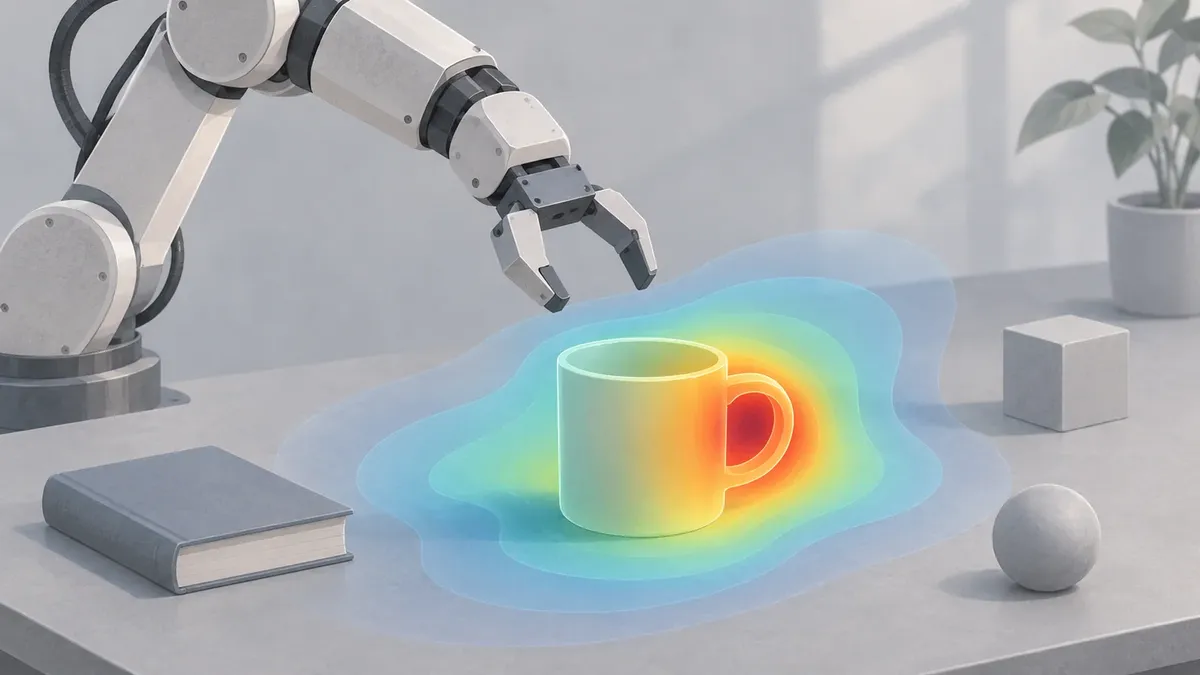
A generated robot video can look convincing yet get the consequences of a grasp or push wrong. MoReWorld addresses this by predicting where the environment may move and using that estimate to guide video generation.
A video-based robot simulator has to do more than make plausible-looking frames. If a model predicts that an object stays upright when a robot should knock it over, an evaluator could mistake the imagined outcome for success. The interaction may occupy only a small part of the image, while most pixels show an unchanged background.
In an arXiv preprint, Yongkang He, Xiaofen Xing and Xiangmin Xu introduce MoReWorld, a video world model designed to give those local interactions more attention. Their central question: can a model predict where a scene is likely to respond to a robot’s action, then use that prediction to generate a more faithful future video without seeing the future first?
A map of likely motion
The authors call the action-responsive part of the environment the “motion region.” Before generating future frames, MoReWorld predicts a probability map of where the environment will move. The estimate uses visual history, robot state and commanded actions; inference does not require future images or motion labels.
During training, the researchers use optical flow—an estimate of how pixels move between frames—to identify moving and relatively static areas. They mask out the robot, whose movement is already specified by the action, so training can focus on the environment’s response. These labels supervise motion prediction and help weight the video-generation losses, so a small moving object is not overwhelmed by a large, mostly static background.
The predicted map also controls where future visual features influence the video generator. In areas expected to move, those features have greater influence; elsewhere, the model keeps a weaker conditioning signal rather than dropping it altogether. A separately rendered representation supplies the robot’s appearance. At inference, the model generates from its current history and actions, then feeds its own generated frames into later predictions.
What the benchmark measured
The team trained MoReWorld on episodes from RoboTwin 2.0 and evaluated it on the RoboTwin subset of WorldSimProbe. The benchmark includes five tests: Local measures whether actions produce the expected robot motion under action perturbations; Global tests action realization when trajectories from other tasks are replayed; Source tests action realization under different control sources. Ground measures whether objects stay still in no-contact rollouts, while Dynamics checks whether an interaction matches its intended primitive.
MoReWorld achieved an overall score of 61.21 on the benchmark’s 0–100 scale, the highest among the six compared models. It ranked first on Local, Global and Dynamics, and second on Source and Ground. Its Dynamics score was 63.38. In a component study, a specific ablation that removed motion-region effects from region-weighted losses and gated conditioning—but retained the flow head and VGGT—scored 30.45 on Dynamics. That ablation did better than the full model on all four reported visual-quality metrics.
This is a trade-off, not an across-the-board improvement: stronger interaction scores did not mean better conventional image and video metrics. The authors also report that moved objects can become distorted. They attribute this to the lack of object-level constraints, such as rigidity, and to the injected V-JEPA features being represented on a 16 × 16 grid, too coarse for fine geometry and texture.
The team also showed results on a real tabletop photograph and three paintings or illustrations, without additional training on those images. These examples suggest possible transfer beyond the training scenes, but they were selected after the researchers inspected the generated rollouts and had no ground-truth future videos for comparison. They do not measure how often transfer succeeds.
Limits of the evidence
The results support a specific conclusion: directing learning toward predicted motion regions improved performance on interaction-focused parts of this benchmark. They do not establish that MoReWorld is a physically complete simulator or show how reliably it generalizes across real robots and tasks. That broader generalization remains untested by the reported evaluation and selected examples.
Because generated frames become the input history for later predictions, errors could affect subsequent steps. The supplied results do not quantify how much errors accumulate over rollouts, so this is a described risk rather than a measured outcome.
The work is an arXiv preprint and may not have undergone peer review. Its scores are the authors’ reported findings, not settled evidence. The practical takeaway is narrower: training a video model to focus on where actions may change the environment can improve its benchmark predictions of object interactions, even while some conventional visual-quality measures worsen.
- robotics
- world models
- video generation
- robot simulation
- robot-object interaction
- MoReWorld
Related reading
Automatically matched by shared topic keywords. These links do not imply that the sources agree or establish a consensus.
WorldFlow predicts motion in both pixels and 3D
Source published
Shared keywords: video generation, world models
Can AI-generated worlds keep up with robots and self-driving cars?
Source published
Shared keywords: video generation, world models
An AI editor repairs robot instruction failures by changing a small slice of its weights
Source published
Shared keywords: robot simulation
A robot's-eye view, generated from outside video
Source published
Shared keywords: world models
Can a Recorded Street Become a Reusable Driving Simulation?
Source published
Shared keywords: world models