TRANSMISSION // 2611.27339v1
When AI Safety Benchmarks Can Be Solved From One Input
Source published
A study finds that common vision-language safety tests may reward image-only shortcuts. A controlled test shows scene and intent can be read together in model representations—but not that the models truly fuse them.
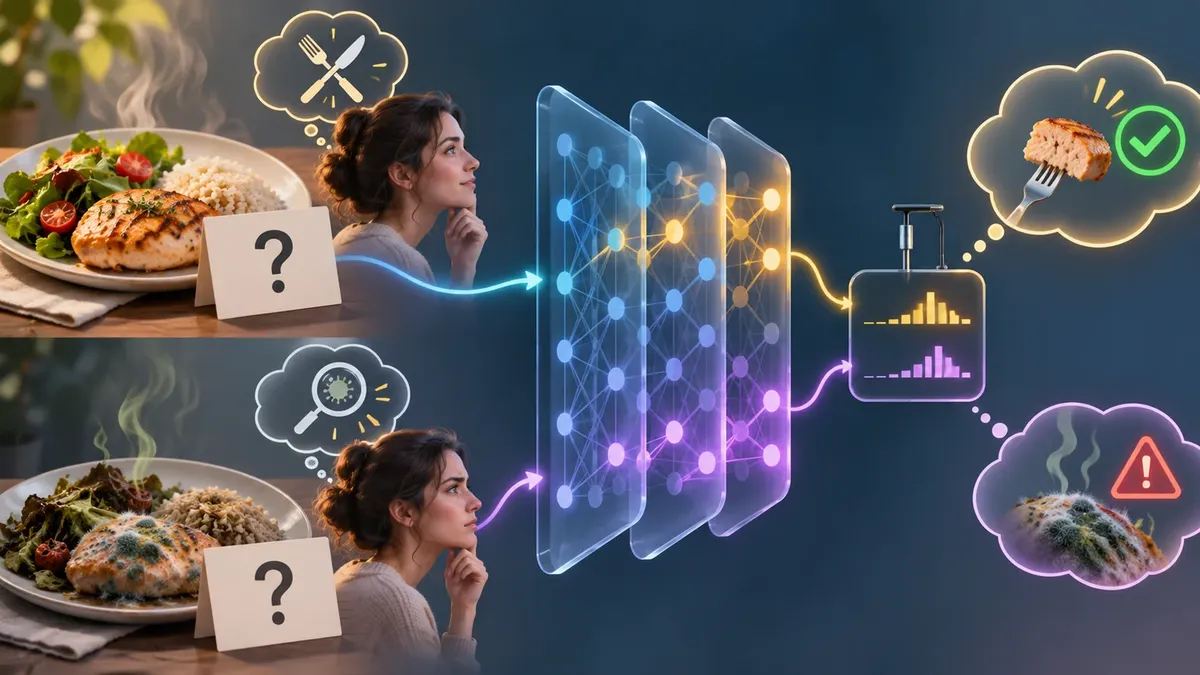
A model might judge a request as safe or dangerous from the picture alone, without considering what the user asks. Researchers test whether vision-language models’ internal representations encode both scene and intent—and why benchmark design matters.
A request’s safety can depend on both a picture and a question. Asking how to serve food is usually harmless if it is fresh, but could invite dangerous advice if it is spoiled. A vision-language model (VLM), which processes images and text, needs to account for both parts of that situation. Yet a strong score on a safety benchmark does not, by itself, show that it does.
In this preprint, Guijia Zhang and colleagues ask whether safety information in VLMs’ internal representations reflects the combination of a depicted scene and a user’s intent, or whether benchmark labels can be predicted from just one input. Their concern is a familiar one in machine learning: a test may reward a shortcut that works on its examples but misses the capability researchers intend to measure.
Testing for shortcuts
The authors first audit five public benchmarks for situational safety. These evaluate requests whose safety depends on context. The team reports that every benchmark they examined permits a shortcut based on images alone: a model using only the image can predict the labels. They also test paired prompts associated with the same image. A probe that does not receive the image achieves an AUROC of 0.9645, a measure of how well scores distinguish between two label classes. That result suggests the prompts themselves carry strong label clues in this test setup.
The authors then construct a controlled evaluation that crosses two factors: whether the scene is safe or hazardous, and whether the user asks to observe or act. The design aims to prevent a rule based only on the image—or only on the text—from solving the task. In this setup, no single-modality rule can exceed 0.500 group-ranking accuracy, according to the abstract.
They apply linear probes to intermediate internal states from two models, Qwen3-VL-8B and SmolVLM2-2.2B. A probe is a comparatively simple model trained to read information from another model’s representations. The reported results are 0.958 and 0.930, respectively. In this controlled setting, those scores indicate that the scene-and-intent conjunction is readily decodable from the tested representations.
What the results do—and do not—show
Decodable information is not the same as proof that a model reasons safely by combining image and text. The researchers report that concatenating separately encoded image and text states recovers most of the signal. That means the probe’s success does not establish that the model uses a special fusion mechanism, or that the information guides its actual responses. It shows that the relevant distinction can be read from the representations under this evaluation.
The probes may be useful as inexpensive screening tools, but the authors report that they generalize poorly to unseen images and other benchmarks. Their results therefore do not establish a reliable detector of multimodal safety across settings. Nor does the abstract report that the models themselves achieved particular response-safety rates; the central measurements concern probes of frozen model representations.
The broader methodological point is that benchmark accuracy needs controls. If labels can be inferred from one modality alone, high performance cannot establish that a model uses both modalities as intended. A test that deliberately balances scene and request helps isolate whether their combination is represented—but even that is not a direct demonstration of robust real-world safety behavior.
This account is based on the paper’s abstract, not a full examination of its methods, tables, or appendices. The source is an arXiv preprint, which may not have undergone peer review. Details needed to assess the evaluation fully—including dataset construction, sample sizes, and statistical uncertainty—are not available in the supplied evidence. The findings should be read as a reported audit and controlled probe study, not as settled evidence about all vision-language models or safety benchmarks.
- vision-language models
- AI safety
- multimodal evaluation
- benchmark shortcuts
- machine learning representations
Related reading
Automatically matched by shared topic keywords. These links do not imply that the sources agree or establish a consensus.
When a Chest X-ray Leads AI to Invent Findings in a Photograph
Source published
Shared keywords: vision language models
When a Picture Hints at a Harmful Task, AI May Help
Source published
Shared keywords: ai safety, vision language models
AI moral choices shift when models take a role in a video game
Source published
Shared keywords: multimodal evaluation
When AI video gets the sound right but the speaker wrong
Source published
Shared keywords: multimodal evaluation
When Observations Limit an AI Safety Guarantee
Source published
Shared keywords: ai safety