TRANSMISSION // 2611.27330v1
A driving planner that looks where each route leads
Source published
GGDriver uses each proposed path to guide which camera details a planner examines, then uses route-specific evidence to rank candidate routes. Preprint tests report gains across several systems, with important limits.
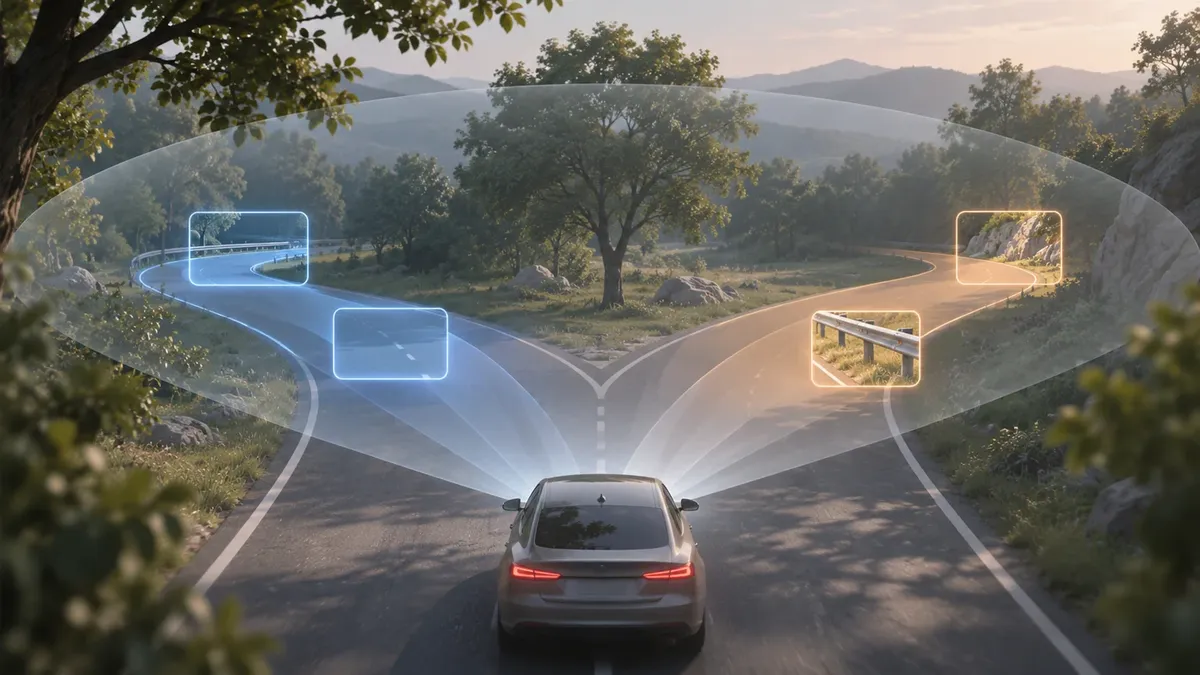
A vehicle considering a turn and one continuing straight may need different visual clues. GGDriver is an arXiv preprint describing a planner that uses each candidate route to select relevant image details. Its tests include closed-loop driving in CARLA simulation, not a real-world road trial.
Why should a driving planner look differently at different routes?
A left turn and a straight-ahead route can depend on different parts of the same scene. For example, the turn might require checking a crosswalk near its exit, while continuing straight might depend on the far lane. Yet many end-to-end driving systems first compress camera images into a shared summary, then ask every proposed route to use that same summary. The authors argue that small, route-specific clues can be hard to retain in a compact representation.
GGDriver asks whether candidate routes could guide a planner toward the visual evidence each one needs. Its approach separates a broad view of the scene from a route-specific look: “glance at what is shared, gaze at what differs.” The work is an arXiv preprint; the supplied source does not establish peer review or independent replication.
From a broad view to route-specific evidence
Across its benchmarks, the paper uses four cameras. On WOD-E2E, these are four selected from the dataset’s eight recorded cameras. The images are processed with a DINOv2 ViT-S/14 backbone fine-tuned using LoRA, a method for adapting a model with additional trainable parameters. First, a global representation summarizes the scene. A planner uses it to propose possible trajectories: predictions of where the vehicle could travel over the next few seconds.
For each trajectory, GGDriver projects a corridor around the route into the camera views. Camera calibration and the predicted path determine which image regions overlap that corridor. The planner can then attend to fine-grained image patches in those regions, rather than relying only on the compressed scene summary. This route-specific “gaze” can help refine a trajectory.
The system also uses route-specific visual evidence to rank its final proposals. In other words, each route’s score is calculated with details along that route available. The method does not train a separate network to choose where to look, and the authors say it needs no perception labels such as object boxes or map elements. It is trained through imitation of expert trajectories, with benchmark scores used to train its proposal scorer.
The authors tested the mechanism in three planner setups: one using learned registers, one using a perception-supervised bird’s-eye-view (BEV) grid, and one using their coarse image-token grid. They report improvements in these experiments, not a guarantee that the method will help every planner. Ablations compared path-aligned image regions with a similar number of randomly selected regions and with attention to all regions.
What the tests found
In the reported ablations, attending to path-aligned patches performed better than selecting the same number of random patches or attending to every image block. The authors interpret this as evidence that where a planner looks matters, not just how many patches it reads.
They also report larger gains when route-specific evidence is used to rank proposals than when it is used only to refine trajectories. Using it for both refinement and ranking performed best in that ablation. On WOD-E2E, GGDriver scored 8.110 on the rater-feedback score (RFS), the highest among methods in the paper’s comparison table. On NAVSIM-v1 it scored 94.2 PDMS, and on NAVSIM-v2 it scored 48.6 EPDMS; the authors describe these NAVSIM results as competitive. On Bench2Drive, it achieved a closed-loop Driving Score of 72.18. These benchmarks use different metrics and evaluation setups, so their scores are not directly comparable.
The reported results also include trade-offs. In NAVSIM-v2’s stage-wise evaluation, the second stage begins from perturbed, synthetically rendered states. The authors report losses on collision and time-to-collision measures in that stage, alongside gains in progress and compliance in the first stage. This is a benchmark-specific finding, not evidence about real-world collision rates. On Bench2Drive, the system’s comfort score was lower than those of UniAD and VAD, which the paper says drive more slowly.
The gaze also adds computational cost. In the stated NAVSIM-v1 setup—672 × 1148 images, four cameras, batch size one on an H200 GPU—it increased inference latency by 12.4 milliseconds, or 22 percent. The paper also reports increases of 12.8 million parameters and 89 MiB of peak memory in that setup.
What remains uncertain
Benchmark performance does not establish safe or reliable driving on public roads. Bench2Drive is a closed-loop evaluation in CARLA, a simulator, not a real-world road trial. The results come from particular datasets, scoring procedures, camera inputs and model settings; they may not predict behavior in unfamiliar environments or unusual situations.
The ablations support the authors’ account of why route-aligned evidence helps in their tests, but cannot show that the design will improve every planner or operating condition. The article describes a single preprint, and the supplied evidence does not establish peer review or independent replication.
The central idea is simple: propose routes from a broad scene understanding, then inspect details each route would encounter and use them to assess that route. GGDriver offers experimental evidence of improved scores in several tested systems. Whether those gains translate into dependable driving beyond benchmarks remains open.
- autonomous driving
- trajectory planning
- computer vision
- end-to-end driving
- GGDriver
- artificial intelligence
Related reading
Automatically matched by shared topic keywords. These links do not imply that the sources agree or establish a consensus.
DriveFoundry links driving-data corrections with selective AI reasoning
Source published
Shared keywords: autonomous driving, trajectory planning
JEPAhead predicts future driving features, but practical benefits remain unproven
Source published
Shared keywords: autonomous driving, computer vision
When a Better AI Score Means an Easier Cheese-Recognition Task
Source published
Shared keywords: artificial intelligence, computer vision
Teaching Motion-Prediction Models the Near Future First
Source published
Shared keywords: computer vision
CoSafe coordinates safety interventions across self-driving cars
Source published
Shared keywords: autonomous driving