TRANSMISSION // 2611.27328v1
A steadier light trap for atom interferometers
Source published
A 60-centimetre Zerodur cavity is designed to keep an optical lattice stable for long atom-interferometry measurements. Tests measured its optical, thermal and vibration performance, but did not demonstrate minute-long measurements with atoms.
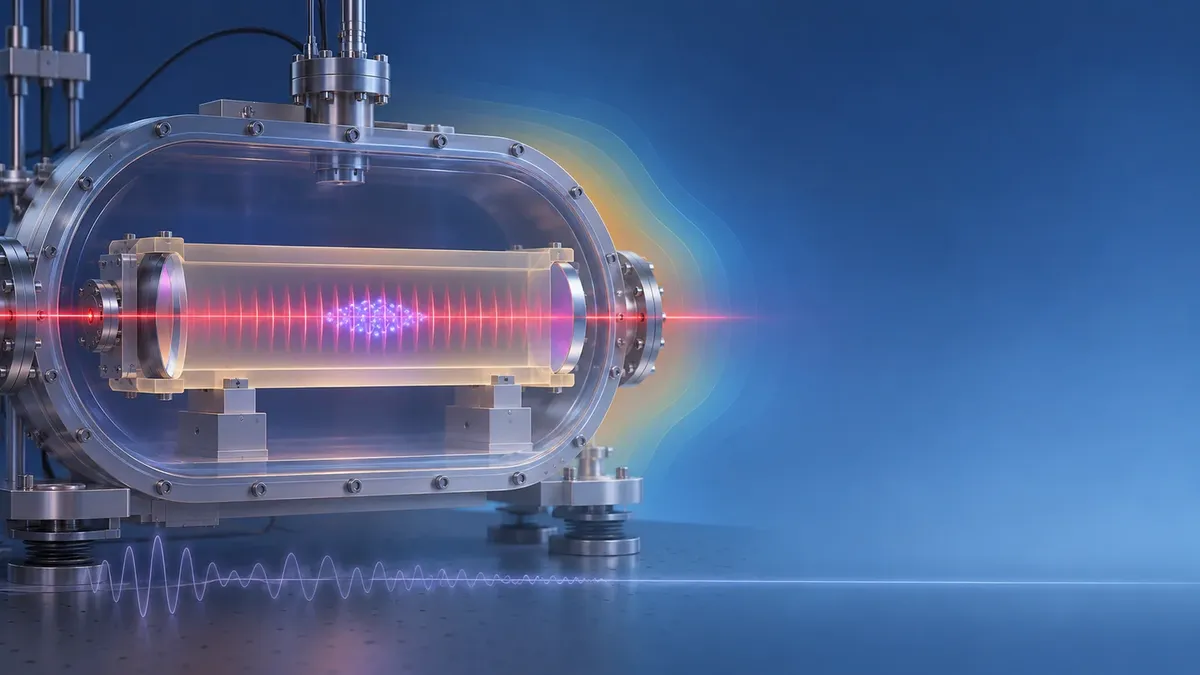
Atom interferometers use the waves of ultracold atoms to measure gravity and other effects. A new in-vacuum optical cavity aims to help such experiments hold atomic superpositions steady for longer, while leaving room for lasers, imaging and possible gravitational source masses.
An atom interferometer can be thought of as a ruler made from matter waves. To make a measurement, researchers split an atom’s quantum wave into paths and later compare them. But the comparison becomes less reliable if the atoms are jostled or the light holding them shifts. One approach is to suspend the atoms in an optical lattice: a standing wave of light that acts like a repeating set of traps.
The cavity in this study is designed to make that light field more stable. It is a 60-centimetre-long optical resonator built around a low-expansion Zerodur spacer and installed inside a vacuum system. The researchers’ goal is to support optical lattice atom interferometers with widely separated wavepackets and long measurement times—not to report a new gravity measurement or demonstrate those goals in this work.
A cavity built around the experiment
An optical cavity uses mirrors to confine light. Here, it serves both to create a clean optical lattice at 1064 nanometres and to support 852-nanometre light used for Raman transitions that control cesium atoms. The cavity’s length was chosen so its free spectral range—the spacing between resonant frequencies—fits the cesium ground-state hyperfine splitting. That arrangement allows the cavity to enhance both frequency components needed for the Raman transitions.
The long spacer also provides room for the experimental apparatus. Openings allow laser beams and imaging optics to reach the atoms; the design leaves space for coils and for centimetre-scale source masses that could be used in future gravity measurements. A differential-pumping section separates the interferometer region from the region where atoms are prepared, helping limit contamination of the higher-vacuum measurement area.
What the team measured
The authors characterized the cavity’s optical resonances, thermal drift, vacuum compatibility and vibration response. They measured the free spectral range at 248.446 ± 0.006 megahertz, close to the design value and about 3 kilohertz from the target. Measurements of the transverse optical modes and the resonance widths were also broadly consistent with the design.
To track slow changes, the team monitored a cavity resonance for 47 hours. Its frequency shifted by about 15 megahertz over that period, with changes correlated to the temperature of the surrounding vacuum chamber. The authors say an integrated piezoelectric actuator can correct the drift. They attribute the reduced temperature sensitivity to the Zerodur spacer, whose length changes less with temperature than the steel chamber. The paper compares the observed drift with larger changes reported for earlier arrangements, but the comparison is not a direct, matched test of complete interferometers.
For vibration measurements, a Michelson interferometer tracked motion of a mirror attached to the cavity. The largest reported peak was around 5 nanometres per square root hertz, near 70 hertz; the authors associate it with a bending mode of the cavity–vacuum setup. They also identify other resonances and laboratory acoustic-mechanical noise. The experiment table was not floated, and the cavity was unsupported at its top during this measurement. The authors suggest that improved support and reduced environmental noise could lower the background, but those changes were not demonstrated in the reported test.
What the results do—and do not—show
These measurements characterize a piece of experimental infrastructure, rather than the performance of an atom interferometer using it. The researchers expect a more stable lattice to reduce atomic motion and loss of coherence, potentially helping future experiments pursue minute-long interrogation and millimetre-scale separations. Those are intended capabilities, not results established by this cavity test.
Vacuum performance is another important qualification. In the test configuration, the system reached pressures in the 10⁻⁸-torr range. The paper says atom-interferometer operation uses combined pumps to reach about 10⁻¹¹ torr. The test system was heated to 110°C to check the assembly’s resilience to bakeout, but the reported pressure measurement does not show the complete apparatus operating at the target vacuum.
The work therefore offers a detailed engineering characterization and a platform designed for future experiments. Whether it improves atomic coherence in practice, and how it performs under the final vacuum, vibration and operating conditions, remain questions for subsequent tests. This account is based on the authors’ preprint; preprints may not have undergone peer review, and the available source does not establish independent replication.
- atom interferometry
- optical cavity
- Zerodur
- quantum sensing
- cesium atoms
- precision measurement
Related reading
Automatically matched by shared topic keywords. These links do not imply that the sources agree or establish a consensus.
How to read a noisy atom interferometer’s ellipse
Source published
Shared keywords: atom interferometry, quantum sensing
A Raman amplifier uses feedback to quiet its own quantum noise
Source published
Shared keywords: quantum sensing
Could trapped light retain the imprint of past interactions?
Source published
Shared keywords: optical cavity
Quantum sensing algorithms target specific spectroscopy questions
Source published
Shared keywords: quantum sensing
When a quantum sensing limit depends on the model
Source published
Shared keywords: quantum sensing