TRANSMISSION // 2611.27306v1
A Simulated World for Robots That Learn From Doing
Source published
γ-Scape connects mobile-robot tasks, physical feedback and reusable experience in simulation. Its benchmark finds that complete household tasks remain difficult for the tested systems.
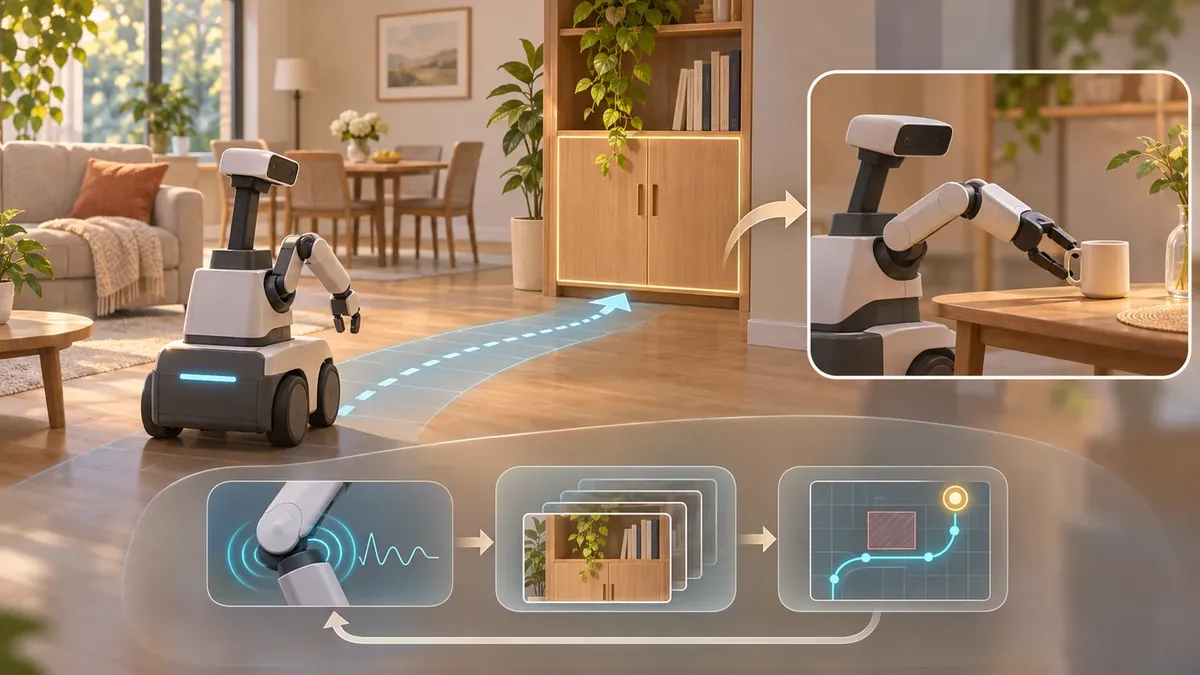
Fetching an object from a cabinet can involve navigation, opening a door, grasping, carrying and secure placement. γ-Scape is a simulation platform built to test such connected tasks and record experience that agents could use to revise their behavior.
Everyday tasks can be hard for a mobile robot because each action changes what comes next. Opening a drawer changes access; carrying an object occupies a hand; and placing it requires reaching the right destination and releasing the object securely. A robot that can perform individual actions may still struggle to finish the whole sequence.
A research team introduces γ-Scape, a simulation and benchmark platform for studying these longer episodes and how agents might learn from interaction. The work is described in an arXiv preprint, a manuscript that has not necessarily undergone peer review.
A shared world for different solutions
The platform represents indoor environments with movable objects and fixtures such as drawers and cabinet doors. Its task-construction system, BenchForge, turns structured objectives into physical task instances. Each comes with an instruction, a reference program and an evaluator that checks the requested outcome and any specified process conditions.
The reference program helps construct tasks and collect experience; it is not the only acceptable solution. Agents can choose their own programs, motion tools and learned skills. The evaluator checks whether their actions satisfy the task goals, rather than whether they exactly reproduce the reference sequence.
The paper describes a fixed benchmark of 220 instances across 22 task families. These span delivery and organization, storage and access, preparation and restoration, and carrying and coordination. Examples include placing objects in specified arrangements, retrieving items from storage, clearing a route, and operating a fixture while carrying a payload. Physical changes persist during a task, so the agent must act from the state the robot actually reached.
What the benchmark found
The authors evaluate four integrated agent systems on the fixed suite, using shared task-goal criteria. Reported overall success rates range from 4.1% to 21.8%. The system with the highest success rate also has the highest reported mean semantic progress, 39.1%. Progress credits intermediate accomplishments; success requires meeting the task’s complete specified conditions. A robot can therefore make progress without finishing.
Carrying and coordination were particularly challenging across the evaluated systems. No system completed an object-sorting instance, although each showed some intermediate progress. The paper also describes individual episodes where a grasp slipped during transport or a robot lost physical stability. Such cases show how a locally successful action, like a brief lift, may not ensure the object remains secure through later steps.
These results apply to the systems, tools and evaluation conditions studied, not to robot intelligence in general. The main benchmark uses one wheeled dual-arm robot, and the tested systems do not all have identical interfaces or capabilities. The reported summary selects the best of three valid trials for each system-task pair, prioritizing success and then progress. It should not be mistaken for the outcome of a typical single attempt.
Turning interaction into experience
γ-Scape also provides a workflow for collecting demonstrations. An agent can control contact-rich actions, such as grasping an object or moving a fixture, while receiving physical feedback. The platform records tool calls and outcomes, along with time-aligned observations and actions that could support program refinement or policy learning. Assisted reference execution and human guidance supply additional experience, with records labeled by their source and assistance.
In one illustrative example, a board slipped after a shallow grasp. After resetting the task, the agent was given the earlier failure record. It used fresh measurements to revise its approach and completed the placement task. This is a demonstration of a possible feedback loop, not evidence that the system reliably improves across many tasks. The authors present γ-Scape as infrastructure for studying embodied self-improvement, not as proof that recursive self-improvement has been achieved.
What remains uncertain
Simulation allows controlled, repeatable testing, but performance in a simulated home does not establish how a system will behave in varied real-world settings. The main benchmark uses one robot embodiment; the manuscript also describes other embodiments and supplementary settings, but these do not change the scope of the main benchmark results. The collection and revision examples are limited demonstrations, so broader claims about transfer or sustained improvement would need additional evidence.
The manuscript describes a reproducible evaluation package, including code, task definitions and evaluators, but the supplied text does not establish a public access link. This article is based on the manuscript text; extraction can also obscure figures, tables or technical details. As an arXiv preprint, the work should be read as a report of research in progress, not as a guarantee of peer-reviewed findings. γ-Scape’s contribution is a framework for asking how agents plan, act and reuse experience—not evidence that mobile robots can already handle household work reliably.
- embodied AI
- mobile manipulation
- robot simulation
- robot benchmarks
- robot learning
- γ-Scape
Reviewed cross-references
These connections were reviewed by a model, not independently fact-checked by a human. Similarity does not imply agreement; consult the original papers and the evidence below.
AI coding agents build a robotics simulation benchmark
Supporting evidence: Both papers report substantial difficulty for evaluated agents on benchmark tasks: γ-Scape’s conclusion describes low instance-level completion and persistent carrying and coordination challenges, while Gym-Anything reports that frontier models failed every RoboWorld test task. This supports the bounded observation that task completion remained difficult in these two evaluations; the benchmarks and evaluated systems differ, so their results are not directly comparable.
Model review: · openai-codex/gpt-6-luna
Evidence and provenance
Selected excerpts, not complete papers. PDF extraction can omit figures or damage equations, tables and reading order; sources may be preprints.
2611.27306v1 — Original paper
Excerpt reference:
static/papers/2611.27306v1.md:929-952
Basis: Paper text
Source SHA-256:7b1d8f40c245243b5038aa0551bae35b00bc870788531a96679d883fe3e1b3202610.40565v1 — Original paper
Excerpt reference:
static/papers/2610.40565v1.md:13-141
Basis: Paper text
Source SHA-256:59fc060799672807fe1e6c81c991eb10565ecfe604c44b91bf61c4671e7ce834
Related reading
Automatically matched by shared topic keywords. These links do not imply that the sources agree or establish a consensus.
AI coding agents build a robotics simulation benchmark
Source published
Shared keywords: embodied ai, robot learning
When a Robot Experiment Becomes Scientific Evidence
Source published
Shared keywords: embodied ai
Teaching robot video models to focus on what moves
Source published
Shared keywords: robot simulation
An AI editor repairs robot instruction failures by changing a small slice of its weights
Source published
Shared keywords: robot simulation
When should a robot look ahead before moving?
Source published
Shared keywords: embodied ai