TRANSMISSION // 2611.27300v1
How Matroids Connect Quantum Codes and Secret Sharing
Source published
A mathematical study links symplectic matroids to stabilizer codes and quantum secret-sharing access rules, while identifying limits on what graph structure can guarantee.
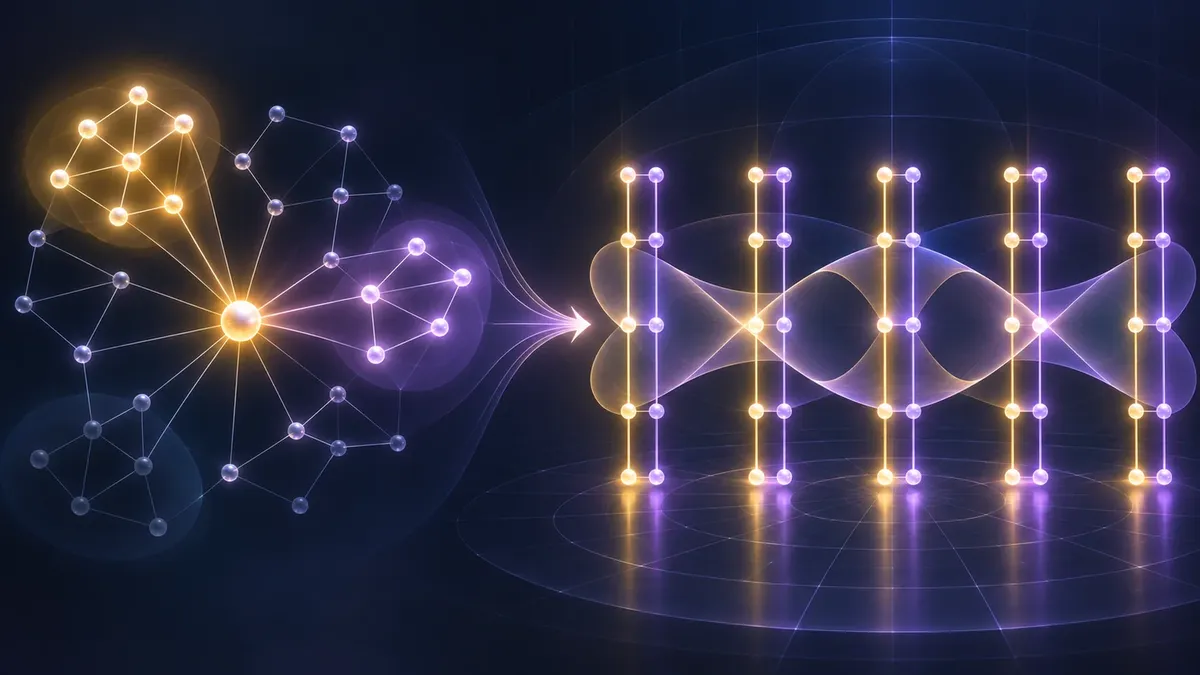
A graph can encode relationships among quantum systems, but does its structure ensure a useful error-correcting code or determine who can recover a shared secret? Sayantan Ganguly’s preprint connects these questions through symplectic matroids, mathematical objects that track which sets of columns behave like independent bases.
A quantum error-correcting code protects information by encoding it across multiple quantum systems. In a stabilizer code, a collection of compatible measurements identifies errors without directly measuring the encoded information. Quantum secret sharing uses related tools for a different purpose: it distributes a secret so that some groups of players can recover it, while others learn nothing or only partial information.
Sayantan Ganguly’s preprint, “Symplectic Matroids, Stabilizer Codes, and Quantum Secret-Sharing,” asks how a mathematical structure called a symplectic matroid can organize both kinds of quantum systems. The work addresses questions posed by Sarvepalli about graph-based matroids, code quality, secret-sharing access rules, and weight enumerators—polynomials that summarize how code elements are distributed by weight.
From columns to codes
The paper works with linear stabilizer codes over finite fields. In this framework, a code can be represented by a matrix whose columns encode information about the system’s quantum operators. Certain collections of columns—identified through their maximal minors—form the bases of a representable symplectic matroid. In broad terms, the matroid records patterns of dependence among the columns, while the code describes which errors can be detected or corrected.
One result concerns graphical symplectic matroids, which are built from graphs. For a simple, 3-connected graph, the paper says that every representation of its graphical symplectic matroid, over any field, produces a stabilizer code with distance exactly 2. Code distance measures the smallest number of physical systems on which an undetectable logical operation can act. Distance 2 is a limited error-protection guarantee: it does not grow with the graph’s girth, the length of its shortest cycle. Thus, the paper rules out using girth as a lower bound on distance in this setting.
Describing who can recover a secret
The second part studies a represented Lagrangian matroid together with a designated dealer, who holds the secret. Ganguly constructs a stabilizer code shortened relative to the dealer, along with its logical operators, an encoding map, and recovery maps for players. The abstract says this is the code implemented by the associated stabilizer state when used through teleportation.
For any set of players, a rank formula based on pairs of columns determines whether that group can recover the secret, has no information about it, or has partial information. The paper identifies this quantity with the group’s mutual information with the dealer. For graph states—a class of quantum states described using graphs—the criterion simplifies to one involving cut rank, a measure of connections across a division of the graph.
This gives a precise mathematical test for access, rather than relying only on an intuitive picture of which players are connected. But the result is a characterization within the stated framework; the abstract does not claim that it provides a ready-to-deploy secret-sharing system or an experimental demonstration.
What depends on the field
The paper also distinguishes binary systems from larger finite fields. Over the two-element field, a symplectic matroid of any rank has only one representation, so the associated code, access structure, and weight enumerators depend on the matroid alone. For fields with three or more elements, even the weight enumerator need not be determined by the matroid. The mathematical structure therefore does not always contain enough information to fix every property of the code.
Another comparison concerns two ways to define authorized player groups: one based on circuits of the matroid and one based on information recovery. Circuit-induced authorized sets always reconstruct the secret when the matroid is self-dual, but not in general. The abstract further reports a six-qubit graph-state example where the two access structures differ even in the self-dual case. Self-duality, then, does not make the two notions identical across all sets.
Finally, the author says a polynomial built from ranks of pairs of columns determines both weight enumerators. The abstract does not provide the polynomial’s detailed definition or the derivation, so those specifics cannot be assessed from the available source summary.
What the evidence can—and cannot—establish
These are mathematical results about representations and constructions, not experimental performance claims. In particular, the distance-2 finding is a negative limitation for a specified graph class, not a claim about all graph-based codes. The secret-sharing results give formal access conditions, but the abstract does not report implementation tests or practical security assessments beyond those mathematical statements.
This account is based on the paper’s abstract because the full text was not available in the supplied evidence. It therefore cannot independently check proofs, assumptions, examples, or technical details omitted from that summary. The work is an arXiv preprint, and the available material does not establish whether it has undergone peer review. Its claims should be read as the author’s reported theoretical findings, pending scrutiny of the complete paper and any later review.
- symplectic matroids
- stabilizer codes
- quantum secret sharing
- graph states
- quantum error correction
- finite fields
Related reading
Automatically matched by shared topic keywords. These links do not imply that the sources agree or establish a consensus.
Randomized search adds new quantum error-correcting codes
Source published
Shared keywords: quantum error correction, stabilizer codes
Extra qubits make quantum error checks agree
Source published
Shared keywords: quantum error correction
Adding a third layer to quantum error correction
Source published
Shared keywords: quantum error correction
Frequency-bin experiment tests fast secret-sharing correlations
Source published
Shared keywords: quantum secret sharing
Why Quantum Gibbs Samplers Can Be Slow
Source published
Shared keywords: stabilizer codes