TRANSMISSION // 2611.27294v1
HookEvo tests coordinated changes to AI agent plugins
Source published
HookEvo lets an improver change connected parts of an AI agent’s software harness together. In tests with a fixed Qwen3-4B task executor, results varied by improver and benchmark, with important limits on what the comparisons establish.
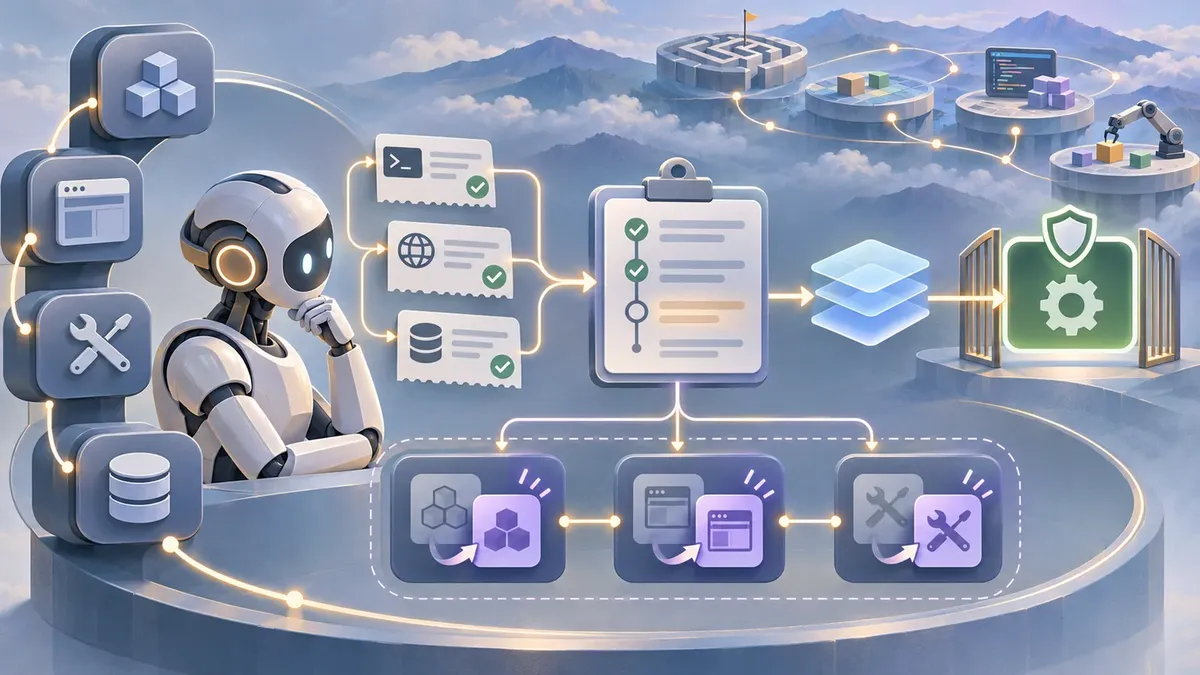
When an AI agent uses a tool, its surrounding software decides what to do with the result and how it affects the next action. HookEvo tests whether updating connected parts of that software together can help—even while the task-performing model stays fixed.
An AI agent that uses tools relies on more than its language model. A surrounding software layer, often called a harness, decides how tool results reach the model, what context is assembled and whether a proposed action can proceed. A useful observation may not help if the harness fails to carry it forward or connect it to a later decision.
A paper introducing HookEvo asks whether harnesses can be improved by changing related plugins together. The framework uses lifecycle hooks in DeepSeek Harness, a runtime that exposes points where software can process tool results, assemble context and check actions. Its central idea is to let one proposed update both record information from a tool receipt and use that information later.
How HookEvo works
HookEvo keeps the task-performing executor fixed during its benchmark comparisons: Qwen3-4B-Instruct-2507. A separate improver proposes harness changes. In each round, it examines execution traces—records of actions and tool feedback—along with the current harness. HookEvo compares the candidate and current harness on matched tasks, trials and seeds. A candidate is retained only if it improves the training objective, changes observed hook outputs and, where a validation split is available, does not lower the validation objective.
The researchers compared three editing scopes. The narrowest changed skill instructions. A middle scope allowed a proposal to replace one component, such as memory, a tool-result interpreter or an action check. The broadest allowed coordinated edits to executable mechanisms and the task-level state they share.
That shared state can connect steps in a task: one mechanism can record a fact from a tool receipt, and another can use it to guide context or check a later action. Editing either part alone may not produce the intended effect if the other part is missing. HookEvo evaluates the coordinated candidate as a whole.
The study also varied the improver—the model proposing harness edits. It compared GPT-6 Luna, GPT-6.1 Terra and GPT-6.1 Sol across the three scopes. These are distinct roles: Qwen3-4B performed the benchmark tasks, while the three improvers proposed changes.
What the study reports
For Sol with the broadest editing scope, the selected harnesses achieved reported test success of 95.41% on ALFWorld, 70.56% on DBBench, 48.17% on WebShop and 41.67% on OSBench. These were the highest scores among the Qwen3-4B comparisons displayed in the paper. Against the authors’ local rerun of Life-Harness using the same executor, the reported differences were 7.64, 6.45, 6.84 and 4.86 percentage points, respectively.
The benefit of broader editing differed by improver. Averaged across the four benchmarks, moving from instruction-only edits to coordinated edits increased test success by 25.91 percentage points for Sol, 7.24 for Luna and 5.75 for Terra. The paper’s examples illustrate that broader scope does not mean every successful harness needs executable coordination: on WebShop, Sol’s selected harness linked recorded product-option evidence to a checkout check; on OSBench, the retained harness relied on a written counting instruction and had no executable mechanisms.
These comparisons need protocol context. The paper’s headline evaluations used three executions, while some entries in the scope comparison used only one. Displayed results from other studies may also use different setups: for example, Harness-R1’s reported WebShop evaluation used 500 tasks, compared with 200 in this study. The authors’ statement that Sol’s harnesses lead applies to the Qwen3-4B comparisons shown, not to a uniform, independently verified comparison across all methods.
Limits and uncertainty
The results concern one runtime, four benchmark environments and a fixed Qwen3-4B task executor; they do not show that the approach will help every model, harness or task. The improver comparisons add another source of variation. The paper also reports that training-data schedules differed in some runs: some reused a fixed task pool, while others rotated through batches. The authors say the contribution of this difference to performance is unclear.
The authors identify two next steps: testing whether an improver can choose an editing scope for each proposal, and disabling state-writing and state-reading handlers separately and together to measure their contribution. Those tests would help distinguish the value of coordinated state use from other changes made during search.
HookEvo is described in an arXiv preprint and may not have undergone peer review. The paper says that code, harnesses, checkpoints and evolution histories are provided; this article has not independently verified their availability or reproducibility. The reported results are best read as evidence from the study’s stated setup, not as a guarantee of performance elsewhere.
- AI agents
- agent harnesses
- plugin evolution
- tool use
- Qwen3-4B
- benchmark evaluation
Reviewed cross-references
These connections were reviewed by a model, not independently fact-checked by a human. Similarity does not imply agreement; consult the original papers and the evidence below.
Banking AI compliance depends on the agent harness, not just the model
Supporting evidence: Both studies show that changing an agent harness can affect a fixed model’s measured behavior: HookEvo reports task-score gains from coordinated handler and shared-state edits with a frozen Qwen3-4B executor, while the banking study reports harness-dependent compliance changes within models. The outcomes and settings differ—benchmark task success versus simulated banking compliance—so this supports only the bounded point that harness changes affected outcomes in these evaluations, not that the mechanisms or effects generalize.
Model review: · openai-codex/gpt-6-luna
Evidence and provenance
Selected excerpts, not complete papers. PDF extraction can omit figures or damage equations, tables and reading order; sources may be preprints.
2611.27294v1 — Original paper
Excerpt reference:
static/papers/2611.27294v1.md:76-139
Basis: Paper text
Source SHA-256:c2cba5106d65f9bb92547a428f51e6e0b97b02ad72b0f77b29a280e45c8a32982611.06116v1 — Original paper
Excerpt reference:
static/papers/2611.06116v1.md:13-50
Basis: Paper text
Source SHA-256:f76bae923aeae7fc88aeeef2fe3f66e7a4fe700a18b805fc74861f1f598dcbb1
Why bigger AI models stumble on a specialized enterprise language
Supporting evidence: Both studies report performance changes from modifying an agent’s surrounding system: HookEvo reports gains when an improver can jointly edit handlers and shared state, while AgentScript-Eval reports gains from an agentic compile-and-edit loop and revised domain guidance. The interventions and tasks differ, and AgentScript-Eval concerns a specialized DSL; this supports only the bounded claim that harness or guidance choices affected measured performance in these evaluated settings.
Model review: · openai-codex/gpt-6-luna
Evidence and provenance
Selected excerpts, not complete papers. PDF extraction can omit figures or damage equations, tables and reading order; sources may be preprints.
2611.27294v1 — Original paper
Excerpt reference:
static/papers/2611.27294v1.md:76-139
Basis: Paper text
Source SHA-256:c2cba5106d65f9bb92547a428f51e6e0b97b02ad72b0f77b29a280e45c8a32982611.13183v1 — Original paper
Excerpt reference:
static/papers/2611.13183v1.md:202-251
Basis: Paper text
Source SHA-256:74b60aef493291cf92f18b9ccb3c188d6032d9a3b16ca548e2bb5f4b5c4a76f92611.13183v1 — Original paper
Excerpt reference:
static/papers/2611.13183v1.md:252-295
Basis: Paper text
Source SHA-256:74b60aef493291cf92f18b9ccb3c188d6032d9a3b16ca548e2bb5f4b5c4a76f9
How an AI agent receives an error can change what it does next
Supporting evidence: Both studies examine harness mediation of tool feedback: HookEvo allows handlers to record receipt information and later use shared state, while the error-delivery study varies error placement and retention of failed history. Their interventions and outcomes differ—plugin evolution versus message-delivery changes—so the connection is limited to the proposition that harness handling of tool feedback can influence subsequent behavior in the studied settings.
Model review: · openai-codex/gpt-6-luna
Evidence and provenance
Selected excerpts, not complete papers. PDF extraction can omit figures or damage equations, tables and reading order; sources may be preprints.
2611.27294v1 — Original paper
Excerpt reference:
static/papers/2611.27294v1.md:76-139
Basis: Paper text
Source SHA-256:c2cba5106d65f9bb92547a428f51e6e0b97b02ad72b0f77b29a280e45c8a32982611.11581v1 — Original paper
Excerpt reference:
static/papers/2611.11581v1.md:13-59
Basis: Paper text
Source SHA-256:605264d17404b0dd9d47fb3ea6b31812563307c215129ade15ea34b60b33f6282611.11581v1 — Original paper
Excerpt reference:
static/papers/2611.11581v1.md:1013-1106
Basis: Paper text
Source SHA-256:605264d17404b0dd9d47fb3ea6b31812563307c215129ade15ea34b60b33f628
Related reading
Automatically matched by shared topic keywords. These links do not imply that the sources agree or establish a consensus.
AI agents can group the right documents under the wrong parent
Source published
Shared keywords: ai agents, benchmark evaluation
When AI Uses a Tool, Did the Tool Actually Help?
Source published
Shared keywords: ai agents, benchmark evaluation, tool use
Training AI agents to learn from different execution guides
Source published
Shared keywords: agent harnesses, ai agents, tool use
Banking AI compliance depends on the agent harness, not just the model
Source published
Shared keywords: agent harnesses, ai agents, tool use
Better AI agent instructions start with studying the agent
Source published
Shared keywords: agent harnesses, tool use