TRANSMISSION // 2611.27283v1
What can skin-lesion descriptions tell an AI about diagnosis?
Source published
DermKG measures the diagnostic limits of dermatology concepts and tests whether organizing their relationships can improve classification across disease categories.
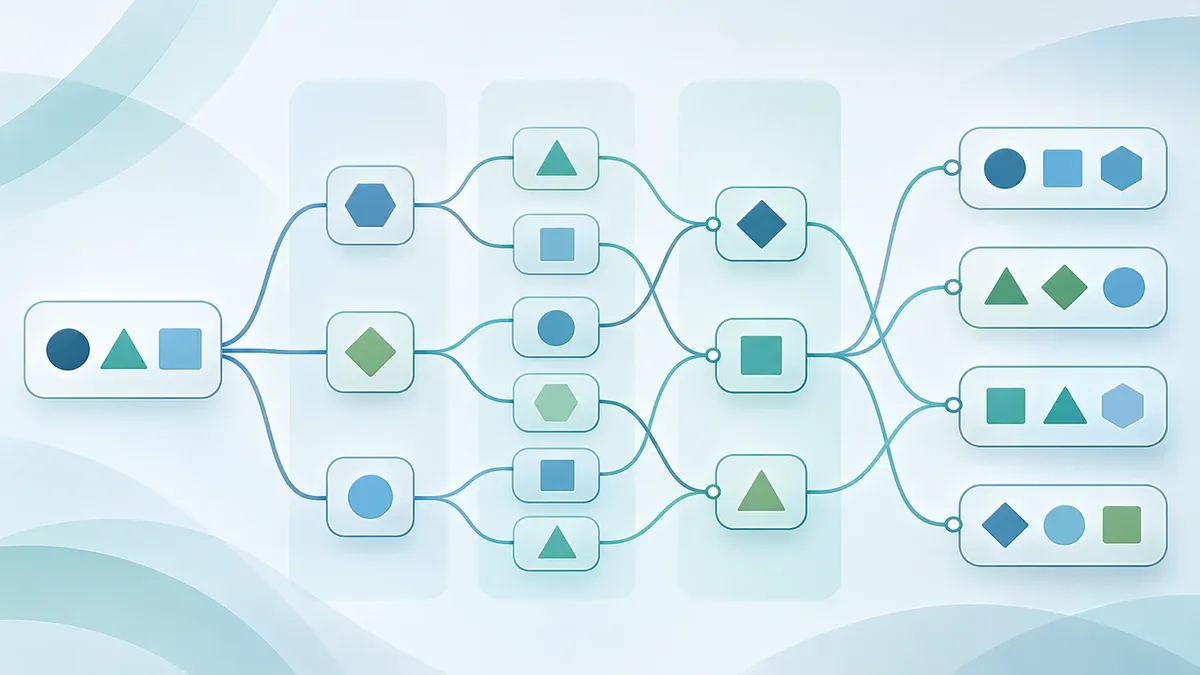
A lesion’s color, shape and other recorded features can guide a diagnosis—but different diseases may share the same description. A preprint measures that limit and tests a model that organizes relationships among dermatological concepts and diagnoses.
Dermatologists describe skin lesions with terms such as “papule,” “plaque,” “erythema” and “scale.” AI systems that base predictions on such concepts can make their reasoning easier to inspect: rather than relying only on a hidden pattern, they can point to features associated with an output. But if two diseases share the same recorded features, a model given only those features may not be able to distinguish them.
A preprint introducing DermKG asks how much diagnostic information dermatological concepts carry, and whether a knowledge graph linking concepts and diagnoses can help a model use that information.
A graph of concepts and diagnoses
The researchers built DermKG using expert annotations from the SkinCon subset of Fitzpatrick17k. After removing images marked unsuitable for annotation, they used 3,230 images, 48 concepts and 113 disease labels. The diseases are arranged into nine categories and three broader groups.
The graph contains more than images, concepts and diagnoses: it also represents concept groups, supercategories, Fitzpatrick skin types and clinical rules. Its links encode relationships such as which concepts appear in disease profiles, which concepts co-occur, and how diagnoses fit into a hierarchy. The researchers included 20 clinical morphology rules—for example, a burrow may indicate scabies—and assessed them using training data. They report that 15 met their threshold for “strong” support and five for “moderate” support.
The team compared conventional machine-learning baselines with graph-based approaches. DermKG-Net represents a lesion using its recorded concepts, scores it against disease prototypes, then combines disease scores through the diagnostic hierarchy. The main evaluation was classification into nine disease categories. Because the data are strongly imbalanced, the researchers emphasized balanced accuracy, which measures recall across categories with equal weight rather than allowing the largest category to dominate.
A ceiling set by repeated descriptions
The researchers first estimated an information ceiling: the best possible performance if a system had the concept annotations but no other information. The 3,230 images mapped to just 813 distinct combinations of concepts. When different diseases share the same combination, a concepts-only system cannot distinguish them using that combination alone.
Under the study’s in-sample calculation, the maximum top-one accuracy was 38.9% for identifying one of 113 diseases, compared with 77.6% for one of the nine categories. These are calculated bounds, not results achieved by a diagnostic tool. The authors describe the estimate as optimistic because it uses the full dataset rather than a separate test set.
On the held-out test set, the strongest conventional baseline had category-level balanced accuracy of 0.257. The best DermKG-Net variant reached 0.411. The reported paired difference was 0.150, with a 95% bootstrap confidence interval from 0.073 to 0.231. The model also raised mean recall across the eight minority categories from 0.173 to 0.389; these are test-set results averaged across those categories. Overall accuracy fell, however, as the model made fewer predictions of the dominant inflammatory category. A model can therefore improve recall among less common categories without increasing the share of all images classified correctly.
The improvement was not mainly attributable to graph structure alone. A version with the same general architecture and training objective but without graph relationships reached balanced accuracy of 0.392. The researchers conclude that most of the gain came from the hierarchical prototype objective, with a smaller contribution from graph structure. Adding rule edges did not further improve the best result. Cutaneous lymphoma remained unrecognized by all the evaluated models.
What the study does—and doesn’t—establish
DermKG can trace predictions through concepts and rules, providing a way to inspect evidence behind an output. But the experiment isolates the step from concepts to diagnosis: it does not test whether an AI can reliably identify those concepts in photographs.
The results come from one annotated dataset, using a particular set of 48 concepts and an uneven distribution of diseases. The information ceiling depends on which features were recorded; other clinical information might distinguish cases that these concepts leave indistinguishable. The study also does not test generalization to other datasets or patient populations, so performance beyond this setting remains uncertain.
The source is an arXiv preprint and may not have undergone peer review. As a useful perspective—not a separate finding—the study highlights that an explanation can make a model’s reasoning easier to inspect, but cannot recover information absent from its inputs. The authors’ results suggest that hierarchical classification can make better use of limited descriptions, especially for less common categories, while leaving the underlying information limits in place.
- Dermatology AI
- Knowledge graphs
- Interpretable machine learning
- Skin disease diagnosis
- Concept-based classification
Related reading
Automatically matched by shared topic keywords. These links do not imply that the sources agree or establish a consensus.
A structured benchmark for AI and everyday skin photos
Source published
Shared keywords: dermatology ai
Simpler building blocks for inspectable predictions
Source published
Shared keywords: interpretable machine learning
Random Symbolic Boosting builds predictive formulas without evolutionary search
Source published
Shared keywords: interpretable machine learning
A medical-language AI that explains predictions through concepts
Source published
Shared keywords: interpretable machine learning
Readable AI estimates simulated jet-engine life—and exposes diagnostic blind spots
Source published
Shared keywords: interpretable machine learning