TRANSMISSION // 2611.27264v1
EAGLE helps image models connect tiny details to the whole scene
Source published
EAGLE selects image regions and context to help multimodal AI answer questions about high-resolution images. Tests on three benchmarks showed gains with two model backbones.
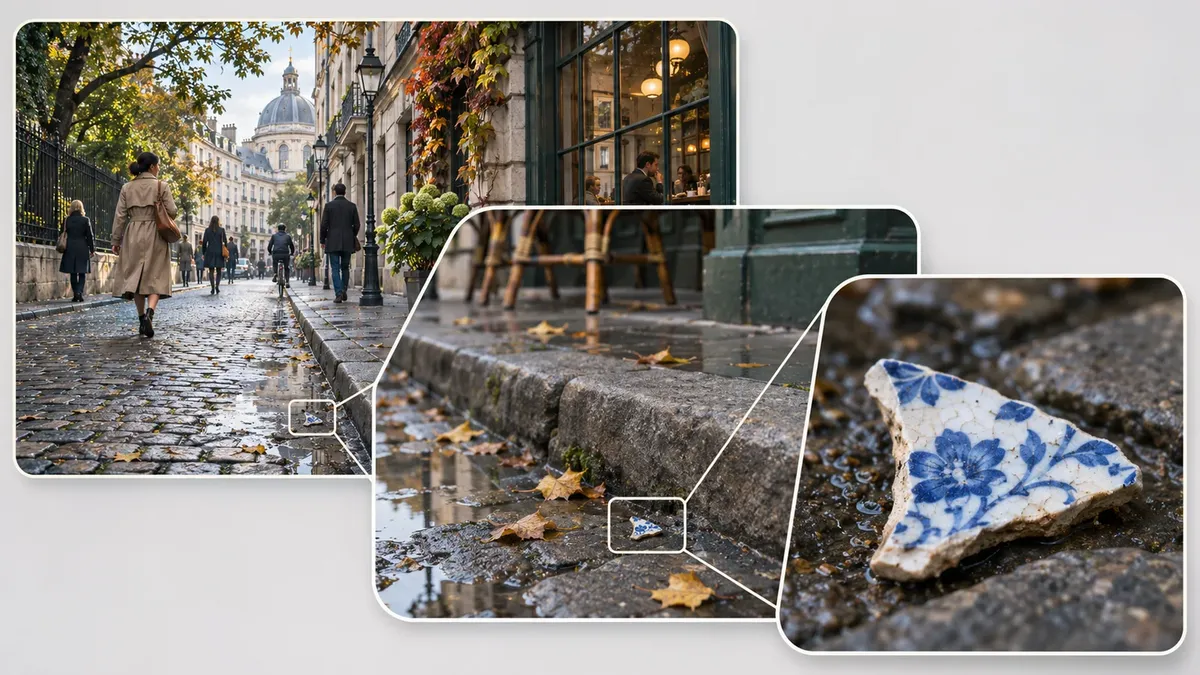
A high-resolution image may contain the clue an AI needs—a small object, a printed label or a subtle attribute—but finding that clue is not enough. The model must also know which object the question refers to and whether the wider scene matters. EAGLE is a plug-in approach designed to help multimodal AI systems select and combine that evidence.
High-resolution images can hide important details in plain sight. A small object may occupy only a few patches in a model’s visual input, while similar objects compete for attention. Even if a system finds a relevant crop, it can lose the surroundings that identify the object or explain its relationship to the scene.
EAGLE, short for Entity-Aware Grounding with Layered Evidence, tackles both problems: where to look and what visual context to give the model. Zhongjian Zou and Quan Qian of Shanghai University describe it as a plug-in framework for existing multimodal large language models (MLLMs), whose parameters remain frozen during use.
Selecting regions and preserving context
EAGLE identifies words in a question that refer to visible entities. For example, it treats “black jacket woman” as one target phrase rather than locating “black,” “jacket” and “woman” independently. The authors argue that separate word maps can activate unrelated regions; combining evidence at phrase level is intended to keep the target together.
The system uses attention maps—signals about which image areas a model attends to—to find candidate regions. But attention heads differ in how reliably they localize objects. To select more useful ones, the researchers curated a fine-grained dataset from the existing Visual-CoT dataset and manually annotated entity regions. Those annotations helped build a pool of 128 candidate heads; a trained ranker then chooses heads suited to the current image and entity. The main model itself is not fine-tuned.
In a held-out localization test, the authors report that selecting 16 heads with the ranker produced 81.5% target coverage, compared with 57.8% for randomly selecting 16 heads from the same pool. Coverage measures how much of the annotated target region is retained. This result tests region coverage, not whether the final answer is correct.
EAGLE then builds two views from the original image pixels: an intermediate view that keeps useful surroundings while focusing the search, and a detail view that emphasizes the target. A question-guided router chooses which views to show the model. A question about a fine detail may call for the intermediate and detail views; a question about broader context may need the original and intermediate views; some questions use all three.
Results on three benchmarks
The researchers tested EAGLE with Qwen2.5-VL-7B and InternVL3-8B on VBench, HRBench-4K and HRBench-8K. The paper reports higher overall accuracy than the respective base models in every tested pairing. With Qwen2.5-VL-7B, accuracy rose from 78.5% to 94.8% on VBench, from 72.5% to 81.0% on HRBench-4K and from 68.2% to 81.9% on HRBench-8K. With InternVL3-8B, the corresponding figures were 80.1% to 93.7%, 69.4% to 79.0% and 68.8% to 77.4%.
The authors also compared EAGLE with other methods using the same backbones. It had the highest overall score among the listed methods in all six backbone-and-benchmark comparisons. That claim is limited to the methods and settings in the paper; it does not establish superiority over every image-understanding system.
Ablation tests offer clues about the design. With Qwen2.5-VL-7B, removing head selection or the combined entity-phrase design lowered overall accuracy relative to the full system. Fixed combinations of image views also scored below question-guided routing in the reported comparison. These tests support the value of the combined approach, but do not isolate every detail of each component.
What remains uncertain
The evaluation covers two backbones and three benchmarks, so it cannot establish how well EAGLE transfers to other models, image types or real-world uses. The paper identifies broader testing and more fine-grained, openly accessible data as future work. The results are benchmark scores, not evidence that the method improves safety or performance in applications such as healthcare or driving.
This account is based on the authors’ arXiv preprint, not an independent replication or a comprehensive review of the field. Benchmark comparisons depend on the chosen datasets, implementations and evaluation setup; the paper also notes that one competing method is a concurrent preprint. EAGLE presents a way to organize visual evidence, but further evaluation is needed to establish how broadly its gains hold.
- multimodal AI
- high-resolution images
- visual grounding
- image understanding
- attention heads
- EAGLE
Reviewed cross-references
These connections were reviewed by a model, not independently fact-checked by a human. Similarity does not imply agreement; consult the original papers and the evidence below.
Teaching image models to notice the parts, not just the scene
Supporting evidence: Both papers motivate building broader image understanding from localized visual details. EAGLE reports gains on high-resolution visual question-answering benchmarks using entity-specific regions and question-guided view selection; CAFT reports gains on long-caption retrieval using part-level alignment composed into global representations. These findings are compatible with the bounded idea that local evidence can contribute to broader visual understanding, but the tasks and methods differ, so neither directly validates the other.
Model review: · openai-codex/gpt-6-luna
Evidence and provenance
Selected excerpts, not complete papers. PDF extraction can omit figures or damage equations, tables and reading order; sources may be preprints.
2611.27264v1 — Original paper
Excerpt reference:
static/papers/2611.27264v1.md:529-610
Basis: Paper text
Source SHA-256:0e27d210a83f6df713d423a3fbd5e75a700447b1e78d7985e7b07e4013feeaf32611.27264v1 — Original paper
Excerpt reference:
static/papers/2611.27264v1.md:611-663
Basis: Paper text
Source SHA-256:0e27d210a83f6df713d423a3fbd5e75a700447b1e78d7985e7b07e4013feeaf32602.02977v3 — Original paper
Excerpt reference:
static/papers/2602.02977v3.md:133-227
Basis: Paper text
Source SHA-256:5b90b45aafeacb59eb229717eefb401e0334b567a4ba6a4d8104ea3b8f2ef1f32602.02977v3 — Original paper
Excerpt reference:
static/papers/2602.02977v3.md:896-964
Basis: Paper text
Source SHA-256:5b90b45aafeacb59eb229717eefb401e0334b567a4ba6a4d8104ea3b8f2ef1f3
Related reading
Automatically matched by shared topic keywords. These links do not imply that the sources agree or establish a consensus.
Teaching image models to notice the parts, not just the scene
Source published
Shared keywords: visual grounding
MMCOMET gives commonsense knowledge a visual anchor
Source published
Shared keywords: multimodal ai
When a Vision-Language Model’s Uncertainty Spikes, Could a Pause Help?
Source published
Shared keywords: multimodal ai
When AI Uses a Tool, Did the Tool Actually Help?
Source published
Shared keywords: multimodal ai
Training visual agents to look, not guess
Source published
Shared keywords: high resolution images