TRANSMISSION // 2611.27262v1
The Double Cluster may not be a gravitational pair
Source published
NGC 869 and NGC 884 share similar ages and distances, but a new analysis finds little evidence that gravity binds them together today.
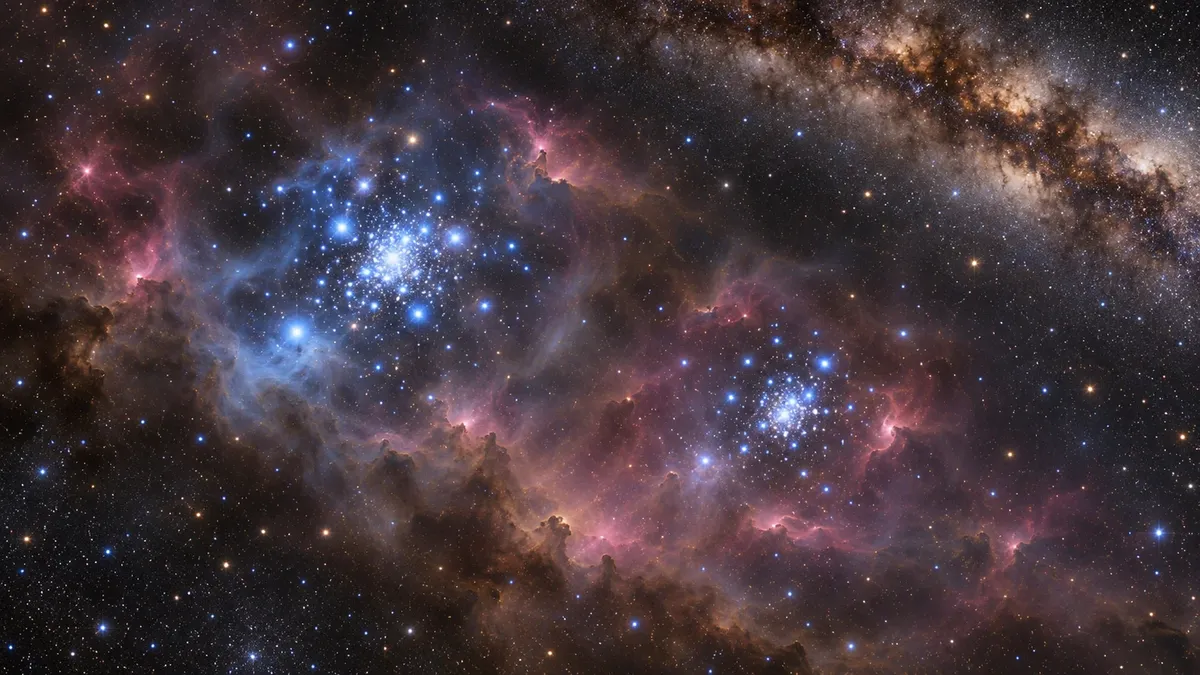
The Double Cluster in Perseus looks like a close pair in the sky. But are its two star clusters held together by gravity, or are they simply neighbours with a shared history? A study combining *Gaia* measurements, ground-based observations and dynamical models argues they are not bound today—while leaving their earlier relationship uncertain.
NGC 869 and NGC 884, also called h and χ Persei, are two bright young star clusters in the Milky Way. Their apparent closeness and similar properties have made them a familiar example of a possible “binary cluster”: two groups of stars bound to each other by gravity. But similar ages and positions do not prove that a pair is gravitationally bound. Their relative motion matters too.
Zahra Al and colleagues revisited the question using new ground-based colour measurements, astrometry and photometry from the Gaia space telescope’s third data release, and line-of-sight velocities from the LAMOST survey. They used the measurements to select likely cluster members and estimate properties such as age, distance and mass. They then reconstructed the clusters’ motions, estimated how likely they are to be bound, and modelled aspects of their future evolution.
The two clusters appear similar in age and distance. The study estimates an age of about 12 million years for each and a photometric distance of roughly 2.29 kiloparsecs—about 7,500 light-years—from Earth. The authors say these similarities are compatible with a shared origin in a larger star-forming environment. They do not, on their own, establish that the clusters remain bound to each other.
The internal motions offer further clues. Both clusters show signs of expansion, but the pattern is stronger and more coherent in NGC 884 than in NGC 869. The authors also estimate the relative motion along the line joining the clusters’ centres. Its average points toward NGC 884 receding from NGC 869, but the uncertainty is large: the paper gives a projected velocity of 3.8 ± 4.0 kilometres per second and about an 85% probability of recession along that axis. This is suggestive, not a definitive measurement that the pair is moving apart.
For a separate test of whether gravity could bind the pair, the researchers compared relative speeds with the escape speed expected from the clusters’ combined mass. Their uncertainty-based calculation gives a present-day binding probability of about 0.8%. A test that reduces the measured line-of-sight velocity difference in a way more favourable to binding raises that estimate to about 3.4%. Under the paper’s assumptions, both results point to a low likelihood that the clusters are bound today.
The authors also ran simulations to explore future separation. In one set, they modelled the clusters’ stellar evolution and dynamics in a Galactic potential; another set used a simplified two-particle representation to test the effect of alternative mass estimates. The models show the separation reaching approximately 1 kiloparsec during the first 100 million years, with continued growth later. The paper describes the early increase as mainly ballistic divergence from the clusters’ present relative motion; Galactic shear probably contributes to later growth. These are model projections, not direct observations of the future.
The simulations begin from the present-day configuration, so they cannot determine whether the clusters were gravitationally bound in the past. A common origin within a larger star-forming complex remains possible even if they are not a bound pair now.
Several uncertainties qualify the result. The observed stars do not include all faint, low-mass members, so total masses rely on corrections based on an assumed stellar mass distribution. The authors note that the formal errors on corrected masses do not include all uncertainties from incompleteness, membership selection or extrapolation. The radial-velocity sample is limited, and unresolved binary stars could broaden its measured velocity distributions. Their uncertainty calculations also do not include correlations among Gaia astrometric measurements.
Age and distance estimates depend to some extent on assumptions about reddening, metallicity and stellar-evolution models. The authors test some of these choices, but formal fit errors do not include every possible source of uncertainty, including unresolved binaries and stellar rotation. The manuscript describes a detailed analysis, but the supplied source does not establish its final publication or review status; its claims should be read as the authors’ findings rather than settled consensus.
Overall, the study finds little evidence that NGC 869 and NGC 884 are gravitationally bound today, and its models predict continued separation from their current state. It does not show whether they were bound in the past—or rule out that they formed together.
- Double Cluster
- NGC 869
- NGC 884
- Gaia
- open star clusters
- stellar dynamics
- Perseus
Reviewed cross-references
These connections were reviewed by a model, not independently fact-checked by a human. Similarity does not imply agreement; consult the original papers and the evidence below.
A star cluster’s motion can tell more than one kind of age
Shared method: Both studies use N-body simulations to examine cluster dynamics: the Double Cluster study models the pair’s present-day and future evolution, while Armstrong et al. use a star-formation simulation and subsequent N-body evolution to test dynamical-age methods. This is a methodological connection, not evidence that their systems or conclusions are directly comparable.
Model review: · openai-codex/gpt-6-luna
Evidence and provenance
Selected excerpts, not complete papers. PDF extraction can omit figures or damage equations, tables and reading order; sources may be preprints.
2611.27262v1 — Original paper
Excerpt reference:
static/papers/2611.27262v1.md:1615-1666
Basis: Paper text
Source SHA-256:5983adec5c115d12675697405d6969f20d9ed6429e82206ade511c8cf4ae39ed2611.12594v1 — Original paper
Excerpt reference:
static/papers/2611.12594v1.md:275-360
Basis: Paper text
Source SHA-256:43ec6e4cf56d80b84b024c1c82ffb2a38b23a6a4ea6672b7a834255332cfa9632611.12594v1 — Original paper
Excerpt reference:
static/papers/2611.12594v1.md:825-882
Basis: Paper text
Source SHA-256:43ec6e4cf56d80b84b024c1c82ffb2a38b23a6a4ea6672b7a834255332cfa963
Related reading
Automatically matched by shared topic keywords. These links do not imply that the sources agree or establish a consensus.
Neutron star binaries may get their chance after a cluster’s black holes leave
Source published
Shared keywords: stellar dynamics
A star cluster’s motion can tell more than one kind of age
Source published
Shared keywords: stellar dynamics
Milky Way Star Patterns May Share a Dynamical Story
Source published
Shared keywords: stellar dynamics
Stellar Motions Put NGC 3227’s Black Hole at About 12 Million Suns
Source published
Shared keywords: stellar dynamics
Stellar motions sharpen the estimate of M87’s black hole mass
Source published
Shared keywords: stellar dynamics