TRANSMISSION // 2611.27256v1
When quantum chaos helps atomic gases synchronize
Source published
A numerical study finds statistical synchronization in selected chaotic regimes of a double-well Bose-gas model, alongside rapid entanglement growth.
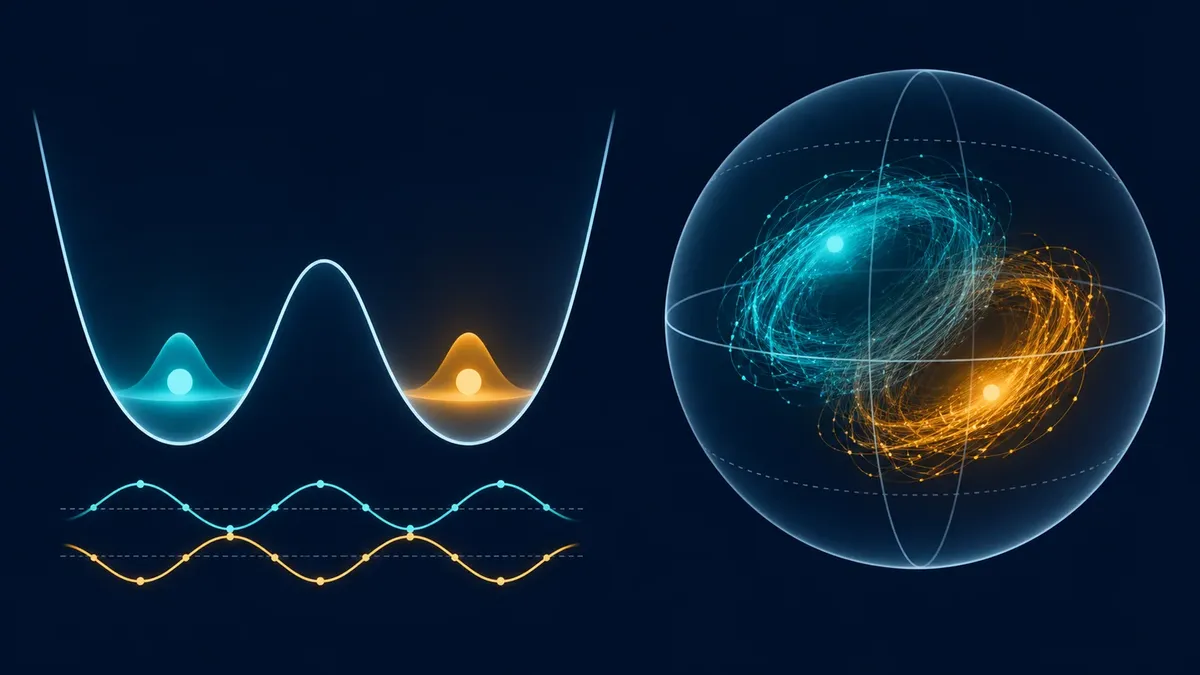
Synchronization often means that two things move in step. But in a conservative quantum system, the question can instead be whether two subsystems explore the same statistical behavior over time. A theoretical study of ultracold bosons in a double-well model examines when this measure synchronization appears and how it relates to quantum chaos and entanglement.
Synchronization without matching every moment
Two pendulums moving in step illustrate conventional synchronization: their motions become coordinated. This study considers a different idea for a conservative quantum system, where there is no dissipation to make trajectories settle together. Measure synchronization asks whether two subsystems explore the same statistical behavior over time—not whether they occupy identical states at every moment.
Xianchao Le and colleagues investigate this question in a model of two interacting species of ultracold bosons held in a double-well potential. Each species can tunnel between the left and right wells, and the species interact with one another. In the model’s two-mode-per-species approximation, there are four bosonic modes in total. The authors ask whether the two species become synchronized statistically, and whether that behavior is associated with quantum chaos and entanglement.
How the model was studied
The researchers map each species’ two well modes onto a collective spin, making the system equivalent to a pair of interacting spins. They use exact diagonalization to calculate the finite model’s energies and quantum states, then numerically follow its evolution from selected initial states.
To distinguish more regular from chaotic regimes, they examine the spacing between neighboring energy levels. Their analysis accounts for the system’s symmetries by separating the spectrum into symmetry sectors, avoiding distortions from mixing independent sets of levels. In the paper’s terminology, regular regimes show level statistics closer to a Poisson distribution, while chaotic regimes show patterns closer to those expected for the Gaussian orthogonal ensemble.
The authors assess synchronization through several quantities: the regions traced by each species’ spin expectation values, their energy expectation values, and fluctuations in their well-population imbalance. They also calculate bipartite entanglement entropy, which describes how strongly the quantum states of the two species are linked. These are numerical analyses of a model, not measurements from an ultracold-atom experiment.
Selected chaotic regimes show faster alignment
In the representative regular regime, the two species explore distinct regions of collective-spin space, and their energy expectations remain separated. In a near-chaotic regime, their behavior can converge, but the process takes longer and depends more strongly on the initial state. At selected, more strongly chaotic parameter points, the explored regions and long-time average energies align more quickly.
The fluctuations have a specific pattern: in the deeply chaotic example, population-imbalance fluctuations become anti-phase-locked, with symmetric oscillation amplitudes. Their oscillations are opposed rather than simply rising and falling together. This accompanies the alignment of longer-term statistical behavior.
The authors report measure synchronization for three different initial states tested in the deeply chaotic regime. In the near-chaotic comparison, two tested initial states behave differently: one does not synchronize, while the other does. These results indicate limited robustness to starting conditions in the cases examined, not a guarantee for every possible preparation. The paper also stresses that chaos alone does not ensure synchronization; the parameters must be selected appropriately.
Entanglement grows rapidly in the deeply chaotic example, approaching the random-state prediction used in the paper. Growth is slower and the long-time entropy lower in the regular and near-chaotic examples. Across the parameters analyzed, greater long-time entanglement accompanies smaller differences between the species’ average energies. This points to a connection between entanglement and synchronization in the model, but the calculations do not prove that entanglement causes synchronization. The authors describe it as part of the dynamics that accompanies and may facilitate the effect.
What the results do—and do not—show
The findings come from exact numerical calculations for a finite model with equal particle numbers in the two species. The reported initial-state robustness concerns only the tested states and parameter range. The study does not establish that the same behavior will persist in larger or more realistic systems, or that it has been observed in a laboratory.
The work offers one way to describe coordination in an isolated quantum system: two subsystems can explore matching statistical behavior without matching their instantaneous states. Whether this effect can be measured in an ultracold-atom experiment, and how broadly it applies beyond the model, remain open questions. The source is an arXiv preprint; its peer-review status is not established by the available evidence, so the findings should be treated as provisional research claims.
- quantum chaos
- measure synchronization
- ultracold bosons
- bosonic Josephson junction
- quantum entanglement
Related reading
Automatically matched by shared topic keywords. These links do not imply that the sources agree or establish a consensus.
How quantum eigenstates encode entanglement growth
Source published
Shared keywords: quantum chaos, quantum entanglement
A Julia toolkit for exploring quantum billiards
Source published
Shared keywords: quantum chaos
Classical algorithm uses quantum chaos to estimate scrambling in one-dimensional circuits
Source published
Shared keywords: quantum chaos
How a tiny gauge-theory ladder approaches thermal equilibrium
Source published
Shared keywords: quantum chaos
A geometric way to ask how chaotic a quantum system is
Source published
Shared keywords: quantum chaos