TRANSMISSION // 2611.27249v1
When Compact Stars Could Strengthen Dark-Matter Lenses
Source published
A preprint models how compact stellar components may alter self-interacting dark matter in some cluster satellites, increasing their predicted lensing signals.
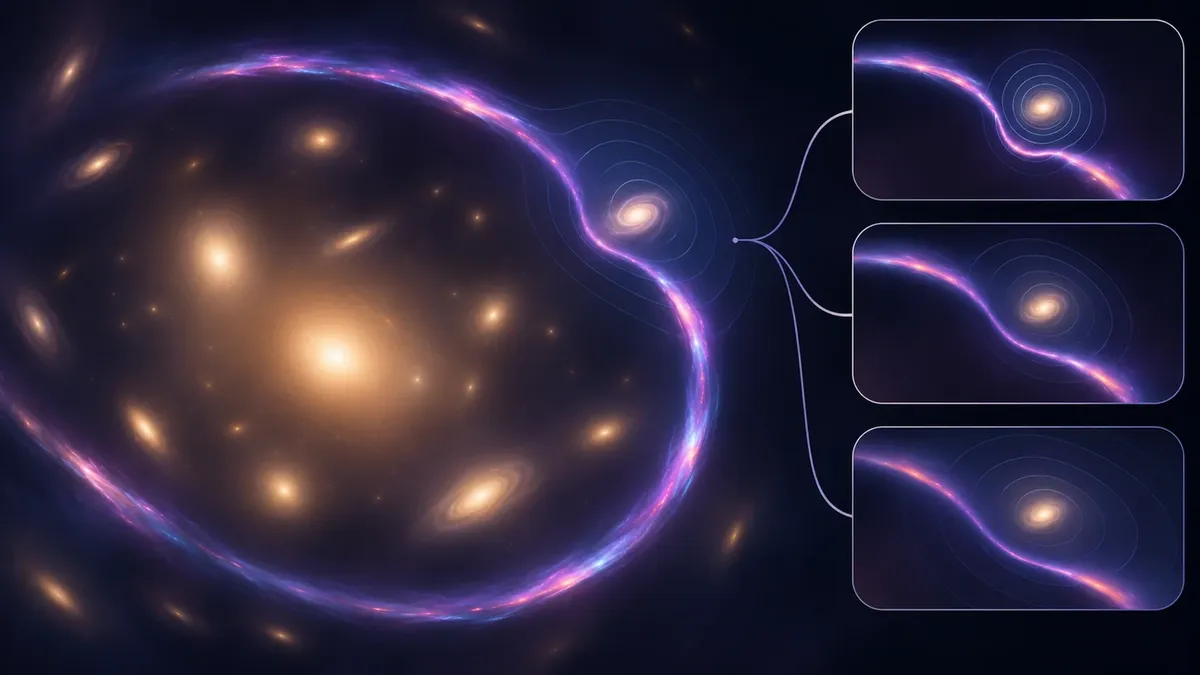
Self-interacting dark matter can form low-density cores that weaken lensing, but its evolution depends on the halo’s surroundings. A new preprint models how compact stars may change that evolution in certain satellite galaxies—and what the resulting lensing could look like.
Gravitational lensing happens when mass bends light from a more distant object. In galaxy clusters, satellite galaxies and their dark-matter halos can add lensing features or distort background arcs. These effects let astronomers investigate matter that does not emit light.
Some cluster observations show more galaxy-galaxy strong lensing (GGSL) than hydrodynamical simulations of cold dark matter (CDM) predict. The size of this reported excess is unsettled: the paper notes that later analyses find a reduced, method-dependent excess. The authors ask whether self-interacting dark matter (SIDM), together with the gravity of stars inside satellite galaxies, could help explain the lensing signals.
In SIDM models, dark-matter particles scatter off one another. The resulting heat transport can form a low-density core, but the halo’s later evolution depends on its properties and environment. Gravothermal contraction can raise central density, while tidal stripping can remove mass and affect lensing. The balance matters: a denser centre does not automatically mean a stronger lens.
How stars could change the evolution
The study focuses on subhalos with compact stellar components. Their gravity deepens the inner potential and changes the dark matter’s inner velocity-dispersion gradient. In the authors’ model, when this gradient is weakened or reversed, core formation can be suppressed or bypassed, allowing inner densities to grow earlier. This is a conditional result for particular stellar and halo configurations, not a prediction for every satellite.
The researchers examined subhalos in the TNG300-1 cosmological simulation to identify configurations where baryons could strongly affect the dark matter. They then ran controlled simulations of six representative systems, comparing SIDM with CDM while including live stars and dark matter. Each system evolved in isolation for a duration that varied by benchmark, then for two billion years in a fixed analytic cluster potential, on idealized orbits that produced tidal effects. These were controlled experiments, not full cosmological cluster simulations.
The simulations used GADGET-2 with an SIDM module. The team also recalibrated a parametric model of baryon-influenced SIDM evolution, tested it against simulations, and applied it to subhalo populations in the three most massive TNG300-1 clusters. They compared SIDM and CDM lensing predictions with the same cluster samples and lensing environments, using two velocity-dependent SIDM models and 11 viewing directions per cluster.
What the models found
In all six controlled benchmarks, the evolved SIDM systems had larger tangential caustic areas than their matched CDM versions. A caustic is a boundary in the source plane—the plane containing the background object—associated with strong magnification or multiple images. The increases were approximately 1.3 to 5 times across these selected examples. This range describes the benchmarks, not a typical value for all subhalos.
For the cluster-population calculations, the ratio of separately averaged SIDM and CDM GGSL cross sections ranged from 1.43 to 2.65 across the three clusters and two SIDM models. These are model predictions, not observed lensing rates or a general measurement of all clusters. The authors say the enhancements are comparable to recent estimates of the residual GGSL excess, whose size remains debated.
The paper also proposes a test involving luminous satellites. If the model is right, SIDM could strengthen lensing distortions near satellites whose positions are marked by starlight. Jointly studying stellar structure and resolved distortions in background arcs or rings could help test this prediction.
What remains uncertain
The population results rely on a calibrated model applied to three simulated clusters, rather than cosmological simulations that resolve SIDM evolution in every relevant subhalo. The authors discuss resolution limits in cited cluster simulations: resolving the internal evolution of subhalos at the masses of interest would require substantially higher resolution, and collapse-time predictions can show substantial scatter below a stated particle-count threshold. The controlled benchmarks also use idealized orbits and a fixed host potential.
The GGSL excess depends on analysis methods and sample selection, and the predictions depend on the modeled stellar configurations, SIDM assumptions, and calibration. The study therefore offers a possible mechanism and observational tests, not proof that SIDM explains the excess. The source is an arXiv preprint; the supplied information does not establish its peer-review status, so the results should be treated as provisional.
- self-interacting dark matter
- strong gravitational lensing
- dark matter subhalos
- galaxy clusters
- gravothermal evolution
- TNG300-1
Reviewed cross-references
These connections were reviewed by a model, not independently fact-checked by a human. Similarity does not imply agreement; consult the original papers and the evidence below.
Why a denser dark matter core can become a weaker gravitational lens
Supporting evidence: Both studies indicate that SIDM lensing efficiency depends on the halo’s evolving mass distribution: Yang et al. find stronger lensing for their star-bearing subhalos, while van den Bosch and Tokayer find non-monotonic lensing during collapse in isolated spherical halos. The results are compatible but concern different halo populations and assumptions; they do not establish the same lensing outcome across those settings.
Model review: · openai-codex/gpt-6-luna
Evidence and provenance
Selected excerpts, not complete papers. PDF extraction can omit figures or damage equations, tables and reading order; sources may be preprints.
2611.27249v1 — Original paper
Excerpt reference:
static/papers/2611.27249v1.md:539-599
Basis: Paper text
Source SHA-256:b9dbeb1abe467a99b2db695a497ce9806636f46241e05a0ba9b8782a6fc57f3d2611.27249v1 — Original paper
Excerpt reference:
static/papers/2611.27249v1.md:484-538
Basis: Paper text
Source SHA-256:b9dbeb1abe467a99b2db695a497ce9806636f46241e05a0ba9b8782a6fc57f3d2611.09546v1 — Original paper
Excerpt reference:
static/papers/2611.09546v1.md:15-68
Basis: Paper text
Source SHA-256:897027af33c9218b617acd0422e12fd785f108702779b5cb1c4ee92cca0e671b
Related reading
Automatically matched by shared topic keywords. These links do not imply that the sources agree or establish a consensus.
VENUS maps 60 galaxy clusters that magnify the distant universe
Source published
Shared keywords: galaxy clusters
Self-interacting dark matter deepens a galactic bar puzzle in simulations
Source published
Shared keywords: self interacting dark matter
A scalar-field proposal connects neutrino masses and dark-matter interactions
Source published
Shared keywords: self interacting dark matter
Why a denser dark matter core can become a weaker gravitational lens
Source published
Shared keywords: self interacting dark matter
Distant galaxy lenses offer a new sample for studying cosmic evolution
Source published
Shared keywords: strong gravitational lensing