TRANSMISSION // 2611.27228v1
A proposed safety barrier for modified-gravity futures
Source published
Some models of modified gravity that can mimic evolving dark energy may enter a future regime with an unhealthy graviton. This preprint proposes a scalar-field potential barrier to prevent that outcome and sketches possible observational tests.
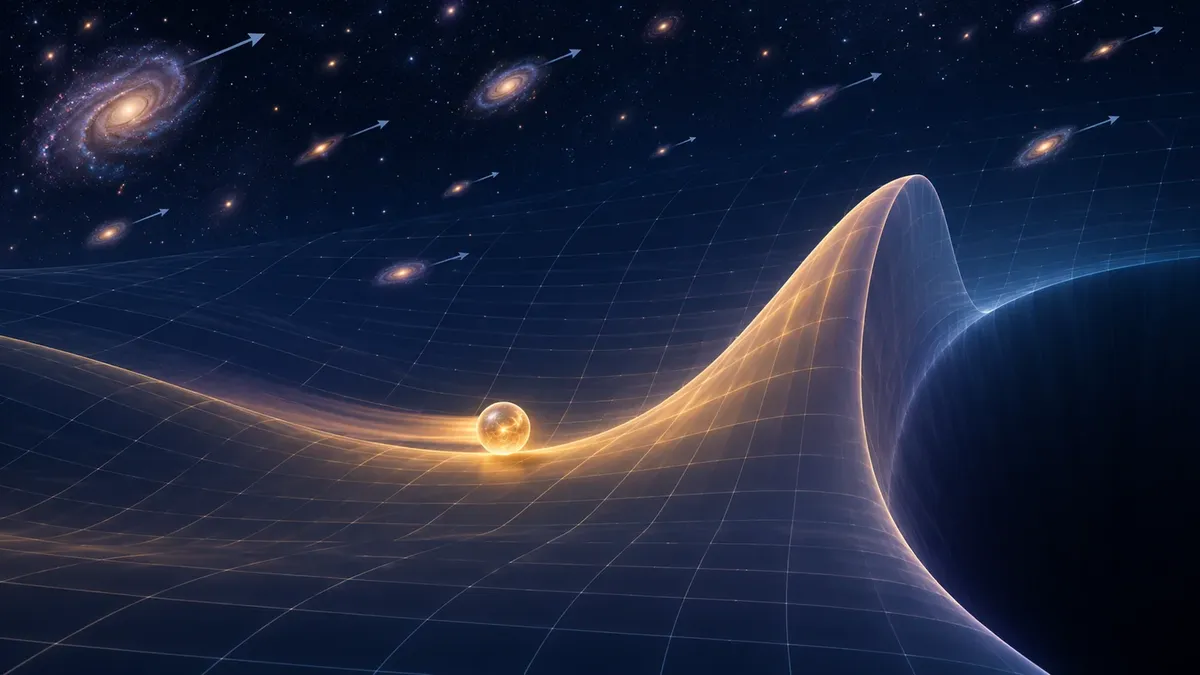
If dark energy changes over time, what might that mean for the far future of the Universe? A new theoretical study examines that question in models where gravity itself is modified, and proposes a way to keep certain models from reaching a physically problematic state.
Dark energy is the name given to whatever is driving the Universe’s accelerated expansion. Some analyses of data from the Dark Energy Spectroscopic Instrument (DESI), combined with other observations, have been interpreted as favoring a change in dark energy’s behavior over time. But that interpretation is not a settled discovery. The paper takes it as motivation to ask a different question: if modified-gravity models can reproduce such an evolving expansion, are they necessarily physically consistent in the distant future?
The authors study F(R) gravity, a family of theories that replaces the usual curvature term in Einstein’s equations with a function of the space-time curvature, R. These theories can also be described using a scalar field. In that picture, the field moves across a potential landscape as the Universe evolves.
The team first reviews how these models can produce an effective dark-energy equation of state that crosses the boundary between “phantom” behavior (often described by an equation-of-state parameter below −1) and “quintessence-like” behavior (above −1). They then examine the future evolution of two specific models previously proposed as compatible with observations: one containing a logarithmic function and another containing an exponential function. The analysis uses their equations and published parameter choices; it is not a new fit of those models to DESI data.
The key issue is the sign of F′(R), the derivative of the function defining the gravitational theory. In the framework considered, if F′(R) becomes negative, the effective gravitational coupling changes sign and the graviton—the quantum associated with gravity—has a “ghost” kinetic term. The authors treat this as a physically unacceptable regime. They report that, for the parameter choices they examine, both models can reach such a regime in the future. A stable de Sitter state, where expansion approaches a steady accelerated phase, does not necessarily prevent this: in the examples studied, the models either lack a suitable stable stopping point before the problematic region or would require carefully selected initial conditions to avoid it.
Their proposed remedy is to modify the model’s function of curvature with a factor that becomes important only at small curvature. In the scalar-field description, this is intended to create a potential barrier before the field reaches the boundary of the ghost-free region. The modification is constructed to have little effect away from that boundary, so the authors argue it can preserve the earlier expansion history while blocking the unwanted future path without fine-tuning the initial conditions.
That is a theoretical proposal, not an observed cosmic mechanism. The paper gives an example of the modification and develops a physical motivation for the barrier, including a possible connection to quantum-cosmology boundary conditions. But it does not establish that the barrier arises from a fundamental theory, nor does it show that every modified-gravity model needs or can use this prescription. The authors also acknowledge that the quantum interpretation is a motivation rather than a uniquely derived correction.
For possible tests, the paper turns to cosmic motions. Modified gravity can affect how matter clusters and accelerates, even when two models have similar histories of overall expansion. The authors outline how peculiar velocities—the motions of galaxies relative to the general expansion—and the pairwise kinematic Sunyaev–Zel’dovich (kSZ) effect, a small temperature signal associated with moving electrons, could probe those differences. They present illustrative calculations, but explicitly caution that these are not predictions for a self-consistent, observationally validated version of their barrier model. Real tests would need to account for scale-dependent growth, galaxy bias, gas properties, survey selection, and other astrophysical effects.
The result is best read as a warning about the future behavior of particular mathematical models, plus a possible design strategy—not as evidence that the Universe will enter an anti-gravity phase or that DESI has confirmed evolving dark energy. The work is a preprint, and its conclusions depend on the models, parameter choices, and theoretical assumptions examined. Independent scrutiny and more complete observational modeling will be needed to assess whether the proposed barrier is viable and testable.
- dark energy
- modified gravity
- F(R) gravity
- DESI
- ghost graviton
- cosmic expansion
- kinematic Sunyaev-Zel'dovich effect
Related reading
Automatically matched by shared topic keywords. These links do not imply that the sources agree or establish a consensus.
Could a quantum horizon timescale shape cosmic expansion?
Source published
Shared keywords: cosmic expansion, dark energy
An apparent dark-energy reversal could require dark matter to lose mass
Source published
Shared keywords: cosmic expansion, dark energy
A softly broken symmetry offers a route across the phantom divide
Source published
Shared keywords: dark energy, modified gravity
Dark energy’s apparent evolution survives a test of uncertain error bars
Source published
Shared keywords: cosmic expansion, dark energy
Could cosmic acceleration end? A dark energy preprint explores the possibility
Source published
Shared keywords: cosmic expansion, dark energy