TRANSMISSION // 2611.27219v1
How NavTTT gives a navigating AI a memory
Source published
NavTTT stores selected visual and spatial clues in episode-specific model parameters, so a language-guided agent can use earlier observations after they leave its active visual context. It performs strongly on two simulated benchmarks, while results on a physical robot are less reliable.
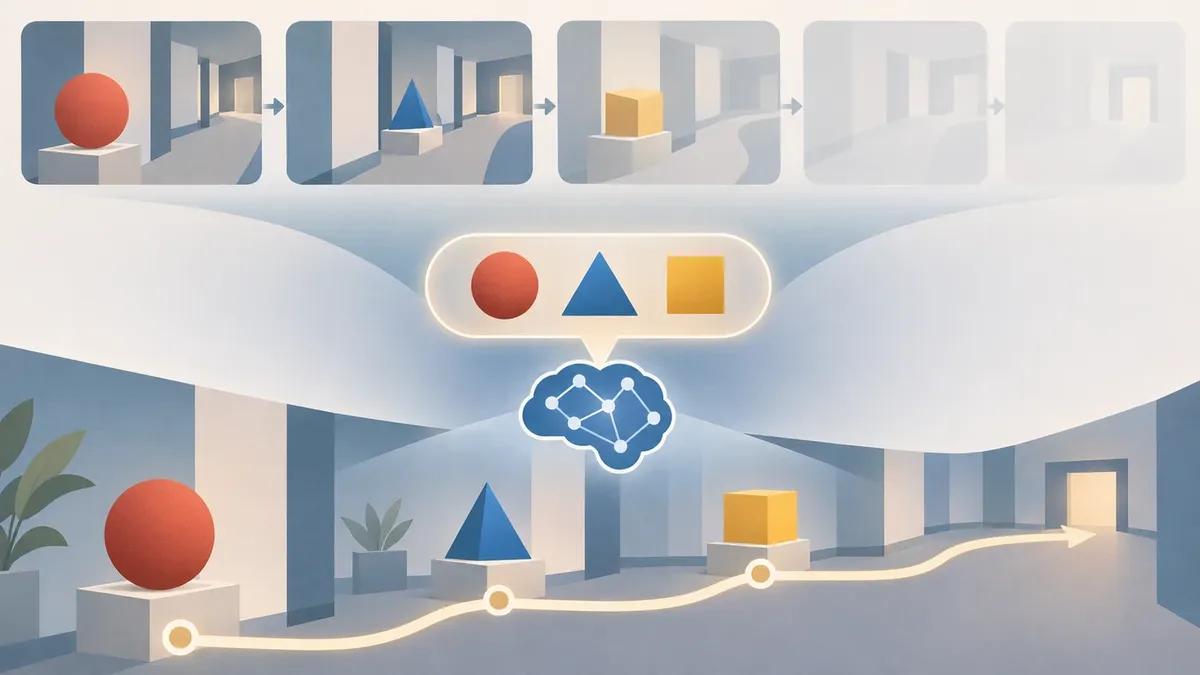
A robot following directions may need to remember a landmark seen several turns ago. NavTTT is designed to save selected observations in changing internal parameters, rather than relying only on a limited window of recent images. The authors report gains on simulated navigation tests and a more mixed result on a real robot.
A robot told to “go past the table, then turn left at the hallway” needs more than a good view of its current surroundings. It must connect what it sees now with landmarks and route information from earlier in the journey. But a vision-and-language model can process only a limited amount of visual context at once. What happens when an important clue falls outside that window?
A paper introducing NavTTT proposes storing selected observations in a temporary, episode-specific part of the model’s parameters. The approach aims to preserve useful route history without writing every visual detail into memory. The work is an arXiv preprint, so its findings should be understood as the authors’ reported results, not settled evidence.
Choosing what to remember
NavTTT stands for Navigation-Conditioned Test-Time Training. It builds on “fast weights”: parameters that can be updated while a model is operating. The main model stays fixed during navigation, while separate fast-weight memories are updated within each episode. The authors call this Adaptive Parametric Memory, or APM.
The system does not treat every image patch as equally useful. It scores visual features using the instruction, the agent’s pose and the decision step. It also tries to avoid storing multiple patches that look alike. Selected features are combined with language and spatial information, so a memory can represent not just an appearance but also its navigation context.
In the full configuration, memory branches sit at six depths in the model’s decoder. Each branch has its own fast-weight state, and decoder representations at those depths can query the corresponding memory. The paper also tests configurations with fewer branches and with memory states shared across layers. During each decision, the model reads the memory formed from earlier observations; after finalizing its current action, it updates memory with selected evidence for use in subsequent decisions.
Results in simulations and on a robot
The researchers tested NavTTT on R2R-CE and RxR-CE, benchmarks in which agents follow natural-language instructions through continuous indoor environments. On the unseen validation splits, they report a success rate (SR) of 66.7% and an SPL score of 59.4% on R2R-CE. On RxR-CE, they report 63.6% SR, 52.7% SPL and 71.0% nDTW, a measure of how closely a route follows the reference path.
The paper compares NavTTT with other systems, but these comparisons do not isolate memory alone. NavTTT used about 2.97 million additional image–action training pairs, and the authors note that methods differ in training setups and observation inputs. Controlled tests within the paper offer a more direct look at parts of the design. Removing fast-weight memory lowered success rates in the reported settings; disabling online updates also reduced performance compared with the same trained checkpoint using updates. Under the tested token budget, selecting visual features by combining task relevance and diversity performed better than using either criterion alone.
The physical-robot result was more modest. In 40 navigation trials, a humanoid robot completed 11, for a reported success rate of 27.5%. It used a forward-facing RGB camera, while model inference ran on an off-board server. The authors say they used no real-world trajectories for fine-tuning. This evaluation shows the system was tested on a physical platform, but the trial count and completion rate do not establish dependable real-world navigation.
What remains uncertain
Storing information in model parameters does not guarantee that the right detail will be retrieved. In supplementary analyses, the authors tested whether the memory could retrieve particular stored values after later updates. Reported hit rates were low. After 32 further updates, the measured change in hit rate was small, and its confidence interval was compatible with a small change in either direction. The authors also report that the memory’s usefulness for predicting reference actions depended on having the correct route history in comparison tests. These analyses provide evidence about the tested memory, but do not show that it can reliably recover every useful landmark.
The paper includes failure examples involving directional drift, repeated action loops and missed turns. Its conclusion points to longer trajectories and environments with repeated landmarks or greater visual ambiguity as areas for future study. The authors also report added inference costs: in one R2R-CE profiling setup, memory writing took 14.28 milliseconds per decision, and total decision latency was 13.13 milliseconds higher than with static APM. Those measurements come from a specified hardware and test setup, not every possible deployment.
NavTTT offers a particular way to select and reuse navigation history, with strong results on the reported simulated benchmarks. Its real-robot trials, memory diagnostics and computational measurements also show why benchmark scores alone are not enough to establish practical reliability. Broader testing and independent replication would help clarify how well the approach transfers to other robots and environments.
Source: NavTTT preprint on arXiv.
- vision-and-language navigation
- robot memory
- test-time training
- fast weights
- robotics
- artificial intelligence
Reviewed cross-references
These connections were reviewed by a model, not independently fact-checked by a human. Similarity does not imply agreement; consult the original papers and the evidence below.
MomentMem teaches robots to save visual memories
Shared method: Both methods select visual evidence for memory instead of retaining the full observation stream: NavTTT selects tokens using navigation context and visual diversity, while MomentMem’s memorizer selects keyframes from annotated key moments. The shared component is selective visual-memory formation, not a shared selection algorithm; NavTTT stores evidence in episode-local fast weights for navigation, whereas MomentMem stores keyframes for manipulation.
Model review: · openai-codex/gpt-6-luna
Evidence and provenance
Selected excerpts, not complete papers. PDF extraction can omit figures or damage equations, tables and reading order; sources may be preprints.
2611.27219v1 — Original paper
Excerpt reference:
static/papers/2611.27219v1.md:133-184
Basis: Paper text
Source SHA-256:e639005193860f652a4a6ba67e36d3d239c5ffcfefefa4a9387fe2ad330736a12611.26745v1 — Original paper
Excerpt reference:
static/papers/2611.26745v1.md:130-189
Basis: Paper text
Source SHA-256:f4669a0d8ff19b6ff24c1636d2915769b8f89108b6629b3d65095d9b9b9b1b51
Related reading
Automatically matched by shared topic keywords. These links do not imply that the sources agree or establish a consensus.
How a robot model learns from each task
Source published
Shared keywords: robot memory, test time training
A Robot Memory System That Keeps the Lesson, Not Every Detail
Source published
Shared keywords: robot memory
How MAWAM helps robot teams act together
Source published
Shared keywords: artificial intelligence
A smarter cache could help robot models act faster
Source published
Shared keywords: artificial intelligence
AI is entering big business—but productivity gains remain unproven
Source published
Shared keywords: artificial intelligence