TRANSMISSION // 2611.27215v1
An audio deepfake detector tops a benchmark—but how broad is the result?
Source published
In Podonos’s October 2026 snapshot, two ARCAS models made three errors each on 4,524 clips. Neural Defend submitted their predictions for private-label scoring.
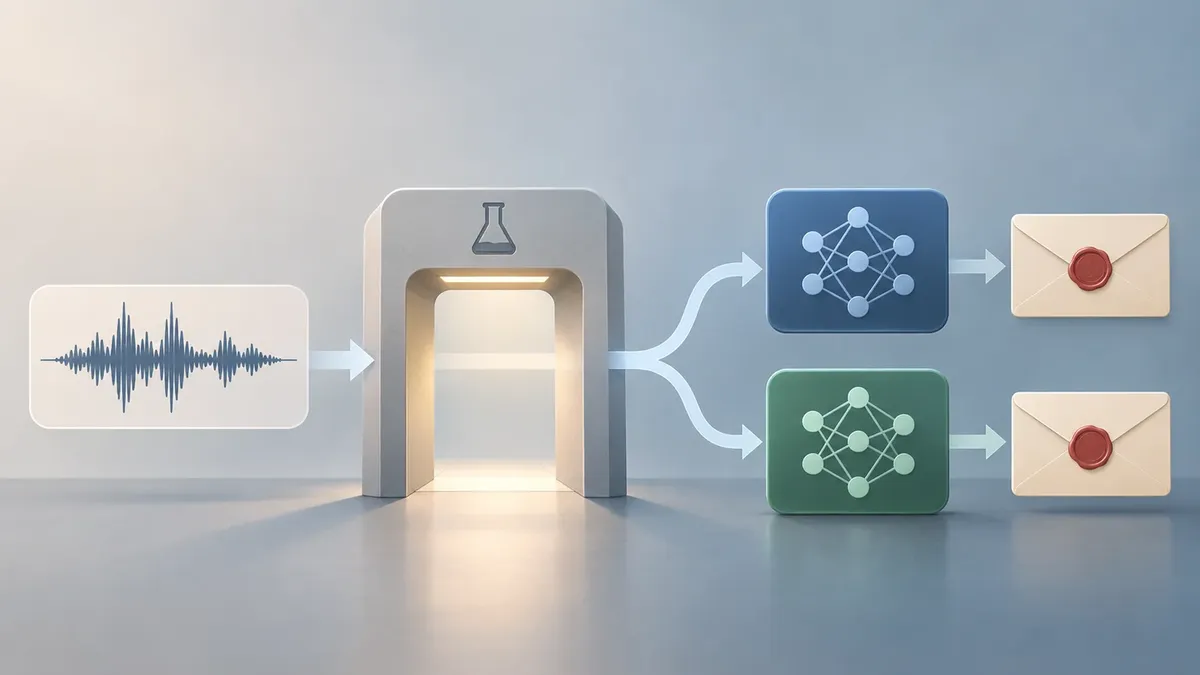
Can an independent benchmark help buyers compare audio deepfake detectors? In one October 2026 leaderboard snapshot, two ARCAS models made the fewest errors. But Neural Defend submitted their predictions for Podonos to score, and the finding applies to a specific set of clips—not every voice, language or phone call.
Commercial audio deepfake detectors can be hard to compare: vendors may test on different data and report different measures. The Podonos benchmark offers a shared test set and keeps its real-or-synthetic labels private. A technical report by Neural Defend researchers describes how the company’s ARCAS models performed in the benchmark’s October 2026 release.
The headline result: ARCAS 290M and the smaller ARCAS 90M tied for first among 28 listed systems. Each made three errors on 4,524 clips, for reported accuracy of 99.93%. That is a result on this particular test, not a guarantee that the models can identify any synthetic voice.
A common test for different detectors
Podonos’s studio set contains 2,262 real and 2,262 AI-generated English clips, averaging about 4.8 seconds long. Real speech comes from three public speech corpora; generated speech comes from about 25 text-to-speech and voice-cloning systems. The full generator list and counts for each generator are not published, and the labels are private. The benchmark also converts clips into six file formats, including WAV, MP3 and WebM.
Participants submit a real-or-fake verdict for each clip. Podonos scores systems at their default thresholds, rather than tuning each one to the test. It reports accuracy, false positives—real speech marked fake—and false negatives—synthetic speech missed. Clips a system rejects are excluded from its scored total, with the rejection rate reported separately.
Podonos retired its API runner. Since then, commercial systems added to the leaderboard—including ARCAS—have supplied prediction files, which Podonos scores against its private labels. So the scoring is performed by the benchmark, but Podonos did not run the ARCAS models itself.
Three errors, with important caveats
Both ARCAS models were scored on all 4,524 clips, with no rejections. The report gives a 0.1% false-positive rate and a 0.0% false-negative rate at the models’ default thresholds.
The authors calculated 95% Wilson confidence intervals for error rates. ARCAS’s interval, 0.02% to 0.20%, overlaps none of the other systems’ intervals; the closest competitor, deetech.ai, has an interval of 0.29% to 0.68%. They also used a one-sided Fisher exact test, treating errors as independent, and report a statistically clear difference between three ARCAS errors and 20 for deetech.ai. Podonos does not publish systems’ verdicts on each individual clip, so the authors could not use a paired test, which they say would be more precise. These results describe the report’s statistical analysis; they do not settle how the systems’ performance would compare across other samples.
The leaderboard is a snapshot: previous Podonos releases had different leaders, and later releases may change the ranking. Some competitors also scored fewer than all the clips. For example, Hiya rejected 2.3%, while Reality Defender rejected 17.2%, so their accuracy figures cover fewer files than ARCAS’s.
The report lists vendor-supplied timing for ARCAS: 89 milliseconds per file for ARCAS 90M and 118 milliseconds for ARCAS 290M. Neural Defend measured these figures on its own hardware, rather than Podonos measuring all systems under one standardized setup.
What the result does—and doesn’t—show
The benchmark is useful because systems are judged against the same hidden labels and scoring rules. But its scope is limited: English speech, three real-speech sources and about 25 generators. Because the full generator list and generator-level counts are unpublished, readers cannot examine how the test’s synthetic clips are distributed across generators. The report also says Podonos does not publish ARCAS results broken down by generator or file format.
Podonos has separate narrowband and wideband telephony tracks, but the report says results for those tracks have not yet been published. Performance on those conditions, other languages, longer recordings or unfamiliar generators cannot be inferred from this leaderboard.
The report is by employees of Neural Defend, which makes ARCAS, and the company submitted the models’ predictions. Podonos provided the private-label scoring. The arXiv version is a preprint; the available source does not establish peer review. Independent benchmark scoring makes the comparison useful, but does not remove the need for replication and broader evaluation.
The narrow takeaway: in the October 2026 Podonos release, ARCAS 90M and 290M each made three errors on 4,524 short English clips. Under the authors’ unpaired analysis—which treats errors as independent—ARCAS had a statistically clear lead over the field. Whether that result holds across the variety of voices, generators and channels encountered in real-world use remains an open question.
- audio deepfake detection
- voice cloning
- AI-generated speech
- benchmark
- ARCAS
- Podonos
Reviewed cross-references
These connections were reviewed by a model, not independently fact-checked by a human. Similarity does not imply agreement; consult the original papers and the evidence below.
When Speech Deepfake Detectors Struggle to Find Edits
Supporting evidence: Both reports show why aggregate audio-model scores need careful scope: the Podonos report notes that its English benchmark does not provide ARCAS results by generator or format, while the PartialEdit study finds localization performance varies by generator and edit operation, with SSR-Speech deletions especially difficult. This supports the bounded point that aggregate results can conceal condition-specific weaknesses; the studies evaluate different tasks and datasets, so the PartialEdit findings do not establish weaknesses in ARCAS.
Model review: · openai-codex/gpt-6-luna
Evidence and provenance
Selected excerpts, not complete papers. PDF extraction can omit figures or damage equations, tables and reading order; sources may be preprints.
2611.27215v1 — Original paper
Excerpt reference:
static/papers/2611.27215v1.md:855-895
Basis: Paper text
Source SHA-256:ec3cbee656e61cf5e58116668b96834dd07adde37e0f12e5a66aaa4ed1b0977d2611.26903v1 — Original paper
Excerpt reference:
static/papers/2611.26903v1.md:12-107
Basis: Paper text
Source SHA-256:a255f1907d19c3012e8ed247df29dcd791c23de31cf9e1934cac6b2e367c67f3
Related reading
Automatically matched by shared topic keywords. These links do not imply that the sources agree or establish a consensus.
How Well Does ARCAS 290M Detect AI-Generated Speech?
Source published
Shared keywords: audio deepfake detection, voice cloning
When a Voice Clone Does Not Sound Like the Same Person
Source published
Shared keywords: voice cloning
How Rhythm-TTS Gives Synthetic Speech More Room to Breathe
Source published
Shared keywords: voice cloning